
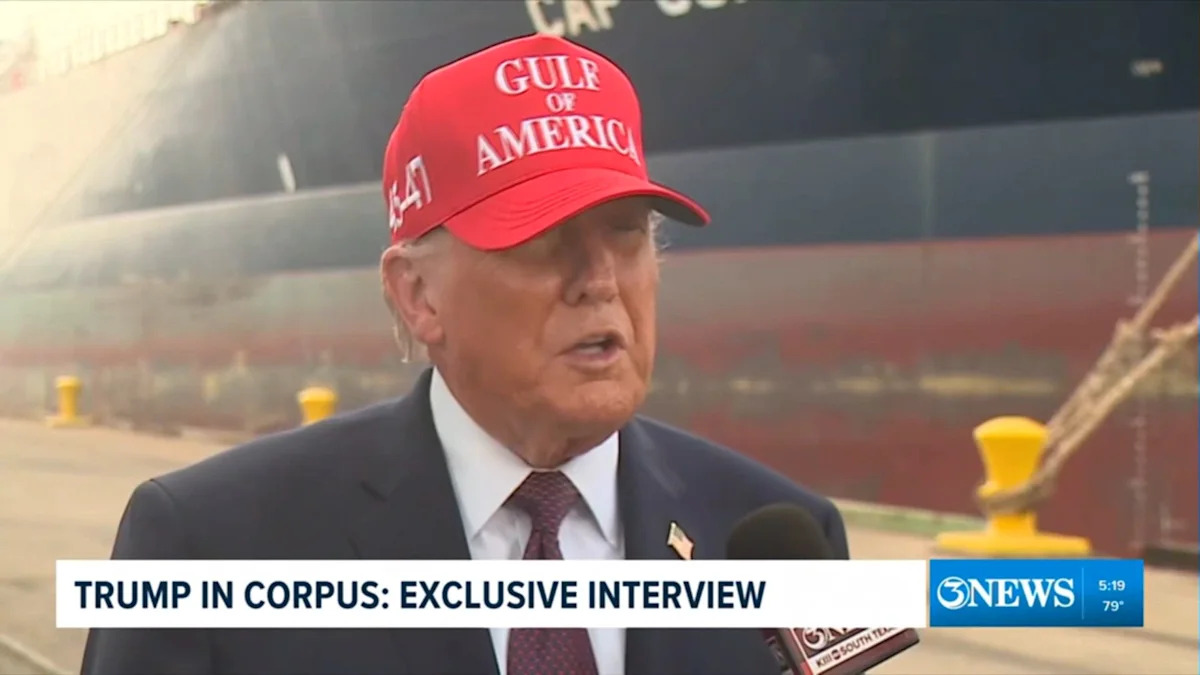
When President Donald Trump visited the Port of Corpus Christi in February, he was already talking about what more Venezuelan oil could mean for Texas and the Coastal Bend.
Now, months later, a new 25-year partnership between the U.S. government and a major Venezuelan private oil company could significantly increase the amount of Venezuelan crude entering the American market.
Trump said during an exclusive interview with 3NEWS during his February visit that Venezuelan oil was already being sent to Texas and Corpus Christi.
RELATED: Breaking Down President Trump’s visit to Corpus Christi
“We took over the oil and we’re working very closely with the Venezuelan representatives and the president of the country,” Trump said. “A lot of that oil is being sent to Texas and a lot of it is coming right here to Corpus Christi.”
Venezuela has the world’s largest proven oil reserves, and much of its crude is heavier than oil produced in other parts of the world.
The new agreement calls for Venezuela to increase production to more than 1.5 million barrels per day from 17 strategic oil fields.
More Venezuelan oil could mean cheaper refinery feedstock
Matt Bradley, an energy trader, said increased Venezuelan production could put downward pressure on the price of other heavy crude used by U.S. refineries.
“We’ll see increased production that will push down the other heavy crudes that we do see flow into the refineries,” Bradley said. “So as we see more pressure push down other alternatives, we’ll see cheaper feedstocks for refineries.”
That could be particularly important along the Gulf Coast, where refineries such as Citgo and Valero are designed to process heavier crude.
And Venezuelan oil is already flowing to U.S. refineries in significant amounts.
U.S. Energy Under Secretary Kyle Haustveit said in August that more than 500,000 barrels of Venezuelan crude were being sent to U.S. refineries each day, accounting for roughly half of Venezuela’s total oil production. Venezuela was producing about 1.25 million barrels per day at the time, according to Reuters.
Reuters also reported that the U.S. refineries receiving that crude were specifically built to process Venezuelan oil.
Bradley said the increased supply does not necessarily translate into lower gasoline prices immediately.
“Immediately, I think there will be little change,” Bradley said. “However, from potentially six months to a year, I think that change is extremely more likely, and we’ll be able to see that translate for the consumer at the pump.”
Heavy crude can also create refinery challenges
There is another consideration for refineries: the condition of the crude they receive.
Evan O’Suilleabhain, a mechanical engineer who works at a refinery, said heavier oil can contain contaminants that create problems inside refinery equipment.
“Heavier oil has the potential to contain contaminants or just like crud up the tubes and the pipes,” O’Suilleabhain said. “Certainly over time that can lead to more expensive repairs and also just make the operating costs of that equipment be higher.”
That means a potential increase in Venezuelan crude could create both opportunities and costs for refiners.
O’Suilleabhain also cautioned that uncertainty surrounding the current administration’s policies could make companies more hesitant to invest billions of dollars into new projects.
“This current administration, where it’s sort of hard to predict what the next move will be, day by day, week by week, that will make a lot of investors a little more hesitant to invest multiple billions of dollars into a project where there’s not as secure of a return on investment,” he said.
Local Venezuelans have a different perspective
The economic questions aren’t the only ones being raised here in South Texas.
Local Venezuelans gathered in January to celebrate what they viewed as the liberation of their home country. Valentina Gomez-Cisneros, a member of the local Venezuelan community, was among them and initially supported the American takeover of Venezuela.
She now says the U.S. should not be doing business with what she considers an illegitimate government.
“Venezuela’s resources belong to the Venezuelan people, not to those who hold power without democratic legitimacy. I believe the U.S. government got this wrong,” Gomez-Cisneros said in a statement to 3NEWS.
The debate comes as the war with Iran has disrupted global oil supplies, adding another layer of uncertainty to the energy market and increasing the potential significance of additional Venezuelan production.
The potential payoff could take years
Bradley said the immediate effect on gasoline prices is likely to be limited, with a more meaningful impact potentially taking years to develop.
“Especially over the long run like 2-5 years, it’s extremely meaningful,” Bradley said.
For Corpus Christi, the question is not simply whether more Venezuelan oil enters the U.S. market, but how much of it ultimately moves through the energy infrastructure here in the Coastal Bend.