

The bell rings as hundreds of feet clad in pristine new sneakers scurry up the front steps and into the building. Any nervousness melts away as excited voices echo through the hallways with stories of summer vacation or teacher assignments. There’s something heartwarming about the buzz of the first day of school. But 11 campuses in Austin ISD did not brim with that thrilling energy when the students returned this year.
“Sixty-one percent of our middle school students—that’s 7,473 11- to 14-year-olds across 12 different campuses—those numbers represent children and campuses affected by middle school closures in all the TAP (Turnaround Plan) decisions that have been made over the past 8 months,” said Austin ISD parent Amy Moore during a public commentary session to the school board on July 28, 2026. “Our 11- to 14-year-olds deserve an education with exploration and curiosity, not one narrowly focused on accountability metrics dictated by TEA,” Moore continued.
The school in question, Paredes Middle School, was not one of the 10 campuses the board moved to shutter during a 2 a.m. vote in November of last year—but it was yet another locale facing closure just three weeks before classes were set to resume. Two days after that July meeting, the board voted 7-2 to close Paredes, bringing the total number of campuses shuttered this summer to 11, not counting the International High School program housed at Northeast Early College High School, which is also being scrapped.
The immediate issues facing Austin ISD are pretty simple: The district lacks funds, and student enrollment is dwindling. But the underlying causes of those problems—and solutions to remedy them—are far more complicated.
For starters, it’s fair to note that school enrollment has dipped about 2.8% nationwide between 2019 and 2024, per findings from FutureEd, a nonpartisan think tank at Georgetown University. But Austin ISD’s enrollment plummeted a whopping 10% in that same timeframe, from 80,890 to 72,700.
There are some obvious culprits to explain the drastic drop-off. First, the number of charter schools operating in the Austin area went from about 10 at the turn of the century to 58 in 2020. Homeschooling was already growing in Austin before the pandemic, which fueled the trend further.
Now, Texas’ new voucher program, which goes into effect for the first time this year, is poised to accelerate the issue. Early reports indicate that about 1,000 students living inside of Austin ISD’s bounds plan to make use of the financial assistance to attend a private school. Estimates suggest that for each student that leaves the district, it stands to lose somewhere between $6,000 and $10,000, but that doesn’t mean that it would be able to offset that loss within its budget.
It’s hard not to see the erosion of Texas public schools as a concerted effort. Already on the ropes, lawmakers know that the new voucher system will funnel more money away from districts and make them even less tenable.
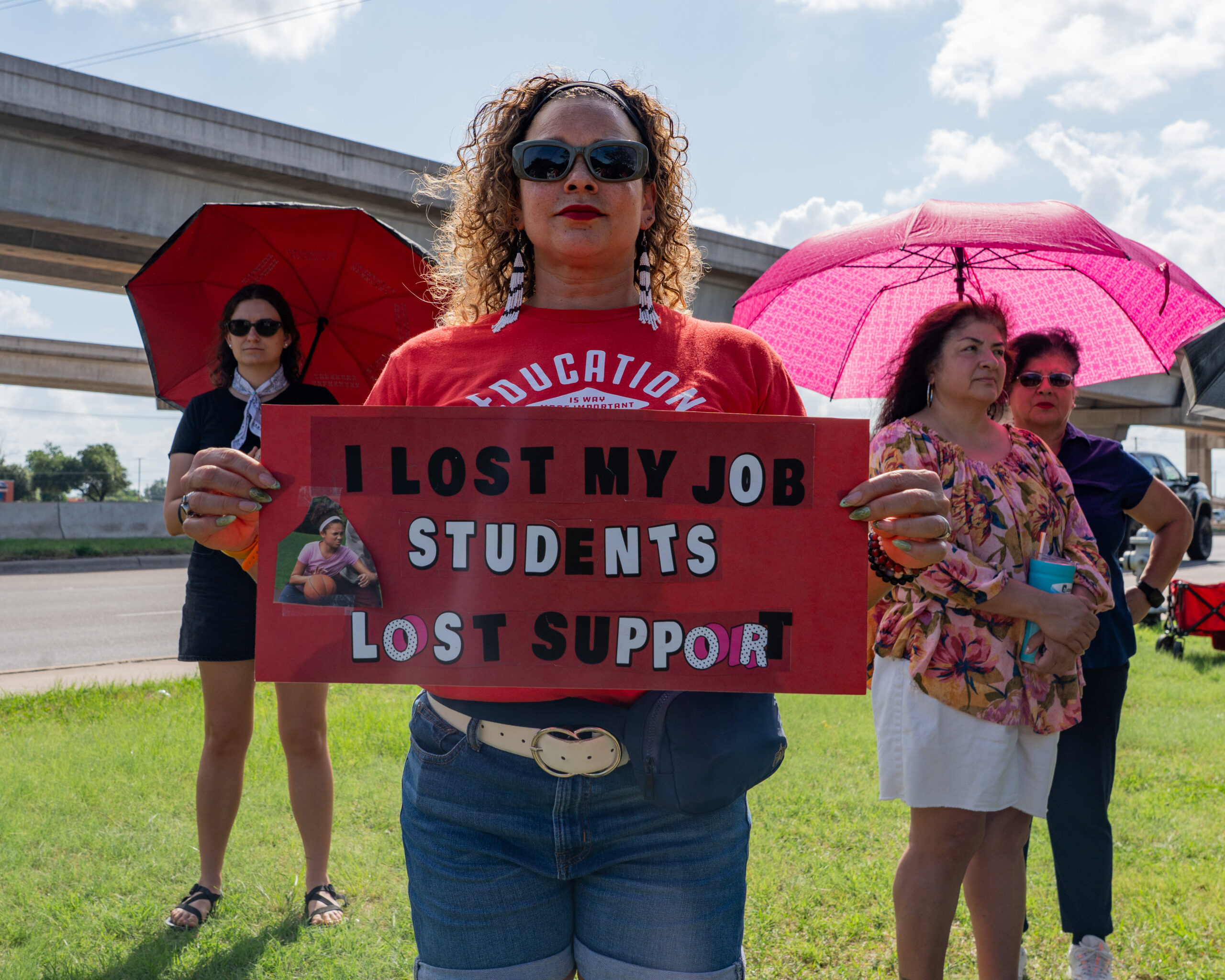 A former teacher protests major cuts to Austin ISD’s annual operating budget. Mikala Compton/The Austin American-Statesman via Getty Images.
The reasons so many families are looking elsewhere haven’t been clearly catalogued, but it’s easy to see that parents on both sides of the political aisle have been alienated in recent years. Some bemoan new state initiatives to place the Ten Commandments in classrooms, add Bible reading to the curriculum, and censor library books. Others welcome those changes, but decry conversations around gender, race, or even climate change and evolution. And parents on both sides fear for their children’s safety amid recurring violence inside schools.
In short, public schools have been snared in a cultural quagmire that has ensured no one is happy. You’d have to go back half a century to find a moment when education in Texas was this fraught.
On top of funds drying up as students depart, Austin ISD pays out more state recapture funds—about to $770 million in 2025—than any other district. Often referred to as “Robin Hood,” the program takes property tax funds from wealthy districts and redistributes it to poorer districts in an effort to ensure equal educational opportunities for all students.
In anticipation of a $181 million shortfall, the district slashed its operating budget by $205 million by eliminating central office staff, scaling back technology initiatives, and reducing some student transporations services, among other cuts.
Amid these financial and cultural pressures, Austin ISD’s school board faces the threat of a state takeover as a response to low-performing campuses—namely, Burnet and Webb Middle Schools. Each school has received five consecutive F ratings, which means those sites are likely to see state intervention. That response could range from simply closing the schools to Texas Education Agency commissioner Mike Morath replacing Austin ISD’s board of trustees and superintendent with state appointed-appointed personnel.
The ensuing fallout could mean mass layoffs, state-designed and mandated lesson plans, and a spike in regular tests to ensure accountability. Those reactions spell the potential for even rougher seas ahead for Austin ISD. And it’s important to remember that behind all these acronyms, statistics, decisions, and political perspectives, real teachers and students are living with the consequences.
One Austin teacher who worked at a school that will shutter and preferred to remain anonymous recalled the tumultuousness around school closure discussions during the past academic year. “We were told from high up in the district that everyone displaced would have a job and not to panic,” they said. “Then, it was recommended that we go to job fairs to find a job. Stress was super high, because people were having the STAAR test at the same time as interviews.”
The teacher recalled how difficult it was to balance the well-being of their students with their own employment realities. Ultimately, they were able to find work at another school in the district, but other colleagues weren’t so lucky. Reflecting on their years of experience, the teacher summed it up with a sentiment that could apply to the situation facing education as a whole: “It feels like it’s getting more difficult every year.”
 School Daze
Austin ISD has endured a head-spinning season of major shifts.
11
The number of campuses that will close in 2026 amid budget shortfalls.
5,095
Approximate number of classroom teachers employed by Austin ISD.
$13,209
Estimated amount Austin ISD spends per student each year.
18.7%
Percentage of Austin ISD campuses that received an F rating from the state in the 2024-2025 school year.
$1.4 billion
Approximate revenue generated from local property tax, almost half of which is paid back to the state for recapture.