
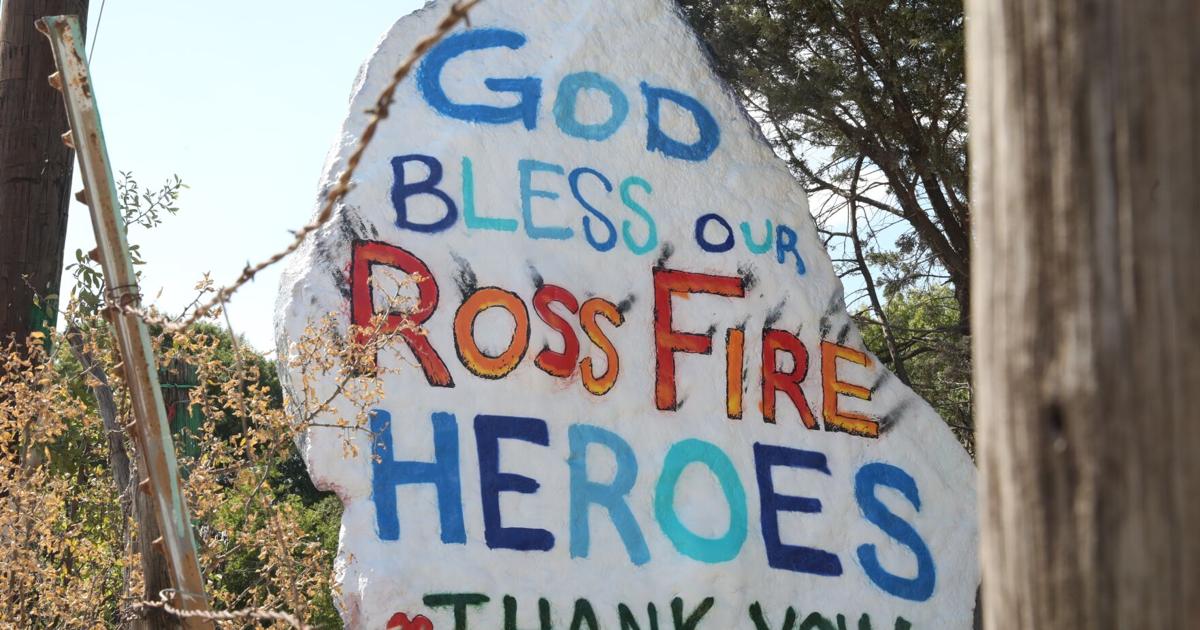

A sign thanking first responders stands Aug. 29 in Weatherford, Texas. Firefighters and first responders have worked for several days to contain and extinguish the Ross Fire.
The Ross Fire continues to burn in Palo Pinto and Jack counties. The fire started Aug. 24 and has increased to over 90,000 acres, with only around 31% contained, as of the afternoon of Sept. 1.
Firefighters across Texas and other states have joined together in an effort to contain the fire and eventually put it out.
Lt. Juan Mata, public information officer for the Arlington Fire Department, said the fire is equivalent to around 133 square miles.
“The city of Arlington boundaries is 100 square miles, so it’s basically like the whole city of Arlington on fire,” Mata said.
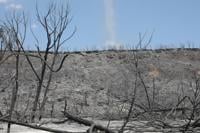
Ash covers a landscape where fire took over Aug. 29 in Palo Pinto County. The Ross Fire has burned over 85,000 acres across North Texas.
Around 16 firefighters from Arlington are deployed for the Ross Fire, he said. Mata is deployed, as well, through the Texas Department of Emergency Management.
He said a normal day for the Arlington crews varies. Mata was working night shifts for the first two nights of the fire, then switched to days; he said it can be a transition going back and forth.
“They try to not overwork people because that ultimately can lead to injuries or fatalities,” Mata said.
He said deployments last about 14 days, and then new people rotate through to give relief.
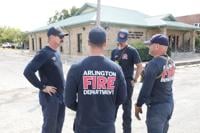
Four Arlington firefighters talk to each other after returning from a call Aug. 29 in Palo Pinto, Texas. Several firefighters from Arlington are helping put out the fire.
Arlington Engine 9, from South Arlington, is one of the resources being used to combat the fire. On Saturday afternoon in a moment of downtime, Arlington firefighters hung their laundry to dry before going out on call.
Mata said that technically those who are working the fire are working around the clock; even when they have some downtime, they can drop what they are doing on a dime to respond to the fire.
“To say that we responded and assisted in this, I mean that’s something that guys are going to remember for the rest of their career, and hopefully we don’t have anything as big as this for a long time,” Mata said.
@j.e.journalism