
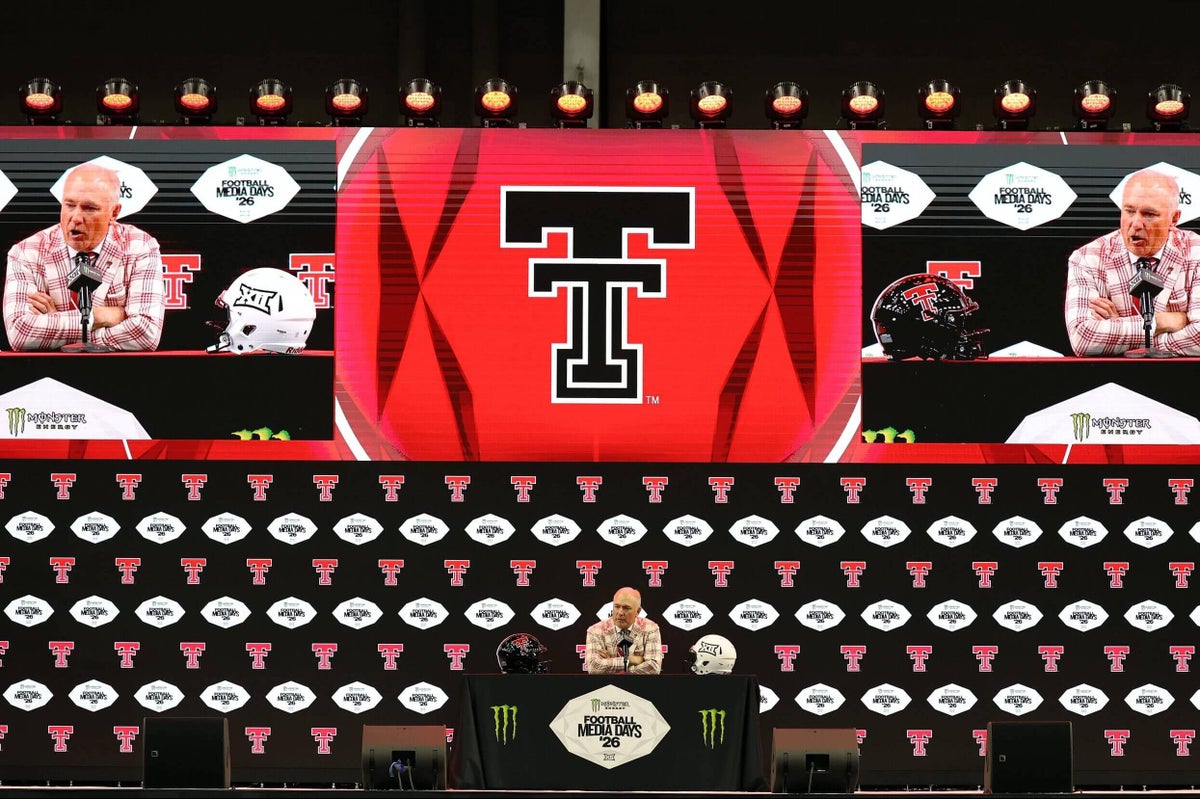
LUBBOCK, Texas — With a roar that shook the ground, the first plume of oil erupted from Santa Rita No. 1 on the morning of May 28, 1923, proof that oil flowed beneath the ground in the Permian Basin.
Three months later, the lucky oil men sent a royalty payment of $516.63 to the owner of that original plot of land where the West Texas oil boom began: the University of Texas, some 280 miles to the east.
By the time Texas Tech opened its doors in 1925, the massive oil field in its backyard had been discovered and divvied up, with some 2 million acres set aside for UT in Austin and Texas A&M in College Station, per the state constitution. Oil has been shaping the geographic and psychological terrain of Texas Tech’s football rivalries ever since.
For much of its history, Texas Tech was a roughneck cousin of the more well-heeled schools to the east, getting by on gumption and spite. Today, the landscape is changing. The Red Raiders have money, facilities, talent and a group of motivated boosters hell-bent on getting Texas Tech to the top.
And not everyone is happy about it.
“People just don’t like disruptions in the way they think things should be ordered,” said Cody Campbell, the former Texas Tech offensive lineman who made his fortune in the oil and gas industry and leads Texas Tech’s cadre of donors. “We’ve certainly been a disruptor.”
Texas Tech, oil money and college football’s new villain
Austin Meek and Lauren Morales-Jones
Campbell, a billionaire donor to conservative political causes, is the force behind much of that disruption. He’s a prominent backer of the Protect College Sports Act, a bill being considered in the U.S. Senate that would regulate player compensation and eligibility. His attempts to wield money and influence to reshape college sports have made him a polarizing figure outside of Lubbock.
Last fall, Campbell appeared in a national ad campaign to lobby for amending the Sports Broadcasting Act, took aim at the conference commissioners and vowed to “drain the swamp that college sports has become.” He also criticized the Big 12 for scheduling Texas Tech’s game against Houston on a Friday night, prompting commissioner Brett Yormark to respond that Campbell “does not run the Big 12.”
Campbell declined to say how much he’s contributed to Texas Tech, but he and other donors have pumped millions into the program. The $242 million Womble Football Center is an oasis equipped with every amenity under the sun. A talented roster fortified with high-priced transfers, including edge rusher David Bailey, the No. 2 pick in the NFL Draft, led Texas Tech to a Big 12 championship and a spot in last season’s College Football Playoff.
Coach Joey McGuire said rumors of Texas Tech spending more than $50 million on its 2026 roster are “nowhere close,” adding that the Red Raiders are “way closer to $30 million than $50 million.” However, McGuire didn’t hesitate to credit Campbell and other boosters.
“What Ohio State is doing, what Indiana’s doing, what Notre Dame’s doing, what Texas is doing — we’re doing it,” McGuire said.
Campbell is part of a new crop of entrepreneurs who hit it big during the so-called shale revolution, when technological advances allowed companies to tap into previously unreachable deposits of oil and gas through horizontal drilling and hydraulic fracking.
College football’s version of the shale revolution happened when players were allowed to accept money in exchange for their name, image and likeness rights, allowing a wider range of programs to tap into once unattainable reservoirs of talent. In both cases, there were advantages in being lean and nimble, not weighed down by tradition or institutional inertia.
“All the chaos that has come from the different lawsuits and everything happening in college football created an opportunity for us,” said Campbell, who serves as chairman of Texas Tech’s board of regents. “We were pretty far ahead in identifying what that opportunity could be.”
Being on the leading edge comes with risk. One of Texas Tech’s aggressive moves blew up when Brendan Sorsby, a coveted quarterback who transferred from Cincinnati on a deal worth roughly $4 million, admitted to placing more than 9,000 sports bets during his college career, including bets on Indiana when he was a backup for the Hoosiers in 2022.
Sorsby left Texas Tech in June without playing a down, but only after a bruising fight that pitted Texas Tech against other schools and even its own conference. Leaders at Texas Tech insisted they were supporting Sorsby’s recovery from gambling addiction by backing his bid to play after a Texas judge granted an injunction against the NCAA. Rival schools saw confirmation that Texas Tech was willing to blur the lines in its pursuit of championships.
“It’s f—ing bulls—,” Kansas State athletic director Gene Taylor told Yahoo Sports in June. “I know the kid has a problem. Well, get well and focus on your problem. It is absolutely devastating for him to be able to play when every other sport, no matter the level, deems an athlete ineligible or they are punished severely for betting on their team.”
As a highly anticipated season begins in Lubbock, the college football world is trying to figure out what to make of Texas Tech. Are the Red Raiders the sport’s new villain? Are they college football’s equivalent of LIV Golf, an upstart that burned through millions in oil money only to flame out? Or are they a true West Texas success story, a scrappy program that boot-strapped its way to the top?
After an offseason that stressed everything they’ve built, the Red Raiders are about to find out.
“Jerry Jones and some of those greats have said, ‘All publicity is good publicity,’” McGuire said, referring to another Texas oil man who owns the Dallas Cowboys. “I’ll tell you, some of it might be true, but it’s not fun going through it.”
The temperature was 19 degrees the day Lawrence Flugence took his recruiting visit to Lubbock.
“I didn’t realize it got that cold in Texas,” said Flugence, who grew up near Houston.
Historically, Texas Tech was known as a college football outpost: isolated, dusty, far from the urban sprawl of Dallas and Houston. Flugence, who wasn’t recruited by Texas or Texas A&M, fit in with the hard-nosed, under-recruited players who often made their way to Lubbock.
“We were the guys who were kind of picked over, looked over,” said Flugence, a linebacker who set an FBS record that still stands with 193 tackles in 2002. “We were just a bunch of ragtag guys who loved playing football.”
Under Spike Dykes, who coached the team from 1987 to 1999, Texas Tech was an above-average program with a middle-class budget. The demise of the Southwest Conference in 1996, driven by disparities between the conference’s haves and have-nots, put the Red Raiders in a precarious position before they landed a spot in the newly formed Big 12 along with Texas, Texas A&M and Baylor.
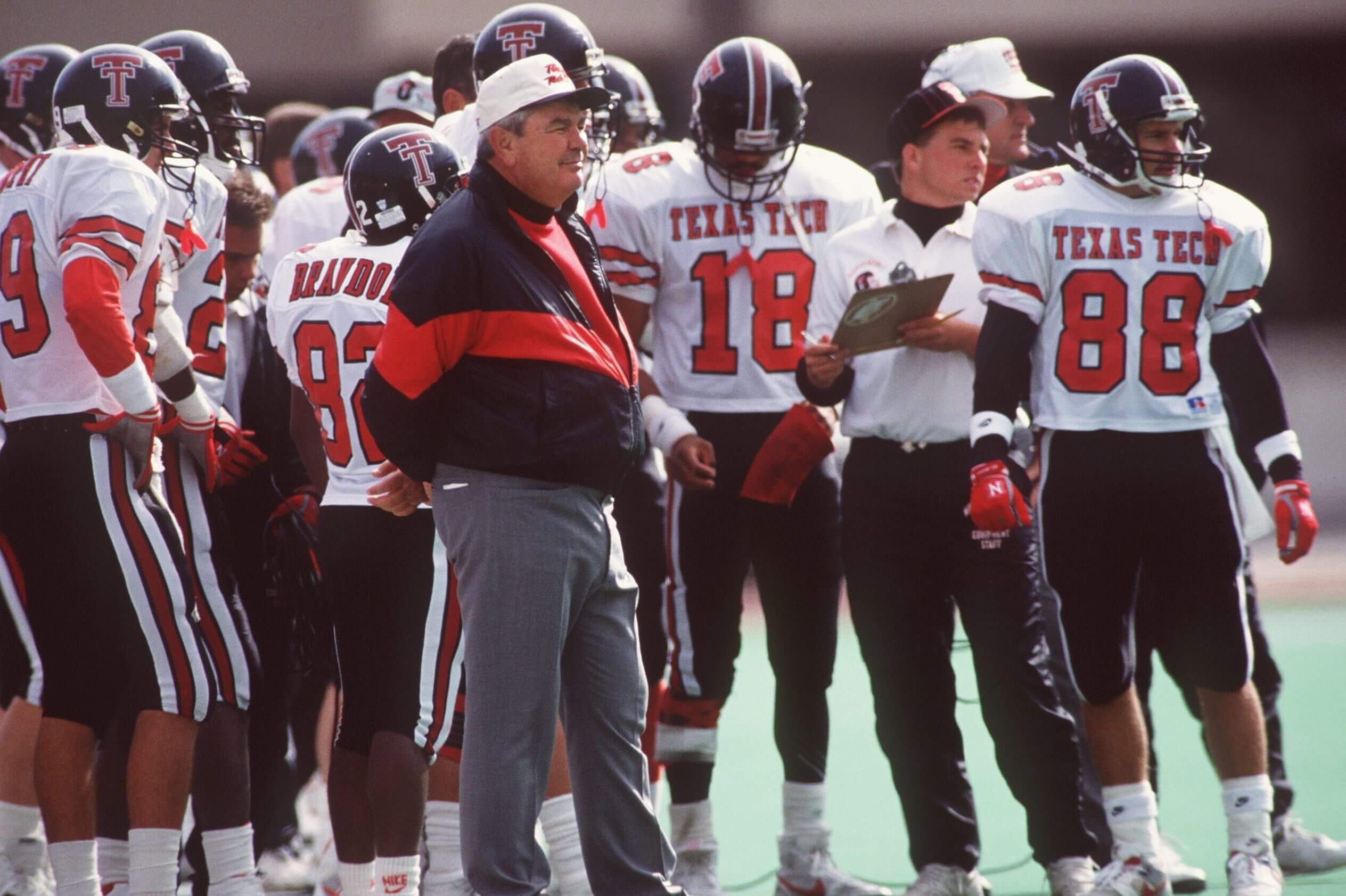
Spike Dykes led the Red Raiders for 13 seasons, taking Texas Tech to six bowl games and beating Texas six times. (Joe Patronite / ALLSPORT)
At the time, Texas Tech’s facilities were among the worst in the conference, former athletic director Gerald Myers recalled. Texas Tech got a boost from joining the Big 12, but the blue bloods made sure the Red Raiders knew their place.
“I remember way back there in conversation with (former longtime Texas AD) DeLoss Dodds, he said, ‘Look, for every millionaire you’ve got, we’ve got 20,’” said Myers, 90, who spent five decades at Texas Tech as a basketball player, coach and AD before retiring in 2011.
After Dykes retired, Texas Tech hired Mike Leach, whose Air Raid offense gave Tech an identity as one of the most entertaining teams in college football. Part pirate and part mad scientist, Leach took the Red Raiders to 10 consecutive bowl games and orchestrated an upset of No. 1 Texas in 2008 on a last-second touchdown pass.
After Texas Tech fired Leach in 2009 amid allegations of player mistreatment, the program lost its way. The next three coaches — Tommy Tuberville, Kliff Kingsbury and Matt Wells — were 36-71 in the Big 12 with zero winning seasons in league play, despite having Patrick Mahomes, a future NFL MVP, at quarterback from 2014 to 2016.
“The Leach situation caused a pretty big fissure in our alumni base,” said Campbell, who was part of Leach’s first recruiting class along with John Sellers, his high school teammate and future business partner.
After a brief stint in the NFL, Campbell joined forces with Sellers to start a company called Double Eagle, named for their high school mascot in Canyon, Texas. The duo made a fortune acquiring oil and gas leases in the Permian Basin and elsewhere. One of their companies sold for $2.8 billion 2017, another for $6.4 billion in 2021 and a third for $4.1 billion in 2025.
The net worth of Texas Tech’s alumni base was skyrocketing just as NCAA rules were changing to allow payments to players. That confluence of events positioned Texas Tech to be a major player in the transfer portal while other programs were still trying to organize their NIL collectives and secure their funding.
New forms of player compensation have leveled the playing field between Texas Tech and its in-state rivals that play in the SEC. Texas and Texas A&M, ranked No. 5 and No. 8 in the preseason Associated Press poll, still have elite talent, but now Texas Tech, ranked No. 12, can compete for recruits who wouldn’t have considered Lubbock in the past and could have an easier path to the Playoff in the Big 12.
Five-star defensive tackle Jalen Brewster, the No. 1 prospect in the Rivals industry rankings for the Class of 2027, committed to Texas Tech almost a year ago.
Flugence has seen the transformation up close. He met his wife, Shaya, a track and field athlete at Texas Tech, in the inflatable bubble Texas Tech used as an indoor track facility in the late 1990s. They toured the country this summer with their son Ryder, a quarterback who is garnering buzz as one of the top prospects in the Class of 2029.
“I can just tell you, Texas Tech’s facilities are one of the best, if not the best, in the nation,” Lawrence Flugence said.
In the past, the Longhorns could land the best players in Texas on resources and reputation alone, said Mike West, an athlete brand manager from the Houston area.
“I think they got to the point where they just thought they were better than everybody,” West said of Texas. “It’s all the UT football program, logo and money. … Texas, you can’t out-money everybody like you used to. You can’t out-money Tech.”
On the morning before Texas Tech’s first practice, McGuire emerged from the Womble Center around 8:30 and climbed behind the wheel of his gray GMC pickup. He’d already met with his staff and stopped for an interview with a local radio station that was broadcasting all day from the football complex. His next stop: the Idalou Elementary School library, where he was speaking at the school district’s annual convocation.
Teachers nibbled on breakfast casserole as McGuire walked in, trailed by a film crew for an upcoming Paramount+ documentary. The convocation began with a word of prayer, followed by a now-viral video clip of McGuire’s postgame speech after the Red Raiders beat Texas in 2022.
“I’m telling y’all right now, the country’s going to find out!” McGuire shouted in the clip. “Everything runs through Lubbock!”
After firing Wells in 2021, Texas Tech needed a frontman who could sell the program to recruits, work a room full of donors and strengthen the locker room culture. McGuire, an assistant coach at Baylor who spent 20 years at Cedar Hill High near Dallas, was an unconventional choice.
Though he’d never been a head coach or a coordinator at the college level, McGuire had strong ties with the state’s high school coaches, a powerful constituency in Texas. When athletic director Kirby Hocutt asked McGuire why he was qualified, he pointed out that Cedar Hill was a bigger operation than many college football programs.
“We pooled all of our resources to force Kirby Hocutt to give us an interview,” said Debbie McGuire, Joey’s wife. “I knew that if he got in there, he could sell himself. He’s just infectious. I knew he would get those players to play really hard for him.”
The Sorsby situation put McGuire, Hocutt and the rest of Texas Tech’s leadership on the defensive. An era of incessant legal challenges has produced eligibility situations that once seemed unthinkable. Even so, NCAA rules that prohibit sports gambling represented some of the last sacred ground in college football.
Sorsby’s decision to challenge those rules, and Texas Tech’s decision to support him, prompted heavy blowback and threats of other schools refusing to play the Red Raiders. At the height of the uproar, McGuire, Hocutt and school president Lawrence Schovanec released a 21-minute video that came across as an attempt at damage control.
“There were a lot of restless nights,” Debbie McGuire said. “Joey is such a genuinely happy guy by nature. He’s very energetic. I saw the life being drained out of him because he loves his players and is going to support his players at all costs.”
Sorsby left the team in June after the Big 12 trumped his lawyers in legal sparring that included Texas attorney general Ken Paxton. The Texas Tribune reported that Campbell donated $274,300 to Paxton’s U.S. Senate campaign the day before Paxton’s office released a letter threatening the Big 12 with legal action if it attempted to sanction Texas Tech for playing Sorsby. With Sorsby ruled permanently ineligible by the NCAA and the NFL declining to hold a supplemental draft, he is preparing for the 2027 NFL Draft.
Losing Sorsby was a blow, but the Red Raiders aren’t lowering their expectations. They still have designs on repeating as Big 12 champions and returning to the CFP behind quarterback Will Hammond, who is returning from a knee injury. They recently added another transfer in former Florida State and Boston College quarterback Tommy Castellanos, who won an injunction to play a fifth year of college football.
The Red Raiders say they’re embracing their role as villain. That’s a new position for a program that spent much of its history in the shadow of Texas and Texas A&M, fighting for resources and relevance. In a roundabout way, rivals are paying the Red Raiders a compliment by painting them in a black hat.
“You have to be seen as a threat to other people to become a villain,” said linebacker John Curry, who grew up in Lubbock.
The life of the Permian Basin provides a parallel for the rise of Texas Tech’s football fortunes. When the shale revolution happened, Campbell said, behemoths like Exxon and Chevron weren’t the first to cash in it. The big winners were the insurgents, the smaller companies that could move quickly and tolerate risk.
Some of those insurgents strike it rich. Others crash and burn. And some survive to become the behemoths of another era.
“We’re not done yet,” Campbell said. “We have much higher and further ambitions.”