
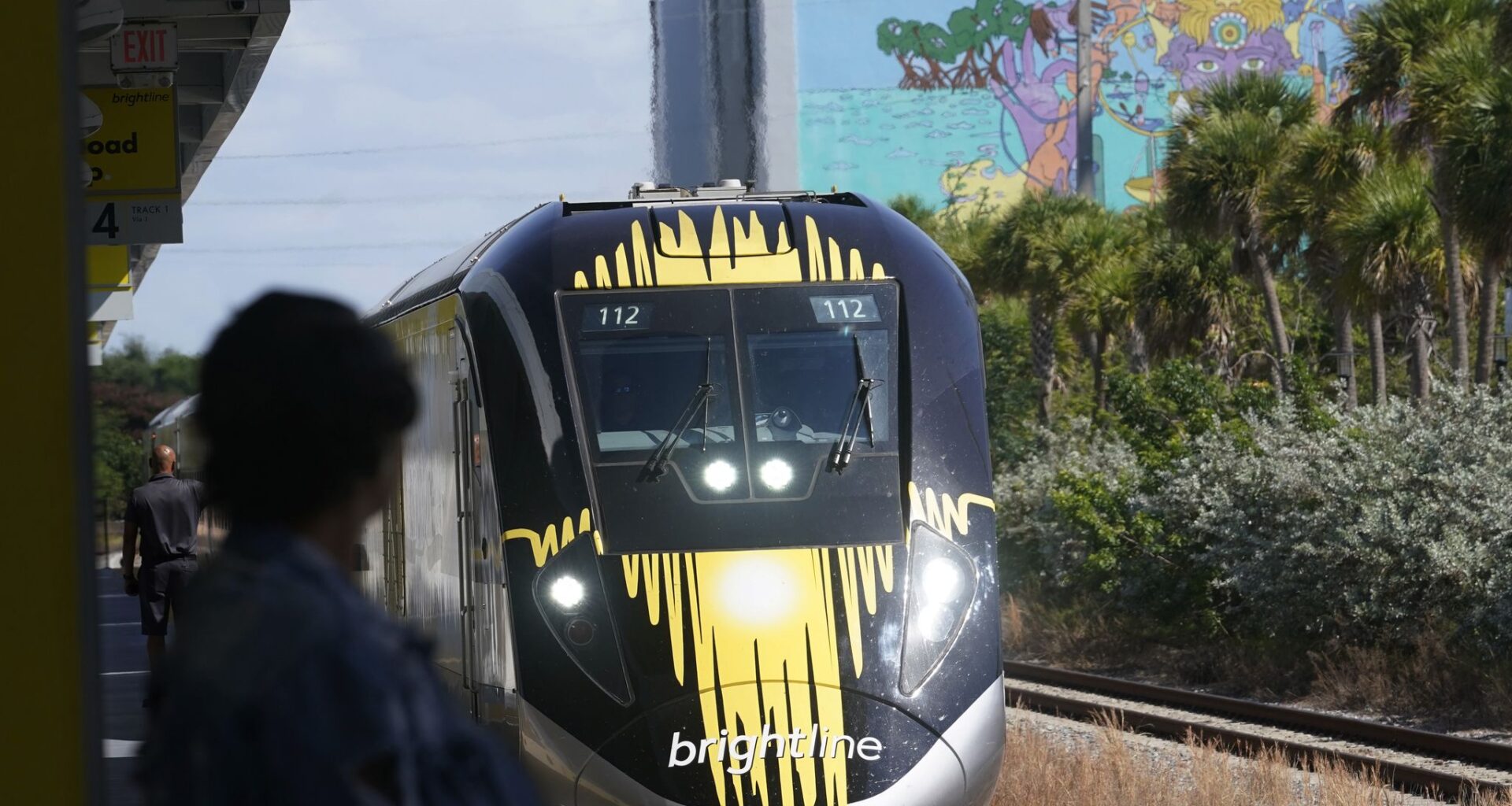
A Brightline train approaches the Fort Lauderdale, Fla., station in September 2023. Riders in South Florida have shown they will use a service that can compete with driving in terms of transit time, price and convenience. Advocates for high-speed rail between San Antonio and Austin need to show that people here want such a service, not just that it’s possible.
Marta Lavandier/Associated Press
Passengers board Amtrak’s Texas Eagle train in October 2024 in San Antonio. The once-daily service is insufficient to demonstrate whether people would use high-speed passenger rail to commute between San Antonio and Austin.
Christopher Lee / Staff Photogra
Local and state leaders pushing to bring faster and more frequent passenger rail service to the San Antonio-Austin corridor need to do more than show it’s feasible or estimate the cost to build it.

They need to demonstrate demand.
Article continues below this ad
The advantages of high-speed rail — or higher-speed, such as the 125-mph concept recently proposed — are clear. At 125 mph, a person in San Antonio could get to Austin in about 40 minutes rather than roughly two hours, which is typical in morning traffic.
Besides getting there in a fraction of the time, and relaxing while doing so, one would not have to pay for parking, which can cost about $30 or more for a day. And even with a short taxi or Uber ride to reach one’s destination, the commuter is still ahead.
Meanwhile, it’s easy to show need, as projections for population growth in South and Central Texas portend increased congestion on Interstate 35 that planned capacity-improvement projects likely can’t keep up with.
COMMENTARY: High-speed rail a means to bring San Antonio, Austin closer together
Article continues below this ad
But showing that high-speed rail is needed — or even that it could be desirable — comes short of showing that it’s wanted.
To date, no surveys or studies have focused on determining whether people who drive between San Antonio and Austin would use rail.
Most recently, a study commissioned by Travis County does three things:
It proposes a 125-mph passenger line along the Texas 130 toll road and a stretch of I-10, rather than along I-35 as prior approaches have done.
It concludes that building this route is possible from an engineering perspective.
It estimates the cost at up to $13.5 billion.
Article continues below this ad
That’s good to know, but it still doesn’t go the extra step of testing demand. If it did, it might get a tepid reception, considering that the proposed route’s endpoints are well south of downtown San Antonio and around Austin-Bergstrom International Airport.
This case perhaps explains why no one has quantified the demand for San Antonio-Austin rail. No one has offered a plan with enough specificity for commuters to make an informed judgment.
Besides the transit time, people need to know where the stations would be and, critically, how much it would cost.
Generally, if rail can beat driving on either time or cost while at least being on par with the other, people will strongly consider it as long as the starting and ending points are reasonably convenient — enough that it doesn’t overcome the advantage of saving on parking.
Article continues below this ad
Consider the Brightline rail service between central Miami and West Palm Beach, Fla., which launched in 2018. At 70 miles, the distance between these metros along I-95 is on par with that of San Antonio and Austin on I-35.
A typical morning drive from West Palm Beach to Miami takes two to two and a half hours, while the conventional-speed Brightline service takes about an hour and 15 minutes, and the cost for a 40-trip pass comes to about $10.73 per ride — less than the price of gasoline in a vehicle with average fuel economy.
Ridership has more than doubled to about 1.2 million in 2025 from nearly 600,000 in 2018, despite a drastic decline during the COVID-19 pandemic. Ridership had climbed to nearly 1.8 million in 2023 before the company launched its 125-mph Miami-Orlando service, which involved shifting capacity to that line, and discontinuing a commuter-pass product.
Similarly, the Coaster, a conventional-speed commuter train connecting seven coastal communities in northern San Diego County to two central San Diego transit hubs, launched in February 1995 with a little more than 500,000 riders in its first year. As highway congestion increased, along with the price of gasoline and downtown parking, ridership nearly tripled by 2019. And while ridership plummeted during the pandemic, it has been recovering, reaching about 1 million in 2025.
Article continues below this ad
And even though the Coaster is not high speed, it gets passengers where they’re going faster than I-5 for less than a typical driver pays in gas.
Nevertheless, while those services increased ridership after proving they could compete with driving, Texas passenger rail advocates must do more than show it’s been done in other places, though such cases may be helpful for public awareness messages to boost acceptance.
Those who advocate for San Antonio-Austin rail need to show, with credibility, what it can offer before we go further. And they need to do so soon before the window to make it happen closes — assuming it hasn’t already.