
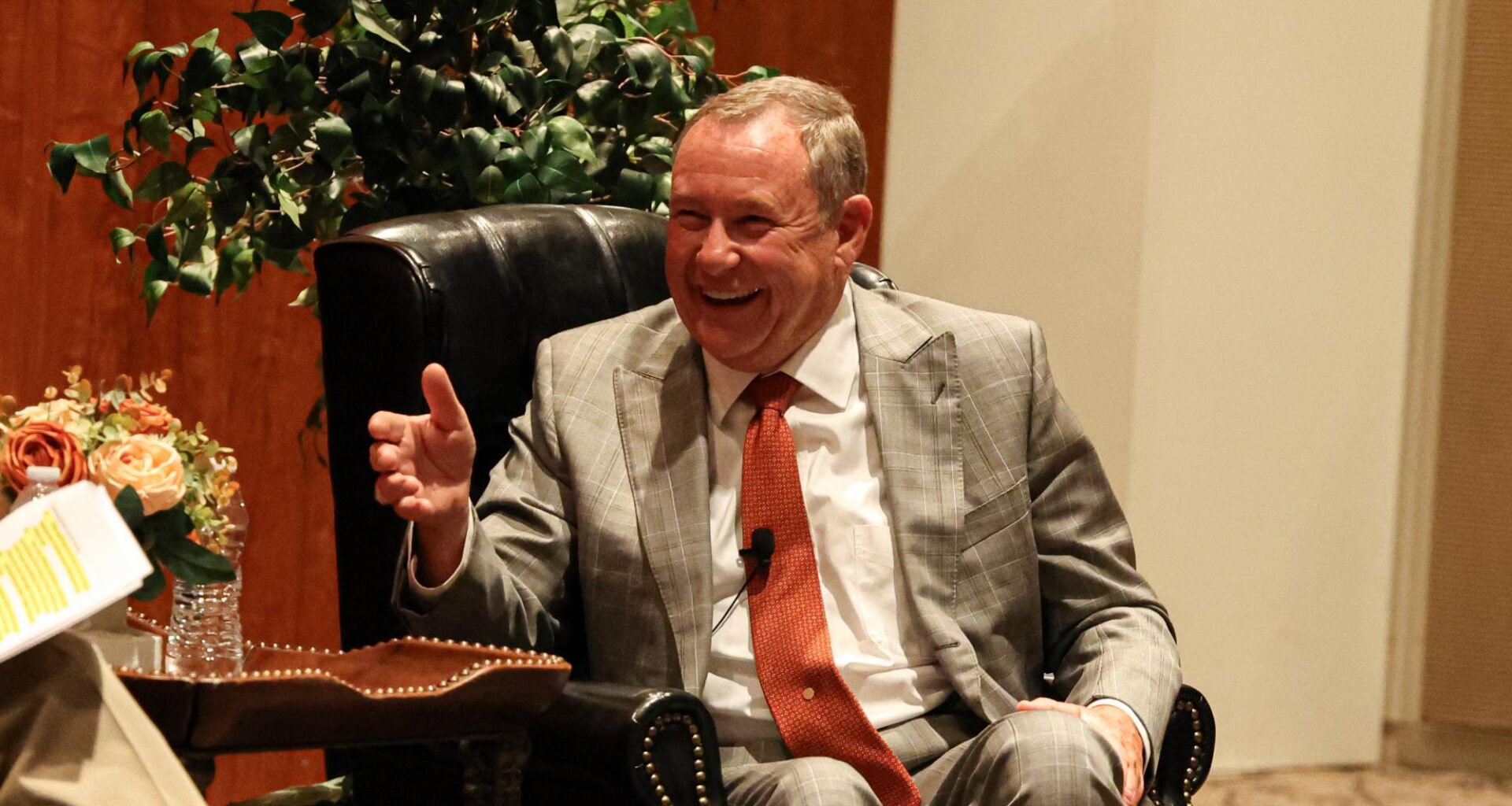
Texas Rep. Terry Wilson, R-Georgetown, who serves as chairman of the House Committee on Higher Education, said Senate Bills 17 and 37 are “misunderstood,” when their main purpose was to protect academic freedom. In the Bass Lecture Hall on Tuesday, he said these bills were created to protect scholarly research and the integrity of academic courses.
SB 17, which was passed in 2023, banned diversity, equity and inclusion programs and offices at all Texas public universities. SB 37 gave universities more oversight of university curriculum and reduced faculty council sizes in 2025.
Wilson said that some professors, whom he called “bad actors,” have gone beyond the bounds of what a class description says, creating a need for protections like those created with these bills.
“That is not protecting the right of the student to have their own independent thought because they were presented both sides of the argument,” Wilson said. “Instead, they were presented, potentially, an activist lens that is leveraging that curriculum to do that. What we’re trying to do is protect.”
Wilson, who also serves as the chair of the Select Committee on Civil Discourse and Freedom of Speech in Higher Education, said SB 37 was created to preserve discourse while ensuring there are no disruptions on campus. He said these disruptions are not limited to one side of the political spectrum, and pointed out one of the “most offensive” things he’d seen was a “right-wing radical nut” screaming and disrupting a formation of the Texas A&M Corps of Cadets, a student military organization.
“I’m all about free speech. I’m all about having the ability to demonstrate,” Wilson said. “But we’re not about taking away from the purpose of this institution or … the foundation that the students are searching (for) in education.”
Wilson, who is currently running for re-election in District 20, said he sees Texas as a leader in higher education policy. He sees that leadership reflected in changes to the curriculum will build a foundation for employment for students who graduate from a Texas university, community college or technical school.
Wilson said courses being taught that do not have a direct correlation with employment should not be eliminated. Instead, these courses should be made optional.
“I’m suggesting that every individual has the right to go take whatever additional class they want, so we’re not suggesting getting rid of a bunch of stuff,” Wilson said. “Look to what employers demand, and look to a place where a student can graduate with a degree that will actually give them a job, and that’s really where our focus is.”