
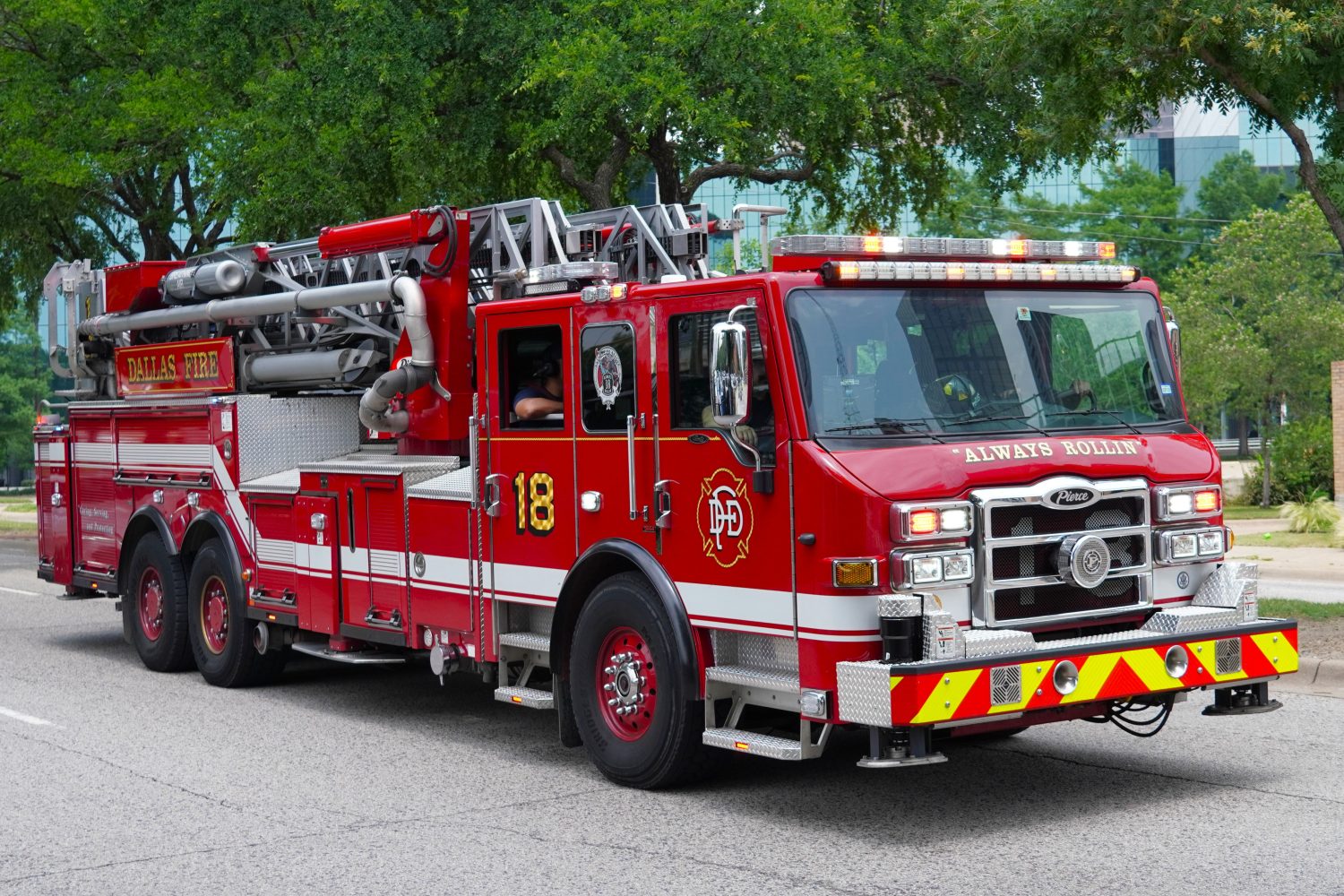
After a fire ripped through an unincorporated Dallas County community over the weekend, officials and advocates are raising concerns about the area’s lack of running water.
The fire started on the evening of Aug. 29 near Sandbranch, an unincorporated area with a population of fewer than 100 people, about 15 miles southeast of downtown Dallas. Around four acres were affected, despite initial reports putting that number closer to 10, and two structures were involved, Jason Evans, a spokesperson for Dallas Fire-Rescue, said.
DFR responded with 31 engines, 9 trucks, 7 boosters, 2 brush trucks, 5 ambulances and other support units beginning Saturday evening, Evans said. While Sandbranch falls outside city limits, the department responded to a mutual aid request from Dallas County.
Responders worked in temperatures up to triple digits during the nearly two-day response period, when they were forced to work around the community’s lack of fire hydrants.
Sign up for the This Week’s Top Stories newsletter to get the latest stories delivered to your inbox
THANK YOU!
You’re all set.
CLOSE
While the blaze was contained late Saturday night and largely extinguished by Monday morning, the logistical hurdles faced by first responders have raised questions about the community’s enduring lack of running water. Officials and nonprofits have spent years trying to bring water to the impoverished community, which has largely relied on bottled water since the 1980s.
What happened?
DFR units responded to the emergency from approximately 10:30 p.m. Saturday night to 10:30 a.m. Monday morning, Evans said, adding that personnel spent Monday morning overseeing “what was left of the fire.”
There were no injuries reported, and Evans said the cause of the fire is still unknown. However, Dallas County officials told WFAA that the fire began at an illegal dumping site the county has been called to before, which reportedly contained piles of rubbish up to 10 feet deep.
Evans said responders responded in an area containing multiple brush, trash and debris piles. An excavator was used to dig out lingering hot spots underneath the rubbish, after which firefighters used aerial ladders to extinguish the flames, he said.
The response involved 15 volunteer, municipal and county fire departments. First responders hauled water from hydrants two miles away, near the Southside Water Treatment Plant, according to prior reporting by The Dallas Morning News.
Why can’t Sandbranch get water?
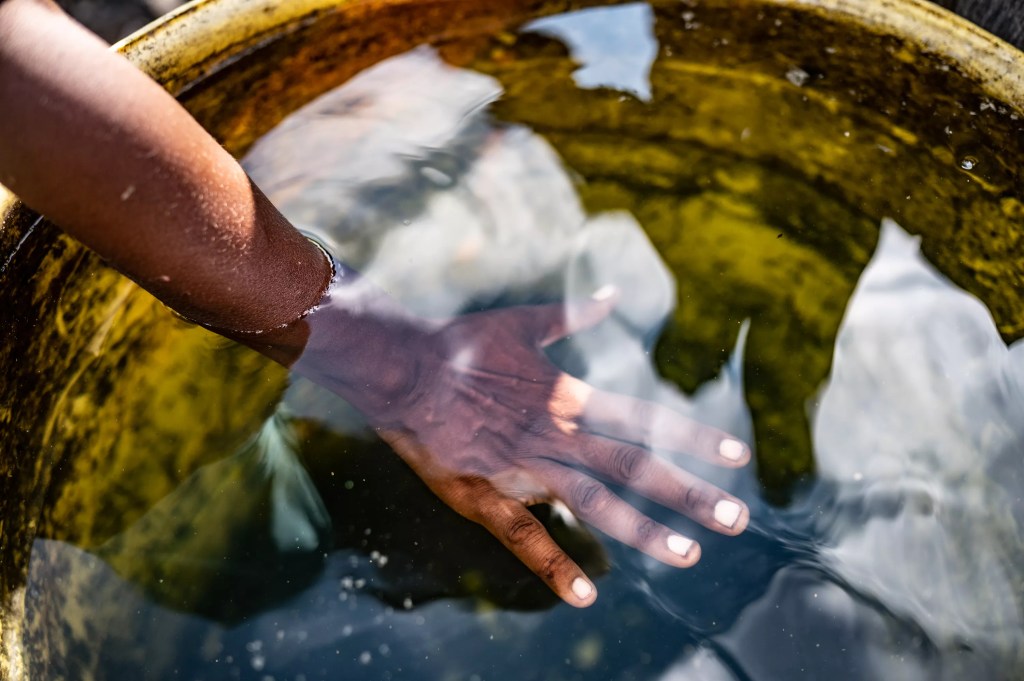 Mahogany Nunnally dips her hand in a barrel of water gathered near her home in Sandbranch.
In a statement released Sunday, Democratic Senate nominee James Talarico highlighted the community’s longstanding water issues.
“For too long, Sandbranch has been denied basic infrastructure to keep its residents safe and healthy,” Talarico said. “The community has no running water, no sewer system, and no fire hydrants — so when last night’s fire broke out, firefighters were forced to haul water into the community.”
Located southeast of Dallas near Seagoville, the area around Sandbranch was settled as a freedmen’s community in the 1800s before being organized in its current form in the late 1950s. The primarily Black community has never had a sewer system, fire hydrants or running water, and some households still don’t have electricity. For decades, residents relied on well water for drinking and household use, but after illnesses linked to the water were reported in the mid-’80s, the community has largely relied on bottled water for everyday use.
The community sits on unincorporated land, which means it does not have direct access to municipal water services, unlike residents in incorporated communities such as Dallas. Dallas leaders have previously shot down proposals to annex the land, citing the high cost of bringing the needed infrastructure to the community.
Attempts to use grant funding to build infrastructure continued until 2003, when the Federal Emergency Management Agency ruled that Sandbranch sat in a floodplain, leading to significant development restrictions. In 2015, KERA reported that around half of the community would have been underwater during a major flood. Advocates have since questioned the designation, and The Dallas Morning News reported in 2016 that county officials were told the agency was unaware of any restrictions that would prohibit a water system.
The county offered to pay residents to relocate from their land in 2005. Most who took the offer received less than $400, while some residents refused to leave their homes. Since then, many have rejected subsequent buyouts and instead demanded basic services from county officials.
How to get water to Sandbranch
In an interview, Dallas County Commissioner Andy Sommerton said the community’s floodplain designation has made bringing water to Sandbranch extremely difficult, as have costs. Estimates for a water system in recent years have ranged from under $1 million to more than $20 million.
“I am told that it brings a very difficult process to be able to bring water to each of those individual homes,” Sommerman said. “There are a few of them compared to the amount of land space that we’re talking about. I’m talking about the density of it. There’s about 200 homes in that area.”
Sommerman said there are potential issues finding a contractor willing to install a system, but if someone brings a developed plan to the county, he’d be open to it.
“Show me the plan,” he said. “I’m open to the idea.”
One notable nonprofit in the area, the Water for Sand Branch coalition, has drafted legislation called the Ken Wright Infrastructure Bond, which would use state tax abatements and rebates to build the water systems residents have long been asking for.
Commissioner John Wiley Price, a noted advocate for bringing water to the community early in his career, told The Dallas Morning News in 2019 that he had lost hope of doing so and felt payouts would be the only feasible way forward, given environmental constraints and financial hurdles.
Dallas GOP takes aim
During Tuesday’s commissioner court meeting, Dallas County GOP justice of the peace candidate Jaylah Godbolt criticized the Democratic-led county leadership and County Judge Clay Jenkins.
“Where is your humanity, dignity, and self-respect? Usually, officials are reactive instead of proactive, so the world must wonder why Price and Jenkins are not taking any actions,” Godbolt told the court.
The county GOP has engaged in outreach in Sandbranch over the summer, and candidates will hand out water this Saturday, she said. Will Campbell, a Dallas County Republican running for a Texas House seat, also took to social media to criticize bipartisan failures at the local and state level.
“Not only have they been neglected by the county for decades, now there has been a major fire in their community,” Campbell wrote. “Because decades of Dallas County officials and state representatives failed to get the job of bringing them water, sewer, and power done.”
Campbell has drafted a piece of legislation that would create a funding structure with the Texas Water Development Board to bring water, sewer and electricity infrastructure to Sandbranch. The proposal would leverage state and federal grants as funding sources.
In an interview, Godbolt said her and other candidates’ advocacy is about helping people, not boosting their election day totals.
“We’re doing it for God, because we’re all Christians that are running, and we’re doing it because we’re actually for the people,” she said. “We’ve never been out there before, and this is our first time stepping in, and this is going to be the only time because we’re going to make sure that we get it.”