
For more than a quarter of a century, Texas has diligently updated its state water plan every five years, a process designed to forecast water supply and demand 50 years into the future — and give communities enough warning about potential water shortages to do something about it.
That warning matters because water projects can take years — sometimes decades — to plan, finance and build.
For Corpus Christi and the rest of the Coastal Bend, it never came.
That’s because the planning process is built largely around past droughts — in fact, some regional plans still rely on the epic 1950s drought of record, the longest statewide dry spell in history. But some experts now say using historical droughts isn’t working because climate change is making droughts more frequent, longer and severe — raising doubts that yesterday’s worst-case scenario is also tomorrow’s.
That means the models that help secure money and political will for new water projects may be dramatically underestimating both future water needs and how quickly communities could face shortages.
“We need to be planning and developing infrastructure for the climate of 2050, the climate of 2100,” said Benjamin Cook, a climate scientist at Columbia University who studies drought in North America.
Nowhere were the weaknesses more evident than in Corpus Christi. A report released Wednesday by Texas 2036, a nonpartisan think tank that researches the state’s long-term infrastructure, population and economic needs, found that five state water plans adopted over 25 years sent conflicting signals about whether the Coastal Bend region, which includes Corpus Christi, could face shortages in the 2020s.
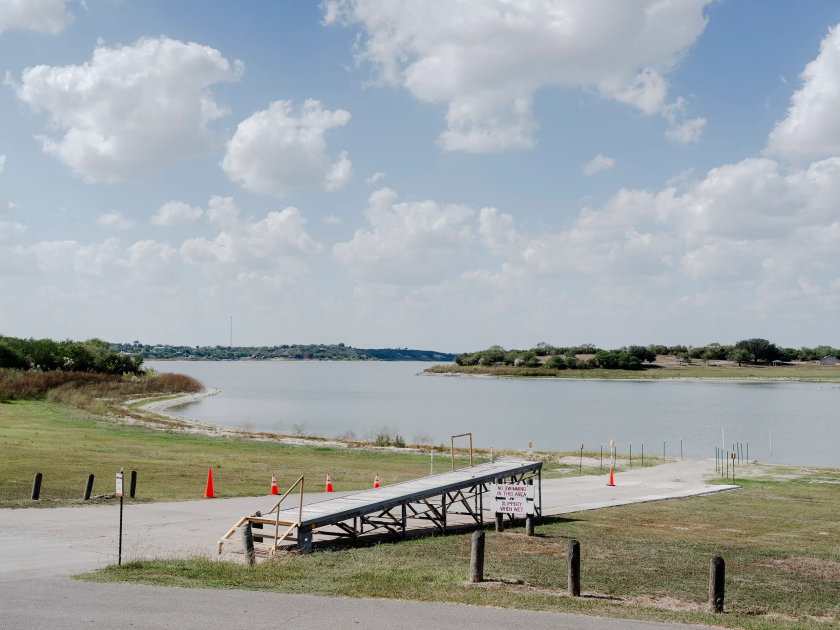
Lake Corpus Christi at 11.8% capacity Oct. 20, 2025. At the time this was the only operational boat ramp out of six in the state park.
(Brenda Bazán/The Texas Tribune)
Some projected surpluses and others deficits. None provided a clear warning that the Coastal Bend needed to expand its water supply — which relies almost completely on drought-sensitive rivers and lakes — before the current crisis emerged.
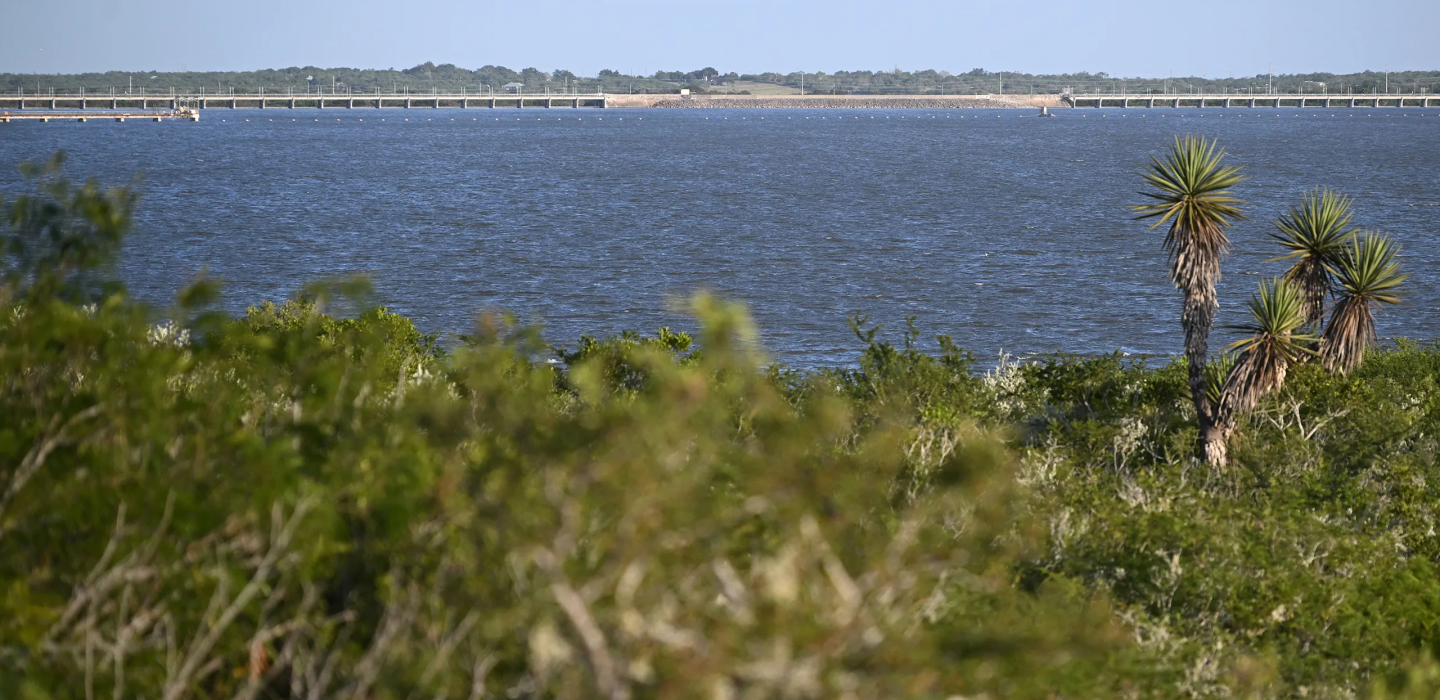
This spring, years of drought threatened to leave Corpus Christi and surrounding communities without enough water to meet demand as critical reservoirs fell to historic lows. Businesses and residents were asked to conserve water. Industry threatened to leave. Cities issued disaster declarations and the governor threatened to take over.
Before summer rains eased the crisis, city leaders in March estimated that by May they could have to declare a water emergency — the point when the city has six months before demand exceeds supply.
“That’s a massive planning miscue from the water plans,” said Jeremy Mazur, the director of natural resources and infrastructure policy at Texas 2036, and the author behind the report. “What would have been the impetus to do anything to prepare for worsening conditions in the 2020s?”
Sarah Kirkle, director of policy and legislative affairs at the Texas Water Association, added that many of the state’s water models aren’t taking into account more recent drought data. “Worse than the 1950s” doesn’t always equal the “worst they’ve ever seen locally,” she said.
A 2023 law allowed regional planning groups to evaluate scenarios worse than the historical drought of record. But it didn’t provide money specifically to pay for updating the models at the heart of these water plans.
Voters last year approved $1 billion on water projects over the next 20 years, but none of it is earmarked specifically to update water supply modeling. Meanwhile, half of the state’s surface water models, which drive decisions about managing river and reservoir supplies, haven’t been updated since they were created in the 1990s — updating them would cost an estimated $4.7 million.
“To really be resilient to future droughts it is necessary to consider how climate change is affecting the vulnerability of particularly water supplies, and there’s no blanket answer to that,” said Texas State Climatologist John Nielsen-Gammon.
The Texas Water Development Board, which oversees the state’s water planning process and folds 16 regional plans into the state water plan, follows state rules that require the use of historical drought assumptions and says they provide the best available benchmark for engineers and planners designing reservoirs, pipelines and other infrastructure.
The board recognizes that the existing models may not capture more recent or severe droughts, but the agency does allow groups to use more recent hydrological data the board provides to inform their planning, Kaci Woodrome, the board’s chief communications officer, said in an email.
“Predicting the likelihood or conditions of new hydrological droughts that are more severe than the drought of record remains challenging, especially at the scale of local water supply sources,” Woodrome said. She added that water planning regions may use a more recent drought than the 1950s and that the TWDB is currently working with the state climatologist to identify regions of the state that are likely to experience severe drought or excessive rainfall.
Coastal Bend planners wrote last year that they suspected the region was facing a new drought of record and that they needed to update their modeling for the 2026 regional water plan, but “there was insufficient funding allocated” to do so as they faced a state deadline to submit the plan.
The state granted more than $637,000 for the Coastal Bend’s 2026 regional plan. It’s unclear if any of that money was used to update the plan’s modeling. Regional planners who deal with the funding did not respond to multiple requests for comment.
As a result, this year’s plan likely understates the region’s future water shortages, according to the Texas 2036 report.
Rain eventually arrived in May, then massive upstream flooding in July eased the immediate threat, delaying the projected water emergency until the fall of 2028. The combined capacity of Corpus Christi’s two main reservoirs — Choke Canyon and Lake Corpus Christi — jumped from below 8% in April to 42.9% this week.
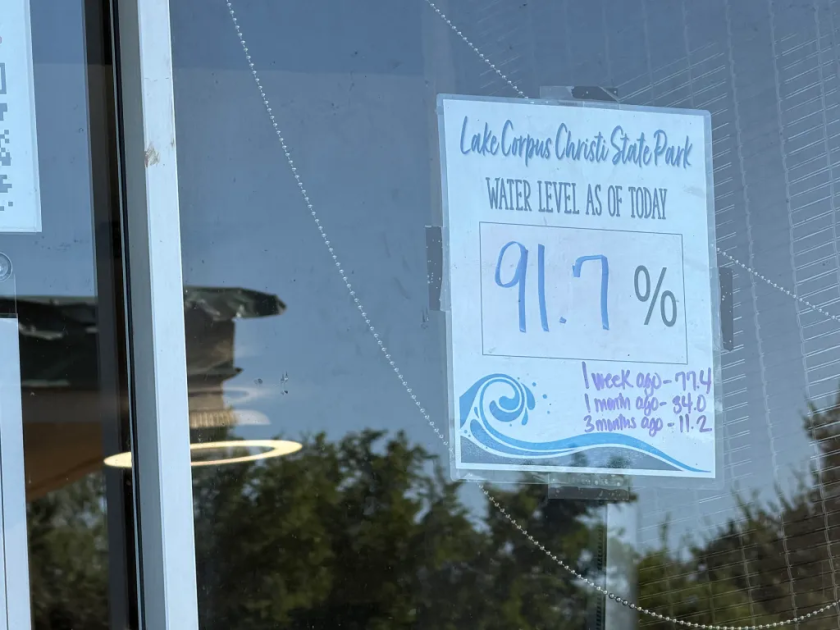
A sign on a window at the Lake Corpus Christi State Park Texas Parks and Wildlife Department station shows current and recent levels at the reservoir on Aug. 15, 2026.
(Pete Garcia/The Texas Tribune)
A state legislative interim hearing is scheduled for Aug. 24, where lawmakers are expected to discuss regional water planning and make recommendations to improve the water planning process.
For Mazur, Corpus Christi’s near-crisis this year is a wake-up call to state leaders: Texas’ planning process could fail to give communities enough warning before their water supplies reach a breaking point.
“We can’t have our policy predicated on plans that are not right,” Mazur said.
Relying on Historical Droughts
The state water plan is built using a bottom-up approach that starts with those 16 regional water planning groups, which divide the state based on river basins and produce their plans that try to look 50 years into the future.
In the Coastal Bend region, by the time planners realized the drought unfolding across South Texas had become more severe than the one they were using as their benchmark — a regional drought from 2007 to 2013 — they were already deep in planning and up against a deadline to submit their plan for inclusion in the state’s water plan.
Starting over wasn’t possible.
The Water Development Board adopted the Coastal Bend’s new regional plan in January, despite concerns by planners that the region had already entered what could be an even deeper drought.
Esteban Ramos, Corpus Christi’s water resource manager and a member of the regional group, said the group didn’t have enough data about the ongoing drought to work with — typically droughts are only fully analyzed after they end.
The region ended up with a plan based on modeling for a drought that it already believes has been surpassed.
The state appropriated $12.6 million between 1998 and 2004 to produce water availability models around the state. They’ve undergone some updates since being created — most recently in 2019 for four river basins, at a cost of $2.1 million.
But half of the state’s regions still haven’t updated their models in decades — the cost to do so is estimated at $4.7 million.
“Why is it so hard to update them? Because the state does not invest. Period. End of story,” said Carlos Rubinstein, chair of the TWDB from 2013 to 2015.
Rubinstein said that the reason the state has not consistently reinvested in modeling is because of budget cuts to state agencies like the board.
While the state gives regional groups planning and research grants each cycle, which can go toward updating models, some planners say that pot of money is not enough to update their models fast enough. They add that spending the state money on modernizing drought models would divert it from other important work like data analysis, forecasts, evaluating water projects and their costs, and reaching out to communities.
Kirkle of the Texas Water Association said regional groups have limited pots of money that they have to stretch across a lot of competing priorities, so updating models often doesn’t rise to the top.
Inconsistent Water Shortage Signals
Over more than two decades of state water planning, the Texas 2036 report found that the plans failed to give the Coastal Bend a clear, timely and actionable warning about the 2020s water crisis — even though that was exactly what the system was created to do.
Mazur, the report’s author, said the state’s premier planning tool instead behaved like a faulty alarm for the Coastal Bend, producing an inconsistent, “on/off” warning signal.
None of the plans projected a significant surface water shortage in the Coastal Bend similar to what cities like Corpus Christi and surrounding communities confronted this year. One plan projected shortages for groundwater users and water treatment capacity in the Coastal Bend, but did not predict shortages of surface water, which makes up more than 90% of Corpus Christi’s supply.
This story first appeared in The Texas Tribune. Read the original here.