
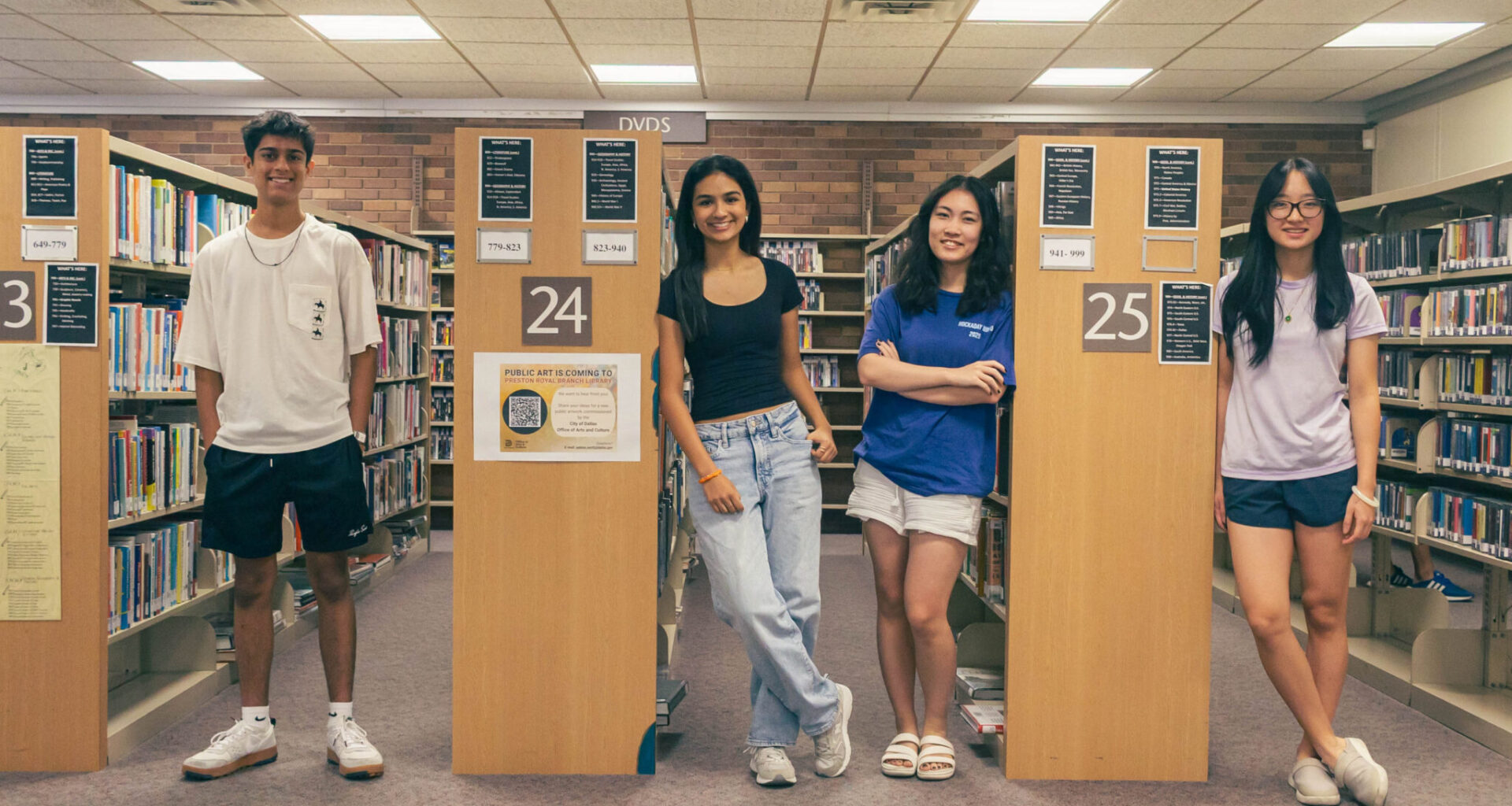
Some topics are so niche that it can be hard for someone to know what’s false, which is why section editors are assigned to STEM topics they are more well-versed in.
“There is a form of trust that you kind of have to have with your writers,” Aravli says.
Over the past year, their publication has expanded to include 36 more of these writers, or STEM Scribes. While most are from The Hockaday School, there are also students from Greenhill, Allen High School, Plano ISD’s Jasper High School, the Harmony School of Innovation, and even the Sevenoaks School in England. STEM Scribes show their passion for the subject in very different ways. There are articles delving into mathematical theorems, showing the chemistry in baking, examining the science behind online trends, and exposing the detrimental effects of EV creation, all of which reflect each student’s perspective. The group publishes about two or three articles a month. They expect to be releasing more in the next school year, but there are no publication deadlines for STEM Scribes.
“Writers are happy to write. We don’t find a problem with them not having things to publish. When you set a deadline, people kind of get burnt out. They’re like, ‘Do I really want to be in this? Is it really worth it?’ You’d actually be surprised how much people would be able to do on their own,” Aravli says.
Aravli’s favorite is an article she published this January that examined Peter Thiel’s rhetoric and compared it to her school reading, Frankenstein by Mary Shelly. Thiel, the cofounder of both PayPal and Palantir, expressed views on transhumanism, government control, and the Antichrist.
“I was seeing similarities between him and Victor Frankenstein in terms of … really wanting to control everything around them.”
“I think our writers write a lot more interesting articles, because most of our time is spent editing. My favorite one is from Aashritha [Shankar]. She writes a bunch of really complicated math articles that no one really understands, but they’re really cool to read,” Katherine says.
According to Ronak’s Youth STEMline Wrapped (modeled after Spotify’s end-of-year recap), Shankar was the busiest writer during the last year with four articles published, including a three-part series on the history of space-time.
One moment that made the founders feel like they had “made it” was when their publication began to appear on the Google search results page. “When you search up Youth STEMline, we show up,” says Ronak, who is in charge of their website and Instagram. “Even ChatGPT and Gemini know about us.”
In just one month this summer, they already had 3,000 views.
“I think we’re growing exponentially,” Aravli adds.
However, looking at the data took their focus away from their mission.
“We all just weren’t satisfied with what the articles were producing in terms of engagement,” Aravli says. “We wanted to see the kids; we want to see them laugh, have them actually find something interesting. And you can do that with the workshops.”