
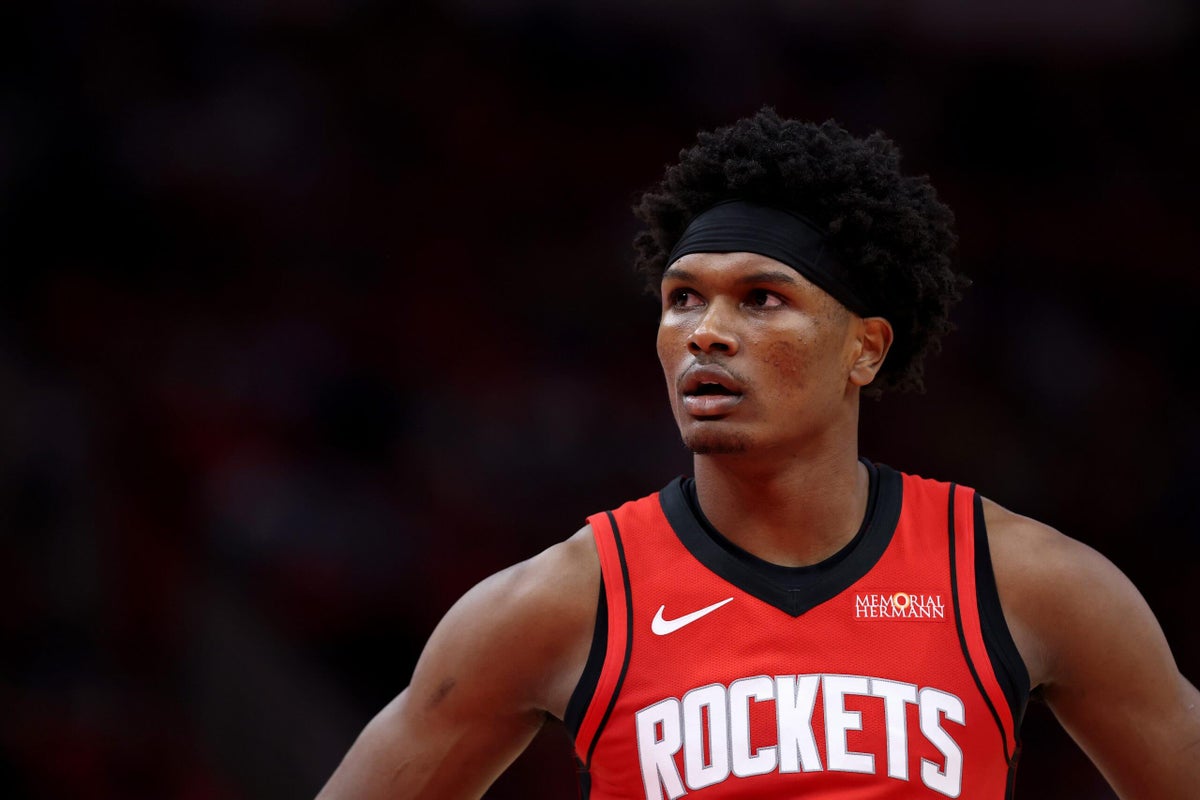
Betting on potential usually comes with the territory when handing out rookie extensions to players in their early 20s. Part of the assumption with these lucrative deals is that the best years are still ahead.
But for the Houston Rockets, the risk-reward with Amen Thompson’s new five-year, $208 million extension, which he signed on Thursday, is different.
On one hand, it’s obvious why the Rockets would be heavily invested in keeping Thompson around for the short and long term. He has already displayed a rare mix of skills that make him one of the most intriguing young stars in the game today and an invaluable part of Houston’s core.
Despite operating as the lead ballhandler on last year’s Rockets, Thompson was second in the NBA with 204 dunks, trailing only Cleveland’s Evan Mobley (207). Although he was asked to spend more time running the offense, Thompson still grabbed 235 offensive rebounds. The only players with more last season were Donovan Clingan, Rudy Gobert, Moussa Diabate, Jalen Duren and Mitchell Robinson.
Thompson averaged career-highs in points (18.3), assists (5.3) and steals (1.5) last season. The only other players to reach those numbers were Luka Dončić, Tyrese Maxey and Donovan Mitchell. He also led the NBA in minutes played, missing just two games.
At 23, Thompson is already one of the NBA’s elite perimeter defenders and has a budding offensive game that’s just scratching the surface. Add that to the chemistry he’s developed with Rockets co-star Alperen Şengün, and it’s easy to see why Thompson plays such a pivotal role in Houston’s title hopes.
There’s only one issue: Houston didn’t hand Thompson a deal worth $41.6 million per season because he’s such a great fit for this iteration of the team.
Although he already contributes in so many areas, Houston believes Thompson can reach even greater heights.
The Rockets hope the return of Fred VanVleet and the arrival of Marcus Smart will allow Thompson to slot back into the do-it-all role he excelled in during his second season rather than operating as a full-time point guard like he did last season. Combining Thompson’s relentless activity and explosive athleticism with the veteran savvy provided by VanVleet, Smart and Kevin Durant will be Houston’s best path to title contention.
Considering how the Rockets have constructed their roster the past few seasons, the organization has clearly prioritized a two-timeline approach that gives Durant and the other veterans a chance to compete right now while also maintaining a pathway to the next phase of competitive basketball in Houston once Durant decides to move on.
With his new contract, Thompson has become the most essential player in that post-Durant phase — which may be years down the line or perhaps as early as the 2027-28 season. While Durant is still performing at a superstar level heading into his 38th birthday later this month, it’s never too early to start preparing for what comes next when the face of the franchise has logged more than 44,000 regular-season NBA minutes. Durant can become an unrestricted free agent following this season if he declines his $46 million player option.
Finding a superstar is one of the toughest jobs for any NBA front office. Perhaps the only thing more difficult is finding your next superstar once your current one departs.
While Şengün has two All-Star appearances under his belt and some sensational offensive skills, there’s a belief among some folks around the league that Houston’s best chance at replacing Durant is by giving Thompson the freedom to take his game to the next level.
Thompson is much more capable of making an impact on both ends of the floor, and his freakish athletic gifts make it easier to envision him developing into a downhill scoring force in the mold of players like prime Russell Westbrook, Zion Williamson or Ja Morant.
Thompson started showing glimpses of his game evolving as he grew more comfortable in his role during the second half of last season, and some of Houston’s most dominant stretches were fueled by the third-year guard taking more control than he has before.
In his final 25 regular-season appearances, Thompson averaged 20.2 points, 8.1 rebounds and 5.2 assists while shooting a sizzling 59.8 percent from the floor. It looked like the game was slowing down for him.
“For Amen, I think it was just that understanding of balance. In the last two months of the season, you kind of saw his numbers take off (and) his comfort level take off,” Rockets coach Ime Udoka said at his end-of-season news conference last May. “The paint touches were evident — not shooting in a crowd or finding his outlets. It became more consistent. … I think (he) took steps in the right direction as far as playing the point guard, even though that wasn’t (his) natural position coming in.”
Amen Thompson grabs the high lob and finishes
As good as Thompson is right now and as good as he’ll probably be three years from now, there’s still one major hurdle he has to overcome to truly ascend into superstardom: He has to learn how to shoot.
He doesn’t necessarily need to start drilling 3-pointers at a 38 percent clip, but there really isn’t much precedent for superstar-caliber players in today’s game whom teams can ignore on the perimeter the way they did with Thompson most of last season. He shot a putrid 21.6 percent from 3. Only Cody Williams (21.4 percent) and Dyson Daniels (18.8 percent) shot a worse percentage while putting up at least 100 attempts from 3.
Although Daniels isn’t as talented overall as Thompson, the Atlanta Hawks guard has become a cautionary tale for players who allow their poor outside shooting to sink their value. Daniels, who won the Most Improved Player award in 2025, has basically been turned into a glorified small-ball center in Atlanta because teams have become so committed to ignoring him on the perimeter.
And it’s not a coincidence that we’ve seen the effectiveness of Williamson and Morant dip in recent seasons as injuries and a lack of growth in their respective games have taken a toll.
It probably won’t be that bad for Thompson, but recent history has shown how difficult it can be to build a high-level offense when opposing defenses get to play 4-on-5 during half-court situations. The spotlight on Thompson’s deficiencies will shine even brighter once he’s getting paid north of $40 million per season.
But that’s not only a product of fan scrutiny — it’s the reality of today’s second-apron NBA, where teams don’t have the financial flexibility to maintain more than two players making that much money. It’s not feasible unless those players making superstar money provide superstar production.
While they may not admit it publicly, the Rockets brass has to have some level of fear making this kind of commitment to a player who still has such mystery attached to what his game will look like three years from now.
However, considering what they know about Thompson’s intangibles — his work ethic, his commitment to winning, his relationship with his teammates — the organization is more than willing to believe its young star will max out his potential.
So just how high is Thompson’s ceiling?
That may be the biggest question Houston has to answer in the present and in the future.