
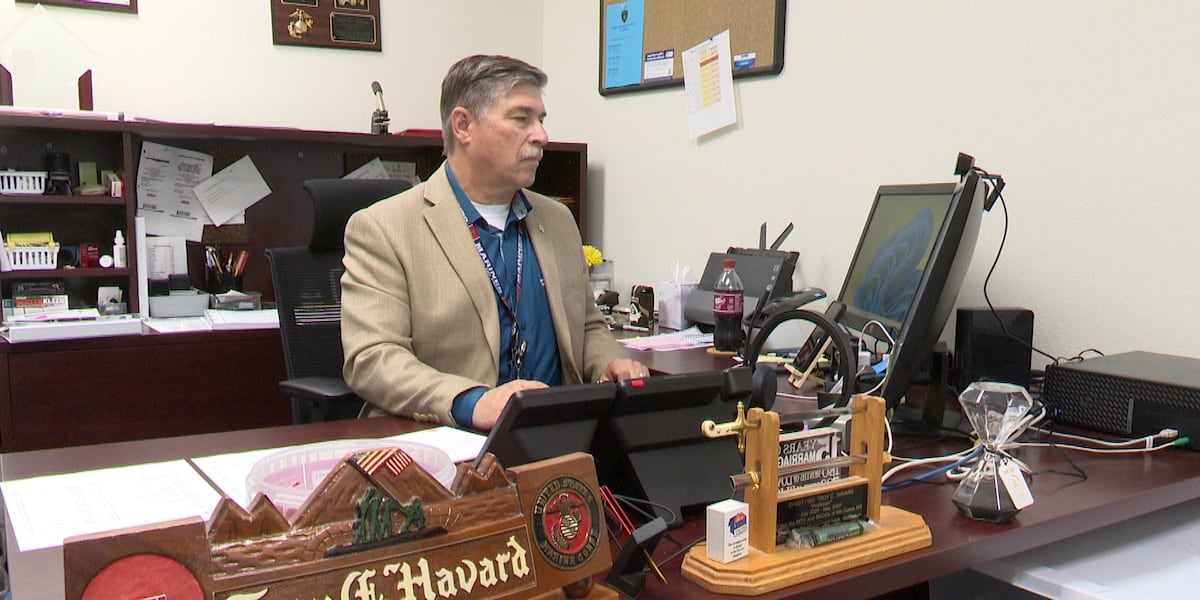
LUBBOCK, Texas (KCBD) – As November elections creep closer, the new Lubbock County Elections Administrator is looking toward the future.
Troy Havard took over for former administrator Roxzine Stinson after her retirement.
The Texas native served more than 28 years in the U.S. Marine Corps and retired in 2019. Just three days after his retirement from service, Havard began working as the Assistant Elections Administrator in Tarrant County. He held that position for eight years before applying for the job here in Lubbock.
He says it was God’s plan for him to work in the election field. He served as the voting officer during service, and said it was chance that he continued the path after retirement.
“I looked at the job description and it was essentially the same thing I was doing in the Marine Corps – just a different name,” Havard said. “So I said why not?”
Havard said similar to military service, working elections isn’t a job – it’s a calling.
“You either love it or you don’t. It’s not something you do to earn a paycheck, it requires dedication and devotion,” Havard said.
Running elections isn’t an easy job, but Havard says he has the discipline to lead Lubbock County through the changing landscape.
Havard used 2020 as an example of an unusual year because of COVID-19 and because Governor Greg Abbott gave an extra week of early voting for the presidential election that November, which had never happened before. Havard said the Legislature has since passed a law prohibiting that from happening again.
Havard said 2026 has also been unusual because of a series of special elections and runoffs, not just in Lubbock County but across the state, along with some off-cycle redistricting.
Havard explained that state law requires voting precincts in all 254 Texas counties, and those precincts are set up based on rules tied to district lines that cannot overlap. He said, for example, voters cannot vote in two separate independent school districts or for a state representative outside the district where they live.
Havard affirmed that despite changes and unusual elections, his office is bound by law.
“In the military, everything you do is governed by laws, rules, regulations, and by your commanding officers all the way up to the Commander in Chief,” Havard said. “The same kind of principles apply here in the elections world. Everything we do is governed by some law or some guidance that is provided.”
Havard said guidance sometimes comes as advisories from the Texas Secretary of State’s office, which interprets law and legislative intent.
He said other decisions, such as voting systems, methods of voting, and polling locations are not mandated by the state and instead require Commissioner’s Court approval. Commissioners also approve presiding and alternate judges for polling locations, ballot board members, and the central count station presiding and alternate judge.
Havard credits Stinson for running a “tight office” during her tenure as the Lubbock County Elections Administrator, saying he doesn’t plan to change much.
“There’s nobody that can replace Roxzine, and I’m not trying to. Her shoes are too big to fill. They’re on the side, and I’ve got mine next to them,” Havard said.
When discussing whether he anticipated any changes to election processes in Lubbock County in coming years, Havard said he plans to evolve as the County grows.
He suggested potentially decreasing hours during the first week of early voting. State law requires polling locations to be open for 12 hours a day during the second week of early voting, not the first, but Lubbock County’s polls are currently open for 12 hours both weeks. Havard said it could be beneficial to decrease that first week’s hours to nine.
“There is a cost savings [aspect] in terms of both money and humans. Most of our poll volunteers are retirees who end up working close to 14 hours a day for two straight weeks,” Havard said. “That wears you out.”
Havard said Lubbock County is also planning to renumber its voting precincts. Precincts currently run sequentially starting at one, up to more than 200. Under the planned change, every voting precincts would get a four-digit number, with the first digit representing the commissioner precinct in which that voting precinct is located. Havard said this would not affect what races or districts a voter falls within — it is intended only to make it easier to identify which commissioner precinct a voting precinct resides in.
Neither of these potential changes would go into effect ahead of November’s midterm election.
Havard said Lubbock County is aware of a recent executive order signed by President Trump regarding voting by mail and the U.S. Postal Service, and that a judge has since removed restrictions to allow it to be implemented.
He said Texas has already implemented some related measures, such as intelligent mail barcodes and serialized ballots on envelopes, and that he anticipates the ruling will affect other states instead of ours.
Havard has attended several trainings in recent weeks to discuss such measures. He says one of the biggest points made involved absentee voting, advising voters who vote by mail to return their ballots early rather than waiting, in order to avoid problems tied to postal delivery timing. He said it matters when a ballot is postmarked and when it’s received by his office.
In all, Havard says he and his team work year-round – whether that’s assisting with voter registration, training volunteer deputy registrars from civic groups and political parties, or voter list maintenance.
He says one of the biggest ways people can help is by volunteering to work the polls. He encouraged people to visit votelubbock.gov to sign up.
Havard said word of mouth is the office’s best method for recruiting poll workers, particularly among retirees, encouraging people to talk to friends and neighbors about the process. He said poll workers are paid an hourly rate and can simply work at a polling location to learn how it operates.
Havard says volunteers and civic engagement hold the utmost importance, and he wishes to see an increase in voters this year.
“I spent over 28 years, almost three decades of my life defending the rights of people in the United States to express themselves by casting a ballot,” Havard said. “And it is a little disheartening to see that the numbers have been declining. I don’t care what your political leaning is. I just want you to vote. Vote your conscience. Vote for whatever’s on the ballot that you can vote for. That’s my goal, to get people to vote.”
You must be registered to vote by October 5th to participate in the November elections. You can register, or check your status, here.
Havard said you can also call the elections office, stop by in person at 1308 Crickets Avenue, or send an email.
Copyright 2026 KCBD. All rights reserved.