
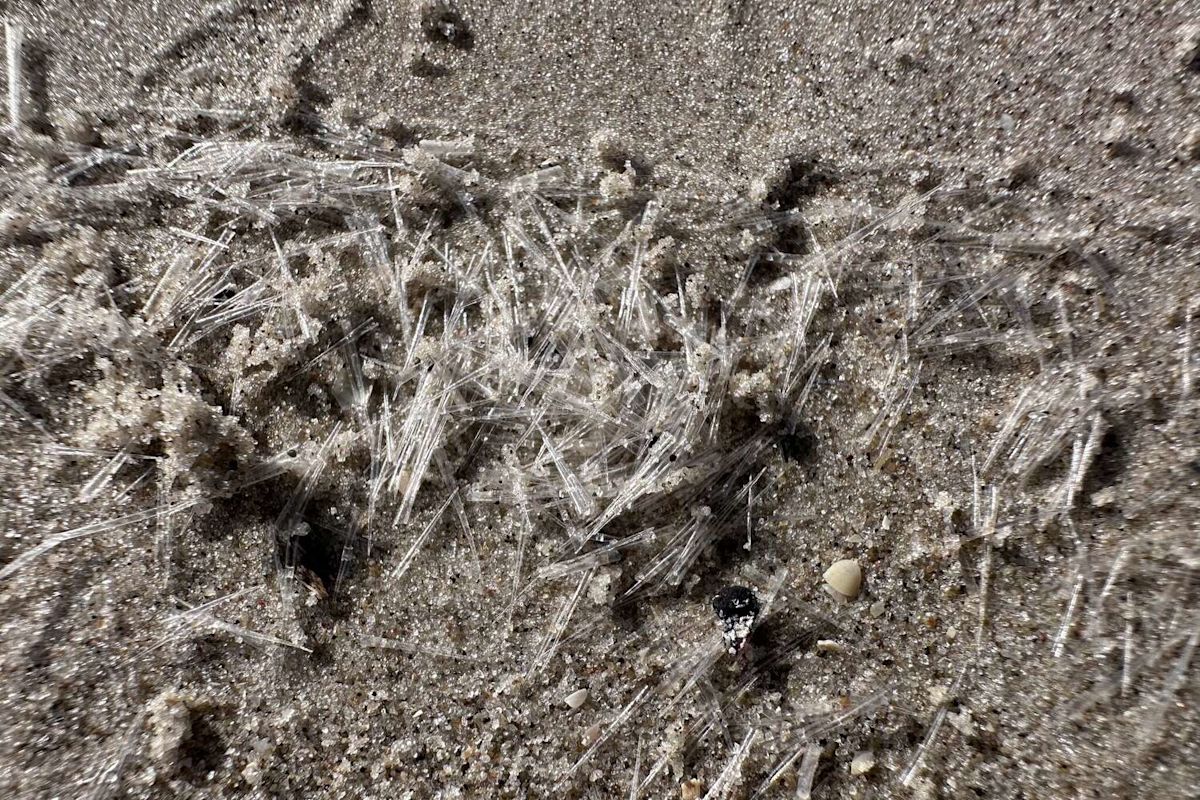
The name “sea butterflies” might conjure images of colorful insects fluttering over the water. What’s washing up on Texas beaches lately is more like tiny shards of glass.
“We started getting reports from beachgoers who thought fiberglass was washing ashore because the tiny shells were sticking in their skin,” Jace Tunnell, director of community engagement at the Harte Research Institute, told Chron. “Reports have come in from Galveston, Mustang Island, and Padre Island, so this appears to be happening along a pretty large stretch of the Texas coast.”

Beachgoers have reported the tiny shells from Galveston to Mustang and Padre Island. (Jace Tunnell)
When Tunnell went out to investigate, he quickly found out why beachgoers were confused.’
“The shells were literally sticking in my fingers like tiny pieces of fiberglass,” he said.

Jace Tunnell investigated reports of fiberglass-like material washing ashore and found tiny sea butterfly shells. (Jace Tunnell)
The sharp debris isn’t fiberglass at all. It’s the tiny, delicate shells of millions of marine snails known as sea butterflies that are washing up along the Texas coast.
Known as pteropods, sea butterflies are tiny, free-swimming sea snails that spend their lives drifting and swimming in the open ocean. Tunnell said there are more than 160 species worldwide and dozens in the Gulf of Mexico.
“The snail’s foot is modified as ‘wings’ that allow the snail to swim in the water… like a butterfly,” Tunnell wrote. “The shells are sharp and can easily stick in your skin.”

Sea butterflies are tiny, free-swimming marine snails found in the open ocean. (Jace Tunnell)
While their delicate, clear shells may look harmless in the water, they can leave behind needle-like debris on the sand that can be painful to step on or rub against while sitting on the beach.
And there are plenty of them. In a single pinch of sand and shells between his fingers, Tunnell counted about 50 sea butterflies.
Ocean currents, winds and waves can concentrate enormous numbers of small drifting organisms along the shoreline. Tunnell said possible reasons so many washed up across miles of the Texas coast could include low dissolved oxygen or changes in ocean conditions and currents.
Sea butterflies are also part of the marine food web, serving as prey for fish and other marine animals, including some whales.

Beachgoers have reported the tiny shells from Galveston to Mustang and Padre islands. (Jace Tunnell)
The strange sight had some beachgoers connecting the dots. One person responding to Tunnell’s report said they recently were walking along the shore at Padre Island National Seashore when they repeatedly felt unexplained “little sharp pokes” underfoot.
In an odd coincidence, they’re not the only “butterflies” to swarm the Texas coast this summer. In June, thousands of American snout butterflies filled the skies over North Padre Island near Corpus Christi. Their dramatic population boom was likely fueled by a prolonged drought followed by heavy rains.
More Parks & Wildlife
Crime | Texas man sentenced for shooting, killing bald eagle in Porter
Nasty | Houston Interactive Aquarium USDA violations include euthanized animal
New Beginnings | Houston Audubon changes name to Birds Houston after 57 years
Water | Texas beaches see a surge of stranded baby sea turtles
For the latest and best from Chron, sign up for our daily newsletter here.
This article originally published at Texas beaches are getting swarmed by some very strange ‘butterflies’.