
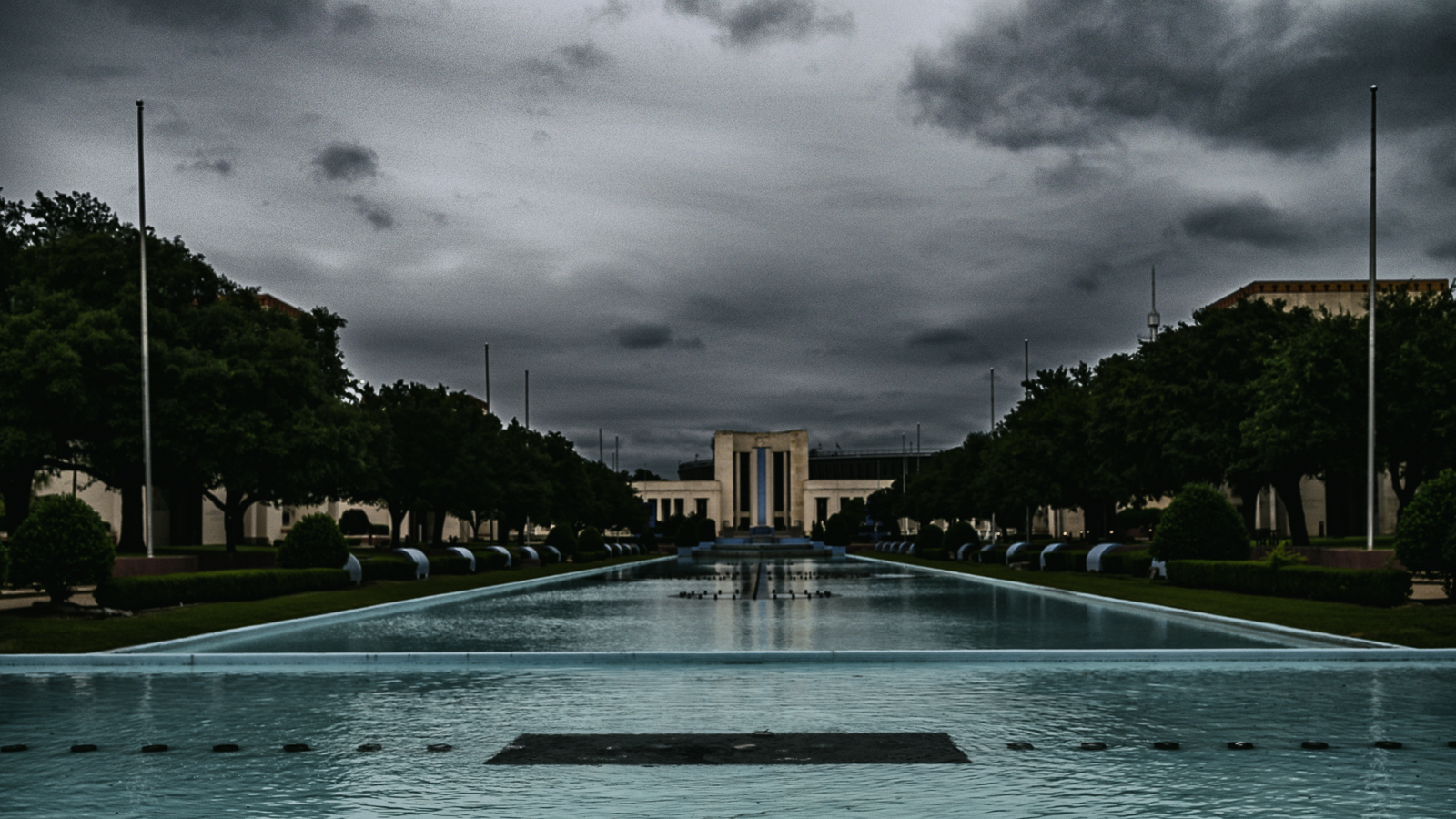
Nearly a year after resuming control of the grounds, Dallas officials are touting gains made at Fair Park. However, millions of dollars in deferred maintenance still need to be addressed.
Described by the Dallas Park and Recreation Director in March as “the toughest political issue to solve in this city,” Fair Park came back under city control in 2025. Fountain ducts were broken, paint was chipped and A/C units were on their last legs when the park department took over management last September, but now, they say progress has been made.
At a Thursday meeting of the Park and Recreation board, park department officials gave one of the most comprehensive updates yet on strides made since resuming control of the home of the State Fair of Texas.
When the city resumed control last year, the deferred maintenance total stemming from years of neglect stood at roughly $48 million, according to the briefing. Officials have made gains on long-needed maintenance projects, park staff told the board, which is why the total estimate for deferred maintenance at the park now stands at $44 million. It’s a dent, but after years of stagnation and decay, the department is taking whatever progress it can get.
Sign up for the This Week’s Top Stories newsletter to get the latest stories delivered to your inbox
THANK YOU!
You’re all set.
CLOSE
“From where we were, to where we are today, it’s pretty dramatic,” Deputy Park Director Ryan O’connor told the board.
Fixing what’s foundationally broken
Fair Park, a sprawling 277-acre campus of architecturally significant Art Deco exposition halls, museums and entertainment venues, has long flustered city officials seeking a long-term solution to sustainably maintain the grounds in good condition. Plans to shift toward a more privatized model for management of the grounds infamously floundered under a public-private partnership with Fair Park First, a nonprofit contracted to manage the campus in 2019. One of the nonprofit’s vendors, the Oak View Group, was later found to have misused $5.7 million in donor funds after an audit, which ultimately contributed to the city’s decision to terminate the contract.
As Director John Jenkins told the park board and has said previously, privatization fell short at Fair Park, as did city-run management. That’s why the park’s future will rely on a hybrid model with city-led management of large-scale projects and maintenance — something which suffered under private management. Partnering with nonprofit or private entities could, as the department hopes, create revenue, activate underused buildings and draw crowds year-round, which is already happening, Jenkins said.
“I think we’re seeing that we laid out a plan one year later you are actually seeing the results,” Jenkins said.
The department has focused on stabilizing operations at the park, department leadership told the board, and will continue to pursue partnerships with long-term contracts to turn the campus into a year-round hub of activity. More partners will create more revenue, Jenkins said, which the department hopes will help the grounds become self-sustaining. Jenkins has been outspoken in his desire to create independent revenue streams across the system at a time when the city is making large cuts to general-fund departments amid declining revenues and rising costs.
“Moving to a model built on strong public-private partnerships, community-focused programming, and a commitment to transparency and accountability was the right call for Fair Park,” Adam Bazaldua, who represents the Fair Park area on city council, said in a release. “This first year has been about getting the fundamentals right, investing in the park, creating economic development opportunities and ensuring it remains active and accessible year-round.”
Fixing what’s literally broken
Since taking over operations last year, the department has resolved $3.7 million in deferred maintenance while keeping costs within an $18.6 million budget, Fair Park General Manager Brett Wulke told the board. Funding for projects completed around the park came from the department’s general fund allocation, multiyear funds and money from past bond programs, according to the briefing.
The African American Museum has received $4 million in repairs over the past year, leadership told the board, including a complete overhaul of the building’s lighting system funded by a Transportation and Public Works grant. Roughly 13,000 square feet of concrete has been replaced in front of the music hall, and repairs have also been made to the water wheel fountain at the Old Mill Inn.
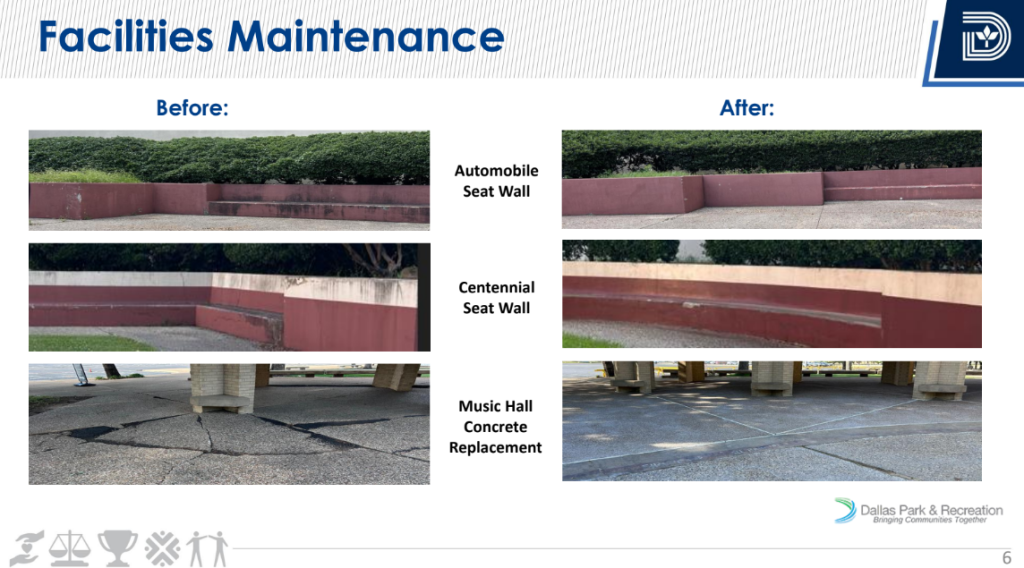 No, the visuals offered were not substantial. But officials say that, at this point, they wouldn’t be, as much of the work has been behind the scenes.
Employees have begun power washing building facades and other concrete structures to remove stains and wear. While the briefing included photos of a few completed projects, Wulke said they couldn’t offer more visuals because much of the work has been incremental, especially with projects like heating pipe replacement and HVAC repairs.
“I’m not gonna have a lot of pretty pictures this time around ’cause a lot of this is in the background, but it is vital to lay the foundation to move us forward,” Wulke said.
Fair Park has received several historic designations, including being only one of two National Historic Landmarks in the city of Dallas, with Dealey Plaza being the other. As a result, more visible projects come with additional hurdles. The department plans to restore sculptures and portico murals and has submitted a list of paint colors for approval by the Fair Park Task Force, the Office of Preservation, and the Texas Historical Commission, according to the briefing.
The department is also working on major repairs to Fair Park’s water and irrigation system. Officials told the board that replacements are 90% complete, after which water use could be cut by 30% through reducing overspraying and pooling. Those repairs will also pave the way for future landscaping projects to further improve the grounds, Wulke said.
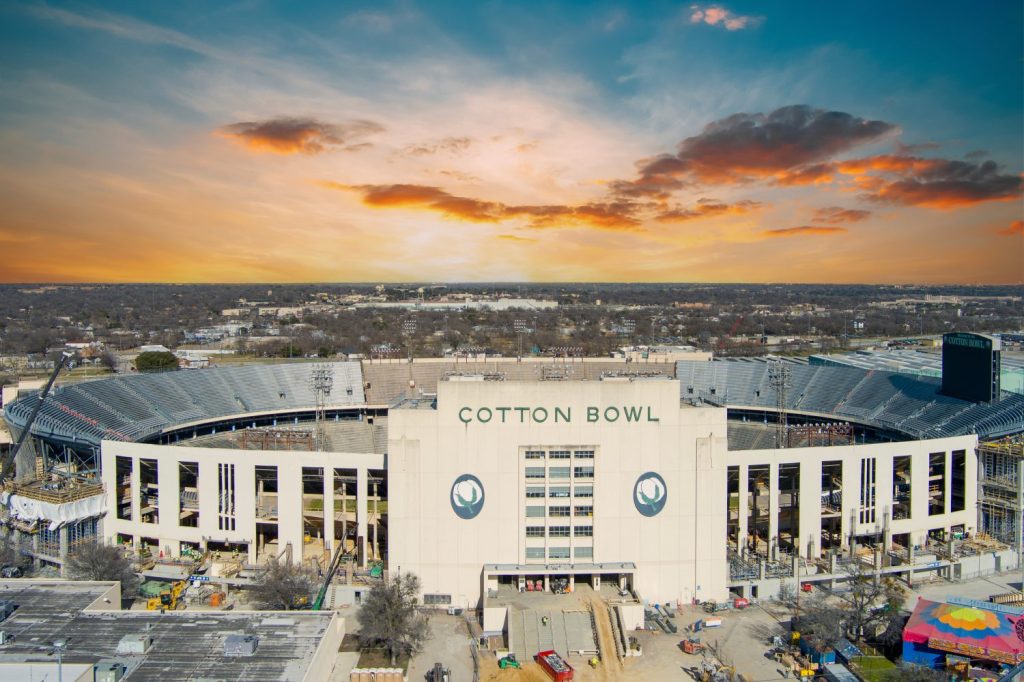 Aerial shot of Cotton Bowl Stadium at Fair Park, where 1994 World Cup matches were played.
Still, the $44 million in deferred total remains staggering, and some advocates have questioned whether it truly reflects the cost of restoring the grounds. Routine maintenance also remains, which the department is looking to supplement through a long-term contract with an outside entity. Voters approved a 2% hotel occupancy tax allocation for the upkeep of the Convention Center and Fair Park in 2022, which officials are counting on for future projects. In 2025, the Cotton Bowl received a $140 million renovation, the largest investment in the stadium’s history, which was partially financed by the hotel tax allocation.
“Don’t take the foot off the pedal, don’t take it off,” JR Huerta, District 1 park board member, said. “I know it’s gonna be a lot more work, but we got a long way to go still.”
Year-round revenue
One longstanding concern for city leaders is how to draw crowds to Fair Park year-round. Campus activations were a major pillar of the department’s plan to revitalize the grounds, and officials told the board they’ve made strides in that area as well.
Thousands have attended events at the park in the last year, according to the presentation, including Monster Truck shows, the FIFA Fan Festival, concerts and the Foodieland Festival, which officials said drew over 46,000 people to the grounds. Event revenue projections are decidedly outpacing those from previous years, officials said.
Community events have also been prioritized to connect with residents in the surrounding area. Officials cited weekly additions such as farmers markets, yoga inside the Cotton Bowl, and a collaborative event with Sunny South Dallas as evidence of engagement. Daniel Wood, the area’s park board representative, lauded the department’s improvements so far but said there was still room to improve its outreach to the community.
“The one thing that remains is that we need a lot more support from the community,” Wood said at the meeting. “There’s not a lot of community involvement, a lot of community support. We have a couple of events happening, but we don’t have a lot of interaction with the actual community.”
The department will look to further shore up its event offering, and officials have confirmed football games, holiday activations, and a two-day music festival for New Year’s Eve and Day. Long-term contracts for building leases and event marketing, concessions and booking will be a part of that push, according to the department. In March, the city council approved a contract with Visit Dallas to provide turn-key booking and marketing services at Fair Park. Staff told the board that Visit Dallas has only recently begun work on those initiatives, with Jenkins saying the entity “hasn’t even gotten warmed up yet.”
One major part of the department’s plan is a proposal to redevelop 40 acres of parking lots on the northeast side of the campus into a multipurpose district with entertainment venues, retail, lodging and parking garages, which Jenkins told the Observer in April will take on a western feel compatible with existing structures. Thursday’s briefing offered little news on that front, although the department is currently seeking proposals on the project, parks officials told the board, with updates coming at later meetings.
While the briefing offered some substantial updates on completed projects, much of the work will come as the department moves from stabilization to “standardization, modernization and optimization” in its second year of management, officials said. Wood, who has been outspoken in his desire to see Fair Park live up to its potential, told the board he feels confident in the department’s plan.
“This next year we’re gonna see it flourish, I believe,” Wood said. “Maybe another year of groundwork, cause you’ve still got a lot of finishing touches.