
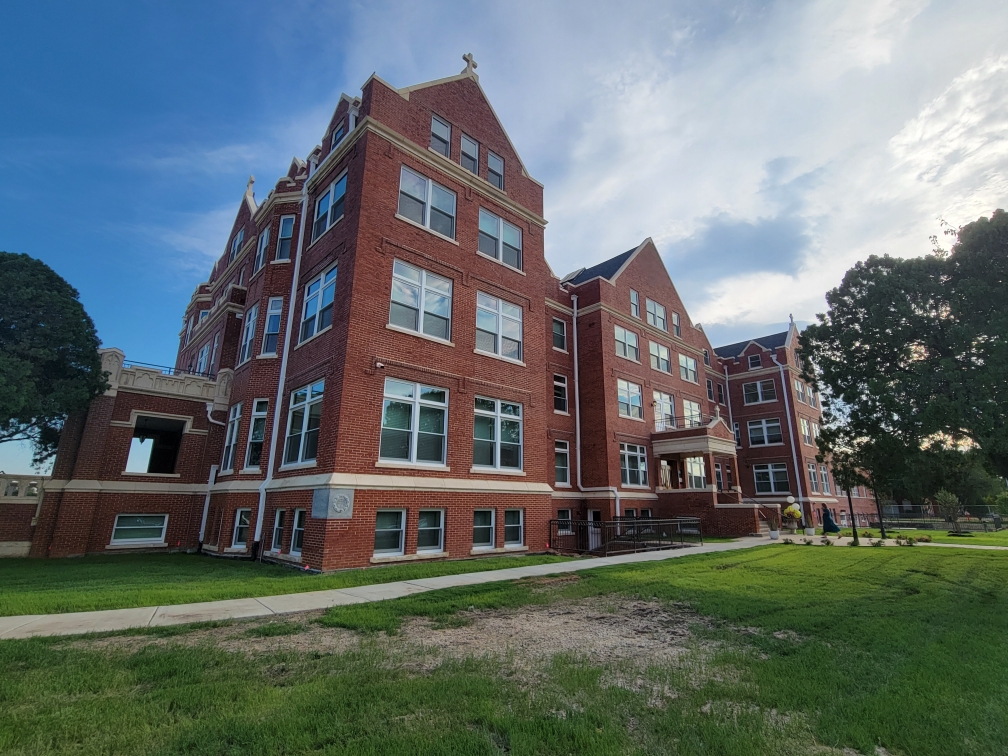
Victory has been declared in the decadeslong quest to save a historic, castlelike landmark in south Fort Worth.
The striking red-brick, five-story Gothic Revival building — once known to many as Our Lady of Victory Academy — is being reborn as a community hub to house dozens of families.
The new name of the complex is Maren Grove, and its freshly remodeled and painted corridors have been transformed into mixed-income affordable housing, modernized into 90 studio, one-, two- and three-bedroom units, some with balconies or lofts. The redevelopment also includes an adjacent residential building designed to emulate the former Catholic boarding school.
 A one-bedroom unit at Maren Grove features a balcony over the front entrance of the former Catholic boarding school. (Eric E. Garcia | Fort Worth Report)
The original building at 801 W. Shaw St. was built in 1910. The building was briefly a residential artists studio and before that, the centerpiece of a massive diocese complex that is now carved into dusty parcels, with dirt piles blowing in the wind, awaiting future redevelopment off Hemphill Street.
Pivotal Residential is busy clearing land there, making way for its plans to build a 348-unit affordable housing complex at 3320 Hemphill St. According to the company’s filing with the Texas Department of Licensing and Regulation, the $33.5 million project will have multiple garden-style apartment buildings across the remaining 13 acres of the Catholic complex.
Walking up seasoned wooden stairs, moving floor to floor during a tour of Maren Grove, former owner Ray W. Boothe and wife Genell marveled at the intricate restoration of key features of the building they fought for over 18 years to save.
It was worth it, they said. Especially since an army of West Texas housewives once spent months cleaning it.
‘A place to call home’
Dozens of community, city and business leaders, along with new residents, filled the building’s former sanctuary on Aug. 27 to celebrate the complex’s grand opening.
Maren Grove, which gets its name from a modern variant of Mary plus a synonym for forest, consists of 90 units for families making between 30% and 80% of the area median income. The complex is located in the Shaw-Clark neighborhood near the Victory Forest Community Center.
 A one-bedroom unit at Maren Grove features modern construction within a historic building. (Eric E. Garcia | Fort Worth Report)
The project received 9% housing tax credits through the Texas Department of Housing and Community Affairs as well as federal and state tax credits.
Amenities include a fully furnished clubhouse and community room, business center, fitness facility and outdoor playground.
An on-site prekindergarten program for up to 40 students is free to residents but available at a low cost to other neighborhood children. Developer O-SDA Industries partnered with the nonprofit United Community Centers for the program.
Sametra Walton, a Maren Grove resident, said there is a feeling of hope and community spirit at the complex.
“Since moving here, things have changed for the better,” Walton said.
 The bedroom of a Maren Grove unit is shown on a tour of the historic building. (Eric E. Garcia | Fort Worth Report)
State Rep. Ramon Romero, D-Fort Worth, hadn’t been in the building since he was in the fourth grade. He said the development will help people at a time when housing costs are skyrocketing.
“Yes, the affordable housing crisis is still growing at an alarming rate,” said Andy Markenson, director of acquisitions for Redstone Equity Partners, one of several partners on the project. But, he said, 90 families’ lives will change for the better.
“Most importantly, it’s a place to call home,” he said.
 Community and business leaders involved in the Maren Grove development participate in a ribbon-cutting ceremony on Aug. 27, 2026. (Eric E. Garcia | Fort Worth Report)
Ray Miller, senior vice president with Amergy Bank, said that institution is committed to helping finance affordable housing solutions.
The bank has provided a half billion dollars to produce 10,000 affordable housing units across Texas, Miller said.
Andrea Glispie, senior manager of community development for Westlake-based Charles Schwab, said the company supported the pre-K program with a $5,000 grant.
“This development just takes my breath away,” she said.
Council member Elizabeth Beck, whose mother grew up in the neighborhood, described Maren Grove as a “bastion of our community” that is now a beautiful place that will provide access to well-paying jobs, since it is near a high-use transit corridor.
 Maren Grove’s new companion residential building is visible from a balcony at the former Our Lady of Victory Academy site. (Eric E. Garcia | Fort Worth Report)
“You have made the rest of Fort Worth proud,” she said.
Megan Lasch, president of O-SDA Industries, said it was important to restore the building and keep special details. She said repair work to the former sanctuary’s windows came in over budget but the city of Fort Worth covered the remaining costs.
“We were able to preserve something important to the community,” Lasch said.
The project involved many partners dedicated to preservation and affordable housing.
“I see what happens when a lot of people get together with some grit,” she said.
A cornerstone of Fort Worth Catholic education
The Maren Grove building is a cornerstone in the history of Catholic education in Fort Worth.
In 1908, with downtown school St. Ignatius Academy overcrowded, the Sisters of St. Mary of Namur purchased 15 acres of the Shaw brothers’ dairy farm on a slightly elevated spot at the end of the Hemphill Street streetcar line on what was then the southern edge of the city. The Sisters of St. Mary of Namur, formed in the aftermath of the French Revolution at Namur, Belgium, in 1819, is focused on education. They came to Texas in 1873.
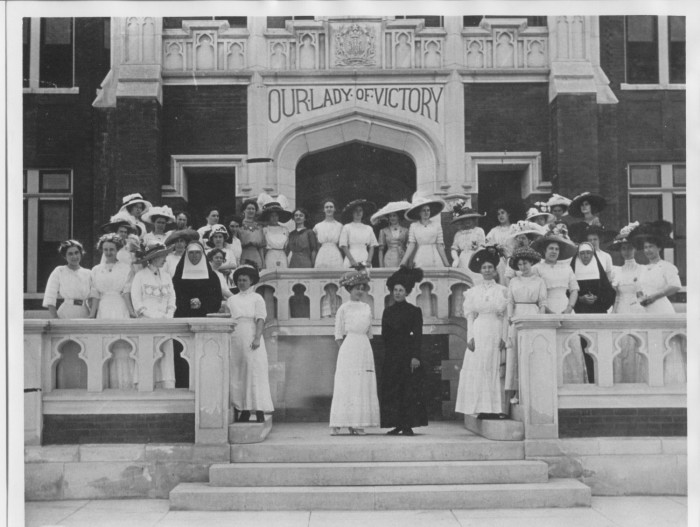 Students and nuns stand on the steps in front of Our Lady of Victory Academy in 1911. (Credit | The Portal to Texas History and Tarrant County College NE, Heritage Room)
The plan for the open field in Fort Worth was to build women a place for an education, with a dorm for up to 150 students. The building is said to have cost between $160,000 and $200,000 or about the equivalent of $7.3 million in 2026 dollars, according to several sources. The five-story structure designed by Sanguinet & Staats was built of red brick with white stone trim. The same firm also designed the nearby St. Mary of the Assumption Catholic Church at 509 W. Magnolia Ave.
Our Lady of Victory, known locally as OLV, served students from elementary to, eventually, junior college level. When it opened in 1910, the school had 72 students, with 31 living in the new building. The curriculum included English, German, Latin, French, science, religion, art, elocution and physical education.
 Our Lady of Victory Academy opened in 1910 in south Fort Worth. (Credit | The Portal to Texas History and Tarrant County College NE, Heritage Room)
Our Lady of Victory was also key to the growth of the medical community in Fort Worth. By 1944 the college offered courses in chemistry, zoology, biology, botany and bacteriology. From 1935 to 1956, Our Lady of Victory was affiliated with St. Joseph’s School of Nursing, part of St. Joseph’s Hospital, the oldest hospital in Fort Worth and located where part of JPS hospital is now.
In 1953, the Sisters of St. Mary of Namur opened the elementary and middle school which was integrated in the early 1950s, long before integration was federally mandated. The school closed in 2021. It was demolished in 2025 to make way for the apartment complex from Pivotal Residential.
In 1956, the junior college moved to the University of Dallas in Irving. In the 1960s the high school was incorporated into Nolan Catholic High School. By 1988, the upkeep of the building was too costly, so the convent was closed and the sisters moved into a newer building located just to the west of it on the same property.
Saving a community landmark
Boothe, president and principal architect of the firm bearing his name, said the nearly two-decade effort to save the building was worth it. He admired the renovation and saw glimpses of the work that he had done on the building.
 Ray E. Boothe, president of Boothe Architects Inc., center, talks with a couple during tour of a Maren Grove unit with a winding staircase to a loft. (Eric E. Garcia | Fort Worth Report)
Eighteen years ago, the building was in danger of being demolished and efforts were made to get someone to buy or renovate the site, Boothe said.
There were no offers, so the Boothes took on the effort to get financing for the renovation.
“I scrounged up some friends, Genell and I, and borrowed a little money and bought it,” Boothe said, adding that they paid about $240,000 for the building — about the same as demolition would have cost then.
At the time, the former school had already been stripped and most items sold. Boothe said Fort Worth leaders such as former mayor Kenneth Barr, Historic Southside supporter Joan Kline, former mayor and U.S. Rep. Kay Granger, and former state Sen. Wendy Davis supported the effort to preserve the building.
 A loft with skylights is a feature of one Maren Grove unit. (Eric E. Garcia | Fort Worth Report)
As renovation work began, Genell Boothe said she recruited dozens of West Texas housewives to clean the 65,000-square-foot building, noting the couple’s ties to the area.
“It was a continuous job,” she said. “You started at one end, and by the time you finished at this end, it was time to start at that (other) end because there was construction so there was always dust and so forth. We were always trying to clean that up.”
 Downtown Fort Worth’s skyline can be seen from a balcony at Maren Grove affordable housing complex. (Eric E. Garcia | Fort Worth Report)
The Boothes said they didn’t have any days off while they remodeled the building. Their son, now 34, grew up in the building doing construction work as a teenager and later lived in one of the artists’ lofts.
“We spent a lot of time here, definitely,” Genell Boothe said.
Eric E. Garcia is senior business reporter at the Fort Worth Report. Contact him at eric.garcia@fortworthreport.org.
Robert Francis is business editor of the Fort Worth Report. Contact him at robert.francis@fortworthreport.org.
At the Report, news decisions are made independently of our board members and financial supporters. Read more about our editorial independence policy here.
This <a target=”_blank” href=”https://fortworthreport.org/2026/09/06/a-place-to-call-home-historic-fort-worth-catholic-school-building-revitalized/”>article</a> first appeared on <a target=”_blank” href=”https://fortworthreport.org”>Fort Worth Report</a> and is republished here under a <a target=”_blank” href=”https://creativecommons.org/licenses/by-nd/4.0/”>Creative Commons Attribution-NoDerivatives 4.0 International License</a>.<img src=”https://i0.wp.com/fortworthreport.org/wp-content/uploads/2021/04/cropped-favicon.png?resize=150%2C150&ssl=1″ style=”width:1em;height:1em;margin-left:10px;”>
<img id=”republication-tracker-tool-source” src=”https://fortworthreport.org/?republication-pixel=true&post=742386&ga4=2820184429″ style=”width:1px;height:1px;”><script> PARSELY = { autotrack: false, onload: function() { PARSELY.beacon.trackPageView({ url: “https://fortworthreport.org/2026/09/06/a-place-to-call-home-historic-fort-worth-catholic-school-building-revitalized/”, urlref: window.location.href }); } } </script> <script id=”parsely-cfg” src=”//cdn.parsely.com/keys/fortworthreport.org/p.js”></script>