
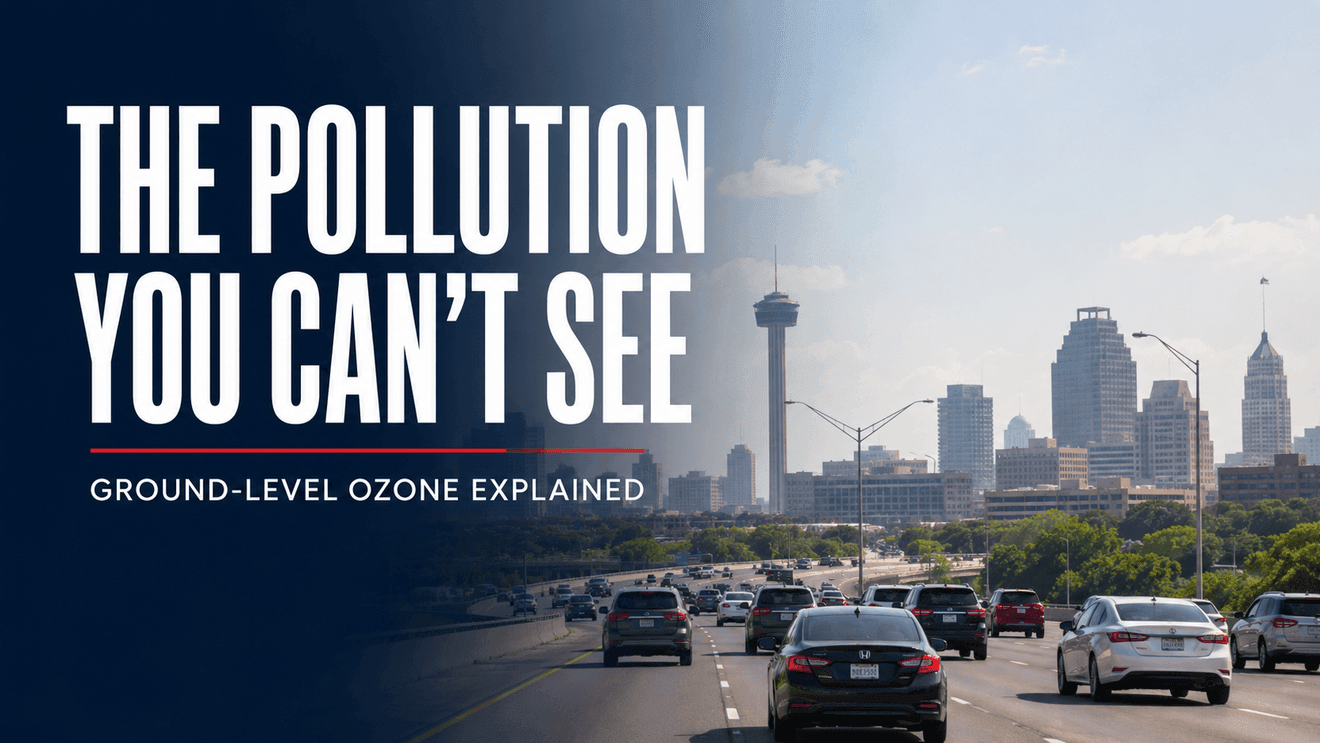
Ground-level ozone isn’t released from a tailpipe. Here’s how vehicles contribute to it—and why Bexar County is beginning emissions testing.
Your car does not emit ozone.
That fact may make Bexar County’s new vehicle-emissions testing requirement seem confusing. If ozone is the pollution problem, why test cars that do not directly produce it?
The answer can be found in how ground-level ozone forms.
It is not usually released directly into the atmosphere. Instead, it develops when other pollutants react in heat and sunlight.
That chemistry—and Bexar County’s repeated difficulty meeting federal ozone standards—is why qualifying vehicles will require emissions testing beginning November 1, 2026.
Good Ozone and Bad Ozone
Ozone is a gas composed of three oxygen atoms.
High in the atmosphere, the ozone layer protects Earth from harmful ultraviolet radiation. That is the “good” ozone people often learn about in school.
Ground-level ozone is different.
It forms in the air people breathe and is the primary component of smog. High concentrations can irritate airways, worsen asthma and make outdoor activity more difficult—especially for children, older adults and people with respiratory conditions.
Where Ground-Level Ozone Comes From
Ground-level ozone forms when two broad groups of pollutants react in sunlight:
Nitrogen oxides, commonly called NOx
Volatile organic compounds, or VOCs
Those precursor pollutants can come from many sources, including:
Cars and trucks
Power plants
Industrial operations
Construction and off-road equipment
Gasoline vapors
Paints, solvents and some consumer products
Diesel engines and backup generators
Hot, sunny and relatively stagnant weather can speed up the reactions and allow ozone to accumulate. That is the weather pattern we have every summer.
That is why San Antonio’s worst ozone days frequently occur during warm-season weather.
Ozone can also form downwind from where its ingredients were originally released. The pollution measured at one location may reflect emissions from across the metropolitan area or beyond it.
Why Bexar County?
The EPA designated Bexar County as a nonattainment area for the 2015 eight-hour ozone standard in 2018.
In plain language, monitored ozone concentrations exceeded the federal health-based standard. We went way over the legal limit.
That designation triggered a formal state planning process. Texas must demonstrate how the area will reduce emissions and work toward meeting the standard.
The resulting plan contains several components, including the new vehicle inspection and maintenance program.
The testing requirement was not created because cars are San Antonio’s only source of ozone-forming pollution.
They are not.
It was added because motor vehicles are one controllable source of the pollutants involved in ozone formation.
What the Test Is Looking For
Modern gasoline powered vehicles contain high-tech pollution-control equipment.
When those systems operate properly, they reduce harmful emissions. When a component fails, however, a vehicle can release far more pollution while appearing to drive normally.
The Bexar County test will use the vehicle’s onboard diagnostic system (OBD) to determine whether its emission controls are working properly.
A glowing check-engine light may indicate a problem involving the catalytic converter, oxygen sensors, fuel system or another emission-related component.
Beginning November 1, gasoline-powered vehicles between two and 24 years old that are registered in Bexar County generally must pass the emissions inspection before registration.
“Is This Just a Money Grab?”
It is fair to question the cost and administration of any new government requirement.
The reason for this program is well documented: Bexar County’s federal ozone classification requires Texas to implement an approved air-quality strategy.
Inspection stations will collect fees, but that fact alone does not mean the pollution problem was invented to generate money.
The better questions are whether the program is administered fairly, whether drivers receive clear information and whether measurable emission reductions follow.
Those are excellent accountability questions.
“What About Data Centers?”
Data centers are a legitimate part of the broader air-quality discussion.
They can require enormous amounts of electricity, and their backup diesel generators can emit nitrogen oxides when operated. The ultimate air-quality impact depends on the facility, its power supply, generator use and applicable emission controls.
But identifying emissions connected to data centers does not eliminate emissions from malfunctioning vehicles.
Air quality is not a contest in which only the largest suspected polluter matters. Different sources are tested through different permits, regulations and control programs.
The public should expect officials to examine all significant contributors—not select one and ignore the rest.
“What About Diesel Trucks?”
Diesel engines can be important NOx sources. Heavy trucks, buses, construction equipment and backup generators deserve appropriate regulation and enforcement.
Bexar County’s new program, however, applies to qualifying gasoline-powered vehicles.
That does not mean diesel emissions are harmless. It means they are handled through different state and federal requirements.
Pointing to diesel trucks raises a valid question about the total pollution inventory, but it does not explain why a gasoline vehicle with broken emission controls should remain untested.
“Isn’t Light Pollution a Bigger Problem?”
Light pollution is real, but it is a different environmental problem.
Excessive nighttime lighting can affect wildlife, obscure the night sky and waste electricity. Producing that electricity may indirectly create air pollution, depending on the energy source.
The light itself, however, is not what forms ground-level ozone.
Ozone pollution and light pollution are not the same however, the both deserve attention.
One Part of a Larger Plan
Emissions testing will not solve San Antonio’s ozone problem by itself.
It was never designed to.
The program targets one category of avoidable emissions: qualifying gasoline vehicles whose pollution-control systems are malfunctioning.
Industrial sources, power generation, diesel equipment, rapid development and emerging demands such as data centers remain legitimate subjects for public scrutiny.
The most accurate conclusion is not that cars are responsible for everything.
It is that cleaner air requires addressing multiple sources at the same time.
Testing vehicles is one part of that work—not the entire solution.