

2026-09-08 05:00
5:00
September 8, 2026
am
America/Chicago
Republish this story
SAND BRANCH, TEXAS — Days after a large grassfire ripped through four acres of land in Sand Branch, Christina Parks is exhausted.
On August 29, brush, trash and debris on a vacant property fueled the blaze, and two nearby structures were damaged. There were no reported injuries, though some residents were forced to temporarily evacuate. After two days of containment efforts by Dallas Fire-Rescue and mutual aid crews from nine neighboring areas, the fire was finally suppressed, according to the department. For Parks, who lives in Sand Branch, it’s another blow to the already struggling community that lacks clean accessible water and makes disasters such as this more difficult to handle.
“I’m drained physically and mentally,” she told The 19th. Amid the chaos, she’s once again assumed her role as a community leader. With the assistance of other volunteers and community organizations — some of whom traveled as long as two hours — Parks is taking the steps to care for her neighbors in the immediate aftermath of the fire as she grapples with their ongoing need for basic necessities.
Sand Branch is an impoverished pocket of land tucked away in Seagoville, Texas, roughly 14 miles southeast of downtown Dallas. It has been without safe drinking water for decades, and it does not have a sewage system or even trash collection. Historically, it’s a predominantly Black community.
Parks has heard stories about a time when more people lived in Sand Branch — that it was once a happy place. When she first arrived four years ago, more young children like her own 12-year-old daughter had also lived there. But since moving to the unincorporated area, she’s seen families go and seen her neighbors struggle. Some people left to start anew in places where resources are easier to come by.
Driving along the thoroughfare, as asphalt highways fade into open plains, the area slowly begins to resemble a scene from a bygone era. Horses freely roam along unpaved trails. Abandoned dogs drift through the community. Some residents have begun installing solar solutions to supplement the lack of streetlights.
“It’s like you took a step back in time,” Parks said. She is one of the few residents who is raising a child in the area. In 1998, the Texas Almanac listed a population of 400. Today, residents estimate that those numbers have shrunk to about 150 people.
“What you’ll hear the older people say,” Parks said, “is that they’re just trying to wait till we all die so they can have our land. And that’s sad because, if you think about it, why else? Why are there no children? Why is there nothing here?”
Despite its proximity to the Dallas Water Utilities Plant, which lies near Sand Branch’s perimeters, clean running water has remained out of reach for the residents despite decades of efforts.
Parks, 46, would like to see Sand Branch become a place where people can envision raising their own families. But, as residents wait for what they’ve described as “forever water” — that is, water infrastructure — with no clear path forward, she’s now trying to preserve what’s left of her community.
“We’re going through a crisis every single day,” she said. “In Sand Branch, you can’t focus on the future like, ‘Hey, what are your goals five years from now,’ because you’re really just trying to get through the now. You’re trying to make it to the next day.”
Parks goes door-to-door with bottled water and groceries for her neighbors each day as part of her work with the nonprofit that she created in 2020 called C’s Corner and Thrift, which serves as a food pantry and thrift store.
She moved to Sand Branch from Dallas after discovering that she required a full hip replacement. In need of an affordable place to recover, she chose to relocate her family, including her three children, to the rural hamlet after stumbling across a Facebook post. “The rent was way cheaper than being in town, and what we did was we bought a couple of campers,” she said. Today, her family owns four.
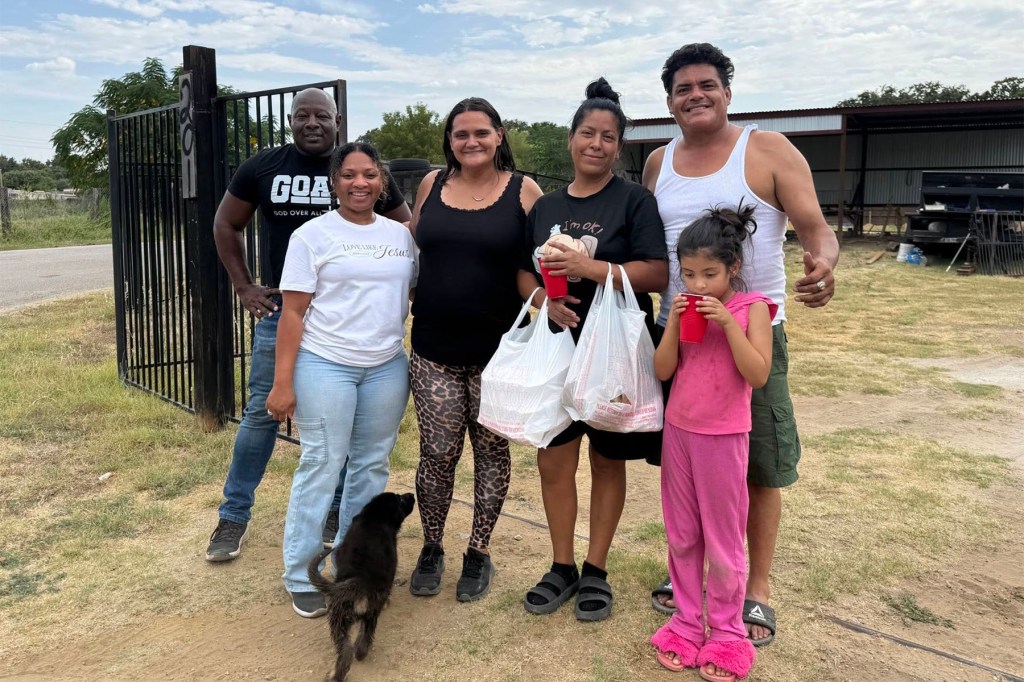 Christina Parks (center) poses with Sand Branch residents during a “No One Goes to Sleep Hungry in Sand Branch” distribution. The initiative provides free meals to people who have no way to heat food at home.
(Courtesy of Christina Parks)
It wasn’t until they arrived, however, that Parks discovered the community had no clean water or functioning sewage system. She told The 19th that, upon moving to the area, her health deteriorated and the surgery she initially moved to Sand Branch to recover from was temporarily stalled due to ongoing health complications.
Still, to the extent that her body would allow, Parks began to devote her time to her new neighbors. Occasional hot meals that she would pass out on Thanksgiving and Christmas turned into managing a food pantry and grocery runs for people in her neighborhood. Soon, she had built an entire operation.
Eventually, Parks’ health stabilized enough for her to get the necessary surgery, which she has since recuperated from. But still, Parks has remained in Sand Branch alongside her family. “We ended up staying out here even though we knew that there was no water and sewer because, in my brain, I knew that once I got better, Sand Branch needed me.”
Parks’ nonprofit was originally born out of a desire to help mothers and babies in Pleasant Grove — her old neighborhood in Dallas — where she would provide items such as children’s clothing and formula. Upon moving to Sand Branch, where children are scarce, she pivoted.
More from The 19th
Though many organizations have poured into Sand Branch over the years, as a permanent resident, Parks’ contributions bring a familiarity and trust. In the past six months, she started the “No One Goes to Sleep Hungry in Sand Branch” initiative, which delivers free meals to people who have no way to heat food in their home. Neighbors are able to visit her nonprofit’s site — a 13-by-20 portable carport planted in front of her home — every day to pick up essentials like food, water or pet food.
In conversation with residents and volunteers, the mention of Parks’ name and efforts inspires appreciation. “Christina, you know, she does a lot of food. That was a blessing. She even helped my dog,” said one man named Hymie, who moved to Sand Branch three months ago.
However, the transition hasn’t been easy. Both she and her husband live on a fixed income, and managing the nonprofit is their full-time work while they are both full-time students. Parks is earning her bachelor’s in health and human services. There is no stream of money coming in, and their organization relies entirely on donations. Last year, her family’s electric generator stopped working during the Texas summer. When they went to use their second generator, it, too, broke.
Parks straddles her role as a mother to her children and, in some aspects, to her community. But, being a parent, especially to her daughter, in an area as secluded as Sand Branch has proven to be grueling.
“I know it’s difficult for us, so imagine a little girl.”
Many Sand Branch residents have access to wells but, oftentimes, they do not function properly or the poor quality means it is used for bathing or flushing, but not drinking. In 1997, the Texas Natural Resource Conservation Commission — now the Texas Commission on Environmental Quality — found that 10 water wells in the community were at risk of contamination, exhibiting high levels of coliform bacteria and, in one case, E. coli, according to records from the Dallas County Department of Health and Human Services. The commission also found metals including iron and manganese in some of the wells.
Because of the community’s shallow well construction, high water table and the persistence of on-site waste disposal, government officials determined that the wells posed a health risk and would not be allowed for public use, effectively removing one of the only reliable water sources the community could easily access. Despite this, some residents like Parks still use their wells.
More from The 19th
Residents and organizations have made several attempts to bring clean water to their community. Elected officials like Democratic state Rep. James Talarico, who is running for U.S. Senate, brought heightened national attention to the residents’ living conditions.
“Ninety-four families call this majority-Black community in Dallas County home. For years, they have lived without safe, clean water or basic sewer infrastructure because the people in power have failed them,” Talarico said in a written statement to The 19th. “In the richest country on earth, that is a moral failure. Access to clean drinking water is a basic human right. It’s time for change. In the Senate, we can tackle our state’s growing water crisis by funding the infrastructure needed to get safe, reliable water to communities like Sand Branch.”
Action plans have been drawn, and even some funding disbursed. In August 2020, the Texas Water Development Board provided $450,000 to the Sandbranch Development and Water Supply Corp (SDWSP), a volunteer-run corporation.
As of this August, however, the project has not progressed. In an emailed statement, the SDWSP told The 19th that the organization is still completing preliminary analysis and planning with the initial funding and is currently pursuing additional funding for design and implementation.
In 2005, Dallas County moved 36 families because their homes were in a flood zone, KERA News reported and, in 2016, the county again tried to relocate residents. While some Sand Branch community members opted for the moving stipend, which was an estimated few thousand dollars according to Parks, the proposed buyouts weren’t enough to make it economically feasible for many people.
Plans for annexation have been brought forward and spearheaded by the Community Movement Builders, an organization focused on assisting low-income and working class Black families, which would require at least 100 resident signatures.
“It should have been annexed a long time ago by the city of Dallas, but you know, if I’m being honest, most people don’t want to handle the responsibility of what’s already been done with the contamination,” said Derek Avery, co-founder and president of the Water for Sand Branch Coalition and a close associate of Parks.
Sand Branch falls under District 3 County Commissioner John Wiley Price’s jurisdiction but, according to Parks and Avery, his long-standing position on how to address the community’s lack of water infrastructure – to relocate residents by giving them a stipend to move — is less than satisfactory. And in light of Saturday’s grassfire, people like Parks feel more let down than ever by what they consider to be county officials’ detachment from the community.
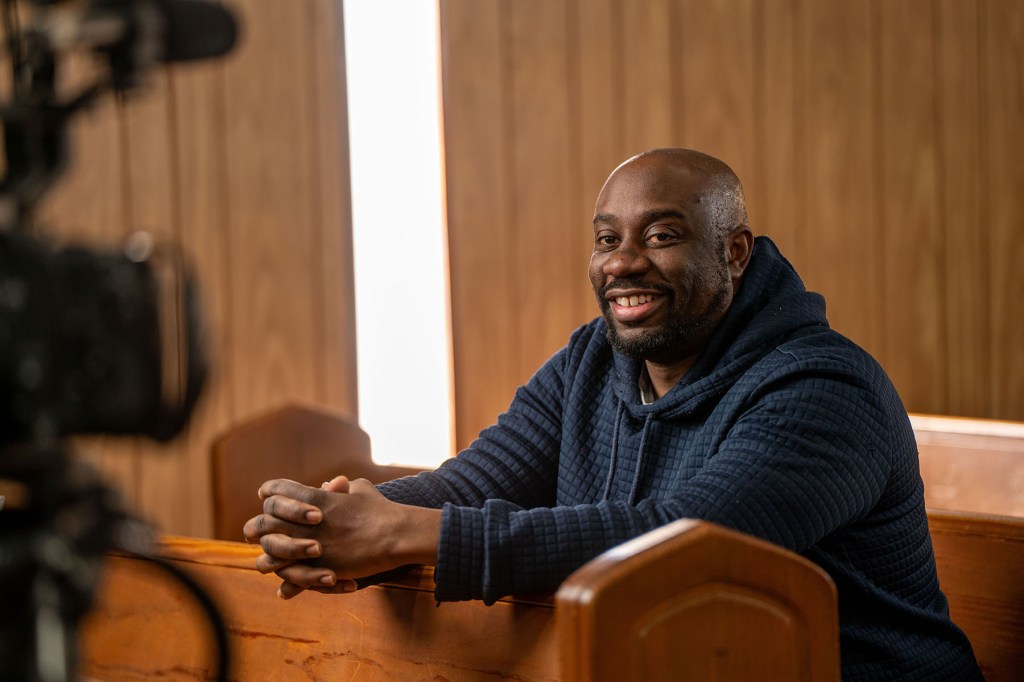 Derek Avery, co-founder and president of the Water for Sand Branch Coalition, has worked alongside Parks on efforts to bring water infrastructure and other resources to the community.
“He wants to pay people to move out of here, but he wants to give us a little tiny money,” she said. “And then if you don’t own property and you just rent, they wouldn’t give you anything … Then what I would have to do is move to another place to rent another place with higher rent, and, like I said, I don’t have the income to do that.”
Price was on the scene during efforts to contain the fire, but, according to Parks, has made little effort to actually involve himself with the constituents beyond brief appearances. She said that she believes Price’s lack of support has made drawing widespread attention to the community more important than ever.
“He’s just all show, and it really sucks because that’s the person that we need to at least change his mind and to at least speak to us,” Parks said. “You don’t have to speak to everybody — speak to me. I’m the community leader, speak to me. And he won’t do it.”
Wiley did not respond to questions from The 19th in time for publication.
According to Avery, Sand Branch has become a political hot potato. “Dallas County says it’s the city’s problem, the city says it’s Dallas County’s problem. Seagoville wants nothing to do with it, so it’s a kick-the-can-down-the-road issue, and we’re here to stop the can.”
Additionally, residents are seeking to introduce a bond proposition that, if approved, could fund a permanent water and sewer infrastructure and flood mitigation in Sand Branch and other areas without water infrastructure. But they’ve encountered road blocks, the biggest one being timing. According to Avery, the likelihood of the proposal being placed on the November ballot is slim, leaving its earliest chance at passing in November of next year.
Most of the troubles that Sand Branch faces arise from its status as an unincorporated community.
“It’s a complicated issue,” said Ariadna Sanchez, an assistant professor of public affairs and planning at the University of Texas at Arlington who has been studying the community. “Because it’s unincorporated, zoning doesn’t apply to the community.”
In the early 2000s, the Federal Emergency Management Agency, known as FEMA, designated Sand Branch as a floodplain, which stalled development and required it to comply with floodplain regulations including elevating houses, a process that Sanchez said is cost-prohibitive and complicated.
“And so that led to demolitions and deterioration of the housing stock,” she said. “Newer residents live mostly in mobile homes or recreational vehicles that obviously have deficiencies and not proper insulation.”
The absence of accessible public transportation adds to the community’s isolation, and leaves residents without options. Last October, Parks said, a friend of hers was struck and killed by a truck while walking to work early morning.
“You can’t get anywhere,” she said. “There’s people literally that are stuck here in Sand Branch and nobody cares. The water plant is next door. It’s just sad. It’s not anybody’s fault, but I think so much more can be done.”
On Father’s Day, a crew of volunteers met on an open plat of grass in Sand Branch. Next to them was a collapsible table with chips, hamburger buns and value-priced sodas, and people hoisted a tent for a makeshift free-of-charge barbershop, the overhead canvas offering a reprieve from the sweltering heat. Throughout the morning, more volunteers and residents trickled in, bringing with them donations like sanitary pads, blankets, dog food and first-aid equipment such as Neosporin and Band-Aids. As the day continued, pallets of bottled water arrived by truckload.
The event was a cookout doubling as a community drive. At the center of the activities was Parks. On a nearby wooden shipping skid, she laid out appliances she’d acquired to give away, many of them she didn’t even own herself: electric pressure cookers, an inflatable bed, an air fryer, a hot plate and other household staples hard to come by on their strip of land.
“These are the raffle items. How cool is that?” she said as she pointed at the goods. Events like this are common, according to Parks, who often hosts with other organizations like Avery’s Water for Sand Branch Coalition and Dallas Champions Academy, an organization aimed at helping under-resourced youth in South Dallas.
The drives are just one way that she has invested her time in Sand Branch. Starting in January, both she and Avery have begun hiring people in the community to complete manual tasks throughout the neighborhood like putting tarps on roofs as a means for these residents to make money.
“You can see a big difference. It’s not everything, it’s just working with what we can. But the community is getting stronger and they know that some people are there for them,” Parks said.
Parks understands the need for permanent water infrastructure in Sand Branch. But her eyes are on the immediate needs of her children, her family, her friends — her home.
“Everybody wants to fight for forever water, OK? And I get that we want water here, but we will not make it to the forever water if we don’t take care of the now.”
Republish this story