
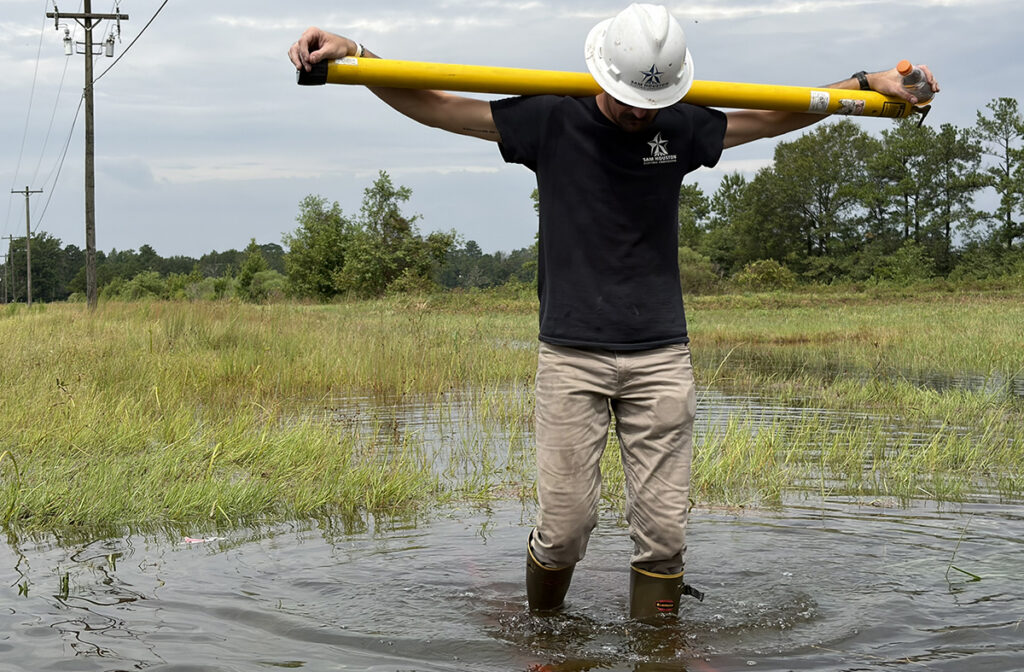
 A lineworker for Sam Houston Electric Cooperative wades through floodwaters to restore power after Tropical Storm Edouard. (Photo By: Chad Simon/Sam Houston EC)
It’s been a rough couple of weeks for some Texas electric cooperatives, with a massive wildfire burning more than 90,000 acres in North Texas and a tropical storm flooding portions of East Texas.
“The only thing we’re missing is a pandemic and a famine,” said Mike Williams, president and CEO of Texas Electric Cooperatives, which helped organize mutual aid to assist the affected co-ops. “Our co-ops have had a lot coming at them, and I couldn’t be prouder of the way they’ve handled it all and restored power to their members.”
The latest round of natural disasters began on Aug. 24, when a fast-growing wildfire—known as the Ross Fire—broke out near Cleburne-based United Cooperative Services.
“Within 30 minutes to an hour, it was spreading very rapidly, and we were affected pretty quick,” said Cameron Smallwood, the co-op’s CEO and general manager.
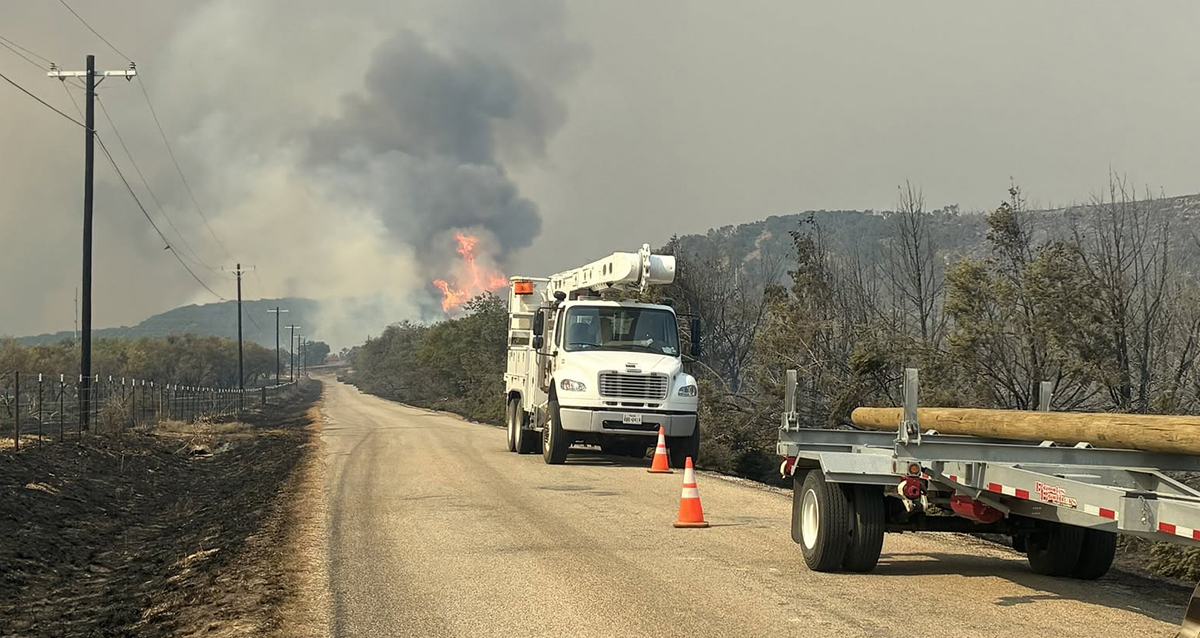
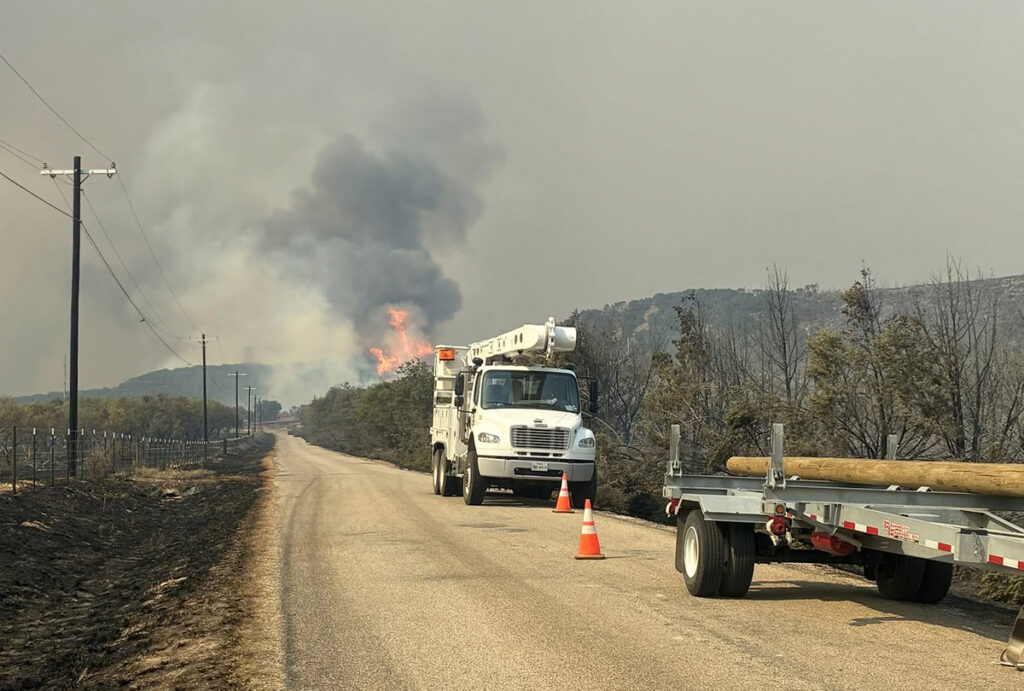 United Cooperative Services crews worked to replace burned power poles as a huge wildfire continued to threaten portions of their service territory. (Photo Courtesy: UCS)
Because the fire was concentrated in one of the more rural, remote parts of the co-op’s territory in Palo Pinto County, only a little more than 300 of the co-op’s approximately 113,000 meters lost power and about 100 broadband customers lost service.
The flames consumed an estimated 350 power poles along with electrical wires and fiber optic cables. Restoration of the system took about five days, with lineworkers having to replace some poles and lines more than once when the fire flared up again and burned the new equipment, Smallwood said.
“We were out there immediately doing restoration,” he said. “There is a lot of coordination between us and the fire crews to keep everyone safe, but we’re pretty aggressive about getting in there to rebuild as quickly as possible.”
About 30 meters remain without power because the homes, barns, deer hunting camps and other businesses that had been connected to the system burned down, Smallwood said. Fortunately, he said, no people were injured but some ranchers lost horses and cattle as they tried to evacuate.
The co-op’s lineworkers, aided by crews from Comanche Electric Cooperative Association and Heart of Texas Electric Cooperative, rebuilt the system in 105-degree temperatures with smoldering trees and smoke all around them.
“One day, a couple of us drove up to where about 15 lineworkers were and there was a pop-up thunderstorm, which is very unusual for this time of year,” Smallwood said. “It got windy real fast. The storm created an ash cloud that blocked out the sun and started moving toward them. It was pretty apocalyptic.
“By the time we got there, a few of the lineworkers were just covered in black ash. Their teeth were all bright white, but they looked like they’d been down in a coal mine.”
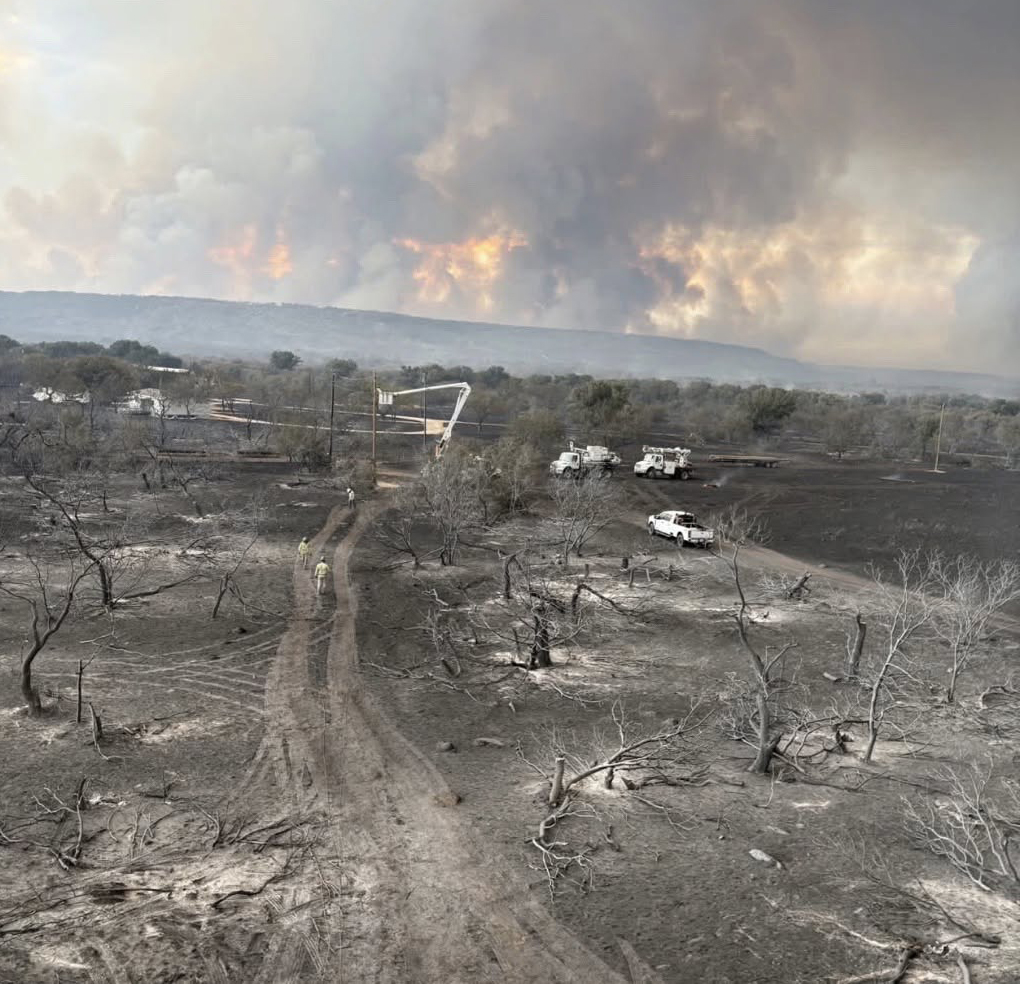 The Ross Fire has burned more than 90,000 acres in North Texas, charring portions of United Cooperative Services’ territory. (Photo Courtesy: UCS)
More than 200 miles away from United Cooperative Services, Tropical Storm Edouard hit Sam Houston Electric Cooperative’s territory about a week after the Ross Fire began. The storm dumped nearly 2 feet of rain as it moved slowly through the area beginning on Tuesday, Sept. 1.
“It sat over us all day Wednesday,” said CEO Doug Turk. “Our crews were wading through water and mud for the first 12 hours.”
At the peak of the storm, the co-op lost power to about 20,000 meters, but the outages didn’t last long. About 36 hours later, all power had been restored as 109 Sam Houston employees worked alongside contractors and crews from five neighboring co-ops.
HILCO Electric Cooperative, Jasper-Newton Electric Cooperative, MidSouth Electric Cooperative, Navasota Valley Electric Cooperative and Wharton County Electric Cooperative all took part in the mutual aid effort.
“We had over 500 crew members in the field at the peak of the restoration,” Turk said. “We are so grateful to our neighboring co-ops. We could never have restored power so quickly without them.”
For the first time, Turk said, the Livingston-based co-op used drones to cross heavily flooded roadways and provide views of areas with outages.
“We don’t energize anything after a storm or a fire without looking at the entire outage to see if there are any safety issues,” he said. “We used the drones to go where our crews couldn’t go to check things out.”
The storm was strong enough to overturn mobile homes in the southeast portion of the co-op’s territory, and floodwaters seeped into some members’ homes, Turk said.
“A couple of miles down the road from the co-op, first responders rescued children trapped in a house with rising water,” he said. “Thankfully, everybody got out OK.”
Both Turk and Smallwood said there are always lessons to be learned from disasters.
“We regularly practice our emergency response so that employees understand what they’re supposed to do,” Smallwood said. “We’re constantly changing our practice scenarios. We did one recently where we practiced what we’d do if there was a massive thunderstorm with a cyberattack in the middle of it. All that practicing really does pay off. This was the smoothest event I’ve experienced.”
Turk said the key for Sam Houston has been lining up help ahead of time and training employees how to lead outside crews safely during a disaster.
“We want to be able to respond immediately so our members can see that we’re out there doing everything we can for them,” he said.
Williams said he’s in awe of all the co-op line crews that responded to the Ross Fire and Tropical Storm Edouard.
“I can’t even imagine what they go through,” he said. “They’re my heroes.”
Erin Kelly is a staff writer for NRECA.