
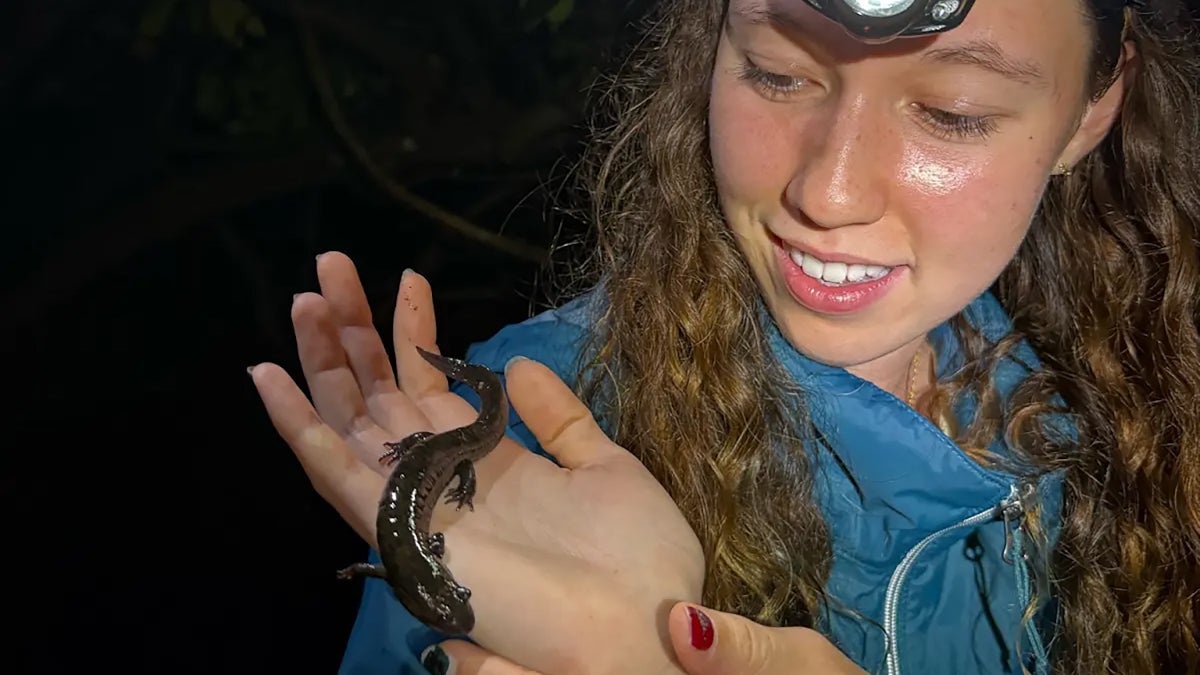
Iris Schmeder is a senior biology major who researches the biodiversity and ecology of frogs in the lab of professor Kelly Zamudio at The University of Texas at Austin. She’s also a Dean’s Scholar and a former Stengl-Wyer Biodiversity Scholar who participated in the Freshman Research Initiative.
We caught up with her recently to find out about her time at UT and her plans for the future. This conversation was edited for length and clarity.
Why did you choose UT and how did you end up researching frogs?
One of the main reasons I chose UT was because of the Dean’s Scholars Honors Program and the community and the culture that they had built. It just sounded amazing. I was really interested in research, but I didn’t really know how to do it, and so that’s what really drew me to UT.
During my first week of school, I went to this grad student seminar and I ran into a professor in the hallway and he asked me what I was interested in. And I said, “Well, I just got here, and I like biology, but I don’t really know what I want to do within that. I think animals are cool.” He said, “Well would you ever work with frogs?” And I said, “Yes, frogs are so cool.” And he said, “You should talk to my wife.”
I ended up joining his wife, Kelly Zamudio’s lab and I’m still in it.
What kind of research have you done with frogs?
In the summer of 2025, I did my first frog field work with one of Kelly’s grad students, a different principal investigator, and my best friend, who was an undergrad in Kelly’s lab at the time. The four of us went to Hawaii for a couple weeks to catch coqui frogs, and that was so much fun.
We were studying the invasive coqui frogs and how they have adapted to inhabit a large elevational gradient on the island. To find the frogs, we would go out to the forest at sunset when they became active, split up to cover more ground, and follow a call and scan the trees, ground, branches, leaves and sticks with headlamps until we found the one that was calling. Then we just grabbed it quickly and put it into a plastic bag until we all met up back at the car, transferred them to containers, and then processed them at the end of the night back at the Airbnb. We usually hit 3 field sites a night, driving to different elevations and areas of the island. Some sites were more difficult than others. There was one site that was so dense that Madeline (the other undergrad) and I had to army crawl on the ground and spiderman crawl up trees to maneuver through the forest and track down the frogs. It also rained almost every night, if not every night.