
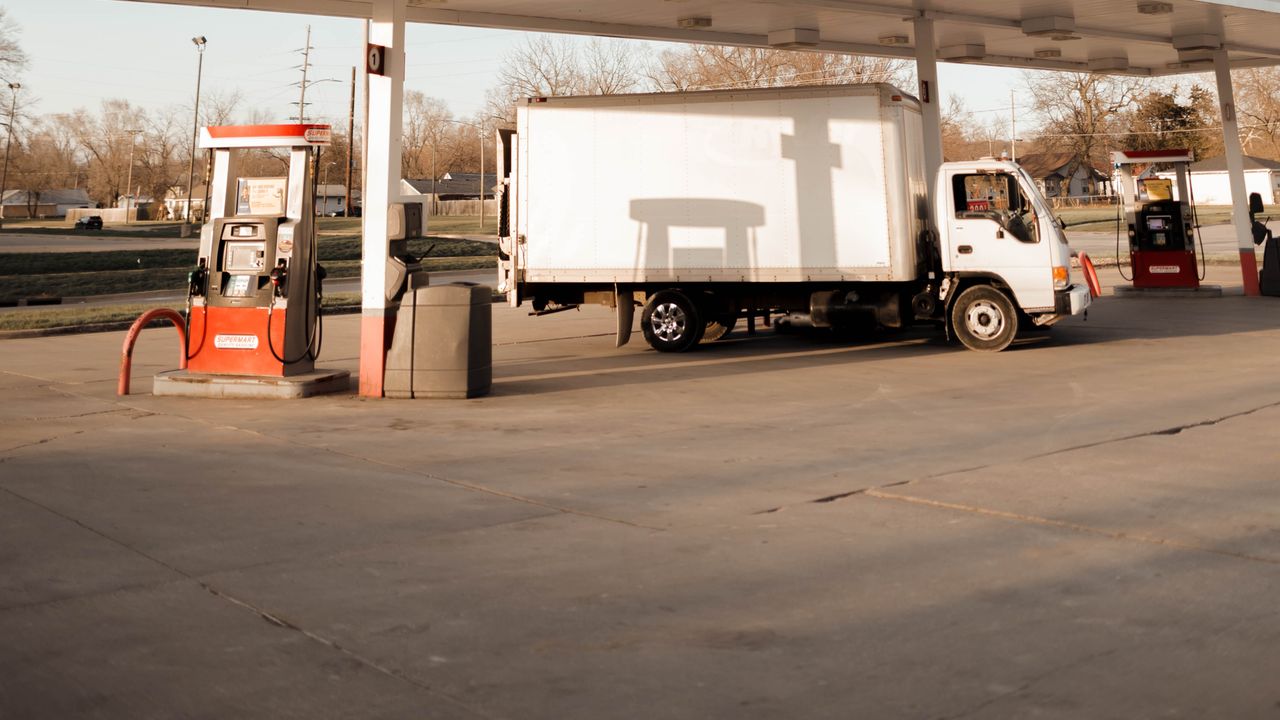
A commercial truck sits beside fuel pumps at a service station. | Image by Nina Hill/Pexels.
Diesel reached nearly $6 a gallon at an Interstate 20 truck stop in Dallas on Labor Day as Texas’ statewide diesel average rose to a record $5.5033 Tuesday, squeezing truckers’ earnings and increasing transportation costs.
Filling a semi at that price can cost nearly $1,000, FOX 4 reported. Drivers who spoke with FOX 4 at the stop said shipping rates have not kept pace with rising fuel expenses.
“It’s hard right now, really,” truck driver Aysha Floyd told the station. “The rates are low, so we’re not really making any money. Everything is going into the fuel tank.”
Another driver, Mustafa Moxiesen, said diesel and oil are essential to his work and rising prices have sharply increased his operating costs.
Diesel climbs 61%
The U.S. average for on-highway diesel rose from $3.477 a gallon on January 5 to $5.599 on August 31, a 61% increase, U.S. Energy Information Administration data show.
AAA listed Texas’ diesel average at a record $5.5033 Tuesday, up from $5.5017 Monday. Dallas averaged $5.5177 Tuesday.
The Dallas Express previously reported that U.S. forces struck three Iranian tankers on September 5 after Iranian missiles targeted U.S. warships. Oil and fuel prices had already climbed before the strikes. The EIA said traffic through the Strait of Hormuz had remained severely constrained and expected flows to increase only gradually during September.
The EIA estimated that crude oil and petroleum liquids moving through the strait fell from 21.6 million barrels per day in the fourth quarter of 2025 to 4.9 million barrels per day in the second quarter of 2026. The agency expects oil prices to remain elevated until traffic normalizes and global inventories recover.
Little room for quick relief
Bud Weinstein, a retired professor at SMU’s Cox School of Business, said higher diesel costs reach beyond trucking because rail freight and farm equipment also depend on the fuel. He called the increase “clearly inflationary” and said consumers would likely face additional price increases.
President Donald Trump met with refiners and distributors at the White House on September 1 to discuss expanding U.S. refining capacity and lowering pump prices.
The latest EIA data show U.S. refineries operated at 98% of operable capacity during the week that ended August 28. That rate leaves little short-term room to increase production, and EIA forecasts suggest pump-price relief will take time even if Strait of Hormuz traffic increases.