
SAN ANTONIO — A new city audit found San Antonio Animal Care Services did not consistently document required inspections, affidavits and other steps in dangerous and aggressive dog cases — gaps auditors warned could pose a public-safety risk.
Animal Care Services Director Jon Gary said the problems were largely ones of documentation, not a failure by officers to investigate cases or enforce requirements. He said the department has already changed policies and created new tracking systems while the audit was underway.
The audit concluded the Dangerous and Aggressive Dog Program was operating effectively overall. But it identified five areas where ACS needed stronger controls: documenting investigations, reviewing compliance, responding to affidavits, assessing fees and reviewing access to its case-management systems.
Dangerous dog cases nearly doubled
ACS handled about 300 dangerous dog cases in fiscal year 2024, then more than 500 in fiscal year 2025.
“We knew there’d be some increase just because more awareness and things like that,” Gary said. “But to go up to where it almost doubled, we did not anticipate that.”
Once a dog is designated dangerous or aggressive, its owner must meet several requirements, including obtaining a license, posting warning signs and following restrictions on how the dog is kept. Dangerous dog owners generally must also maintain a secure enclosure, carry liability insurance, and allow annual inspections.
Auditors reviewed 16 dogs that required a 30-day compliance inspection in fiscal year 2025. In eight cases, or 50%, ACS did not have documentation showing communication with the owner to schedule and perform the inspection. In 14 cases, or 88%, records did not show the dog was in compliance within 30 days.
Auditors also reviewed 50 dogs due for annual inspections. In 45 cases, or 90%, case notes did not document that an annual inspection occurred or that the dog was complying with regulations.
The audit said the lack of inspection procedures and documentation “may cause safety risks to the citizens of San Antonio.”
Gary said compliance work can be difficult when owners move, dogs die without ACS being notified, or owners cannot be located.
He said ACS has temporarily moved two first responders to focus on compliance cases.
He said dogs are usually brought into compliance before their owners can reclaim them from ACS, though longer-term compliance remains a challenge and can lead to hearings.
“It’s not that we weren’t working it and we weren’t communicating it,” Gary said. “It’s we weren’t documenting it.”
Gary assured city council members and our crew that compliance checks are happening and are being better documented now.
“Can you report that back to us in another way, other than just saying it happened?” Councilwoman Ivalis Meza Gonzalez asked after the audit was presented.
Gary said teams are now going through the paper files and uploading notes into the electronic system to document compliance checks and communication.
“Some of them won’t exist because in practice, the officer didn’t go in and make a note saying ‘I called this person, and then did this,’ which we addressed through policy,” he said.
Audit finds no system to track affidavits
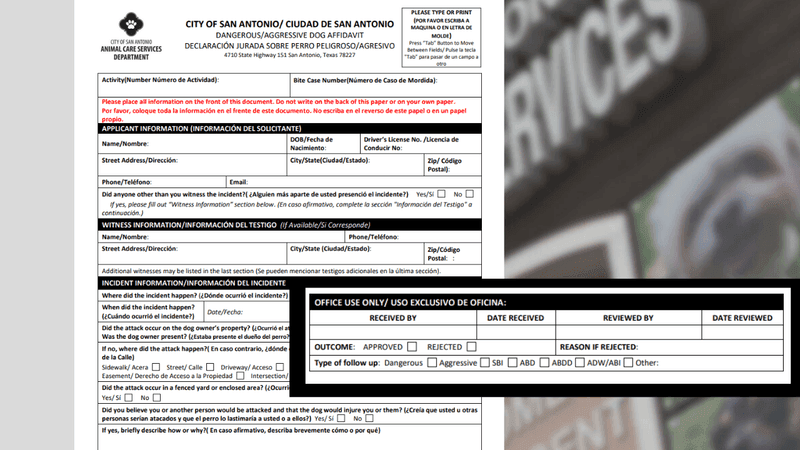
The audit also found ACS did not document and track affidavits submitted by residents reporting potentially dangerous or aggressive dogs. An affidavit is required to open an investigation.
Without a record of incoming affidavits, auditors said they could not determine whether ACS responded to all of them. The audit warned that some reported dogs could remain undesignated if affidavits are not tracked.
“If people are making dangerous dog complaints and submitting these affidavits, and nobody at ACS is responding, and maybe the case doesn’t get opened… you have another potential dangerous animal on the street that’s not looked at. So there we have a substantive public safety issue,” Councilman Marc Whyte said.
In a sample of 35 dangerous and aggressive dog investigations, 28 cases — 80% — lacked documentation showing investigators contacted the person who filed the affidavit within three days and the dog owner within five days.
Gary said affidavits had been arriving in several ways, including walk-ins and mail, making the process difficult to track. He says the agency was responding to affidavits, but again, not documenting an officer’s process.
ACS has now created a tracker intended to log every affidavit.
“We actually have a tracker where every affidavit that comes in, it’s logged into that tracker, no matter which way it comes from,” Gary said.
Auditors also found ACS case files did not consistently include required communications, notices and supporting records such as scene photographs or injury photos.
Gary said the department has added written procedures, checklists and supervisory checks to make sure staff document each step.
“Now we can hold our staff accountable because it’s now written out into a policy,” he said.
Audit finds documentation gaps in dangerous dog program; ACS says fixes are underway
ACS agreed with audit recommendations
The audit also identified areas where ACS was performing well. Auditors found officers responded to all 100 sampled 311 calls involving potentially dangerous or aggressive dogs, meeting required response times in 89% of those calls. In a separate sample of 44 investigations, ACS responded to every initial call and met the response-time standard in 95% of cases.
Auditors also found ACS properly supported all 25 “unfounded” designations they reviewed, humanely euthanized all 44 sampled dogs ordered for destruction, and ensured all 68 sampled Animal Care Officers had the required state certifications.
The audit found ACS did not consistently assess some program fees, primarily euthanasia fees. Auditors reviewed 41 cases involving $7,107 in fees and found 22 included waived fees totaling $736.
Gary said ACS may waive euthanasia fees when owners cannot afford them because the public-safety risk of keeping a dangerous dog can outweigh the lost revenue.
And he says the agency agreed with all of the audit recommendations and started making changes right away.
“We reacted immediately,” he said. “We didn’t even wait for the final audit results to come back.”
The City Auditor’s Office is expected to follow up on ACS’s corrective actions. The audit will also go before the full City Council for discussion.