
HOUSTON – Imagine sitting down to help your child with homework only to realize some of the information they are being asked to learn is not correct.
A map contains misspelled or made-up locations. Characters’ names change within the same story. An illustration shows animals that do not look quite right.
For parents, it can mean another responsibility at the end of an already busy day: checking whether the material their children receive at school is accurate.
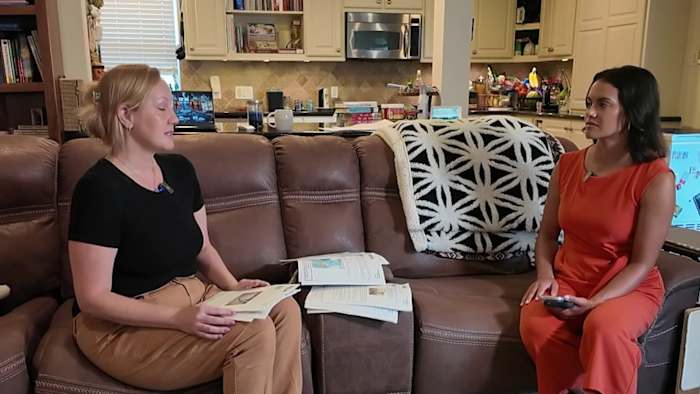
Houston ISD parent Christine Hurley said she has encountered those problems while reviewing work brought home by her 8- and 10-year-old children. She has also seen examples shared among other district parents, including a sixth-grade social studies map containing locations that were misspelled or did not exist.
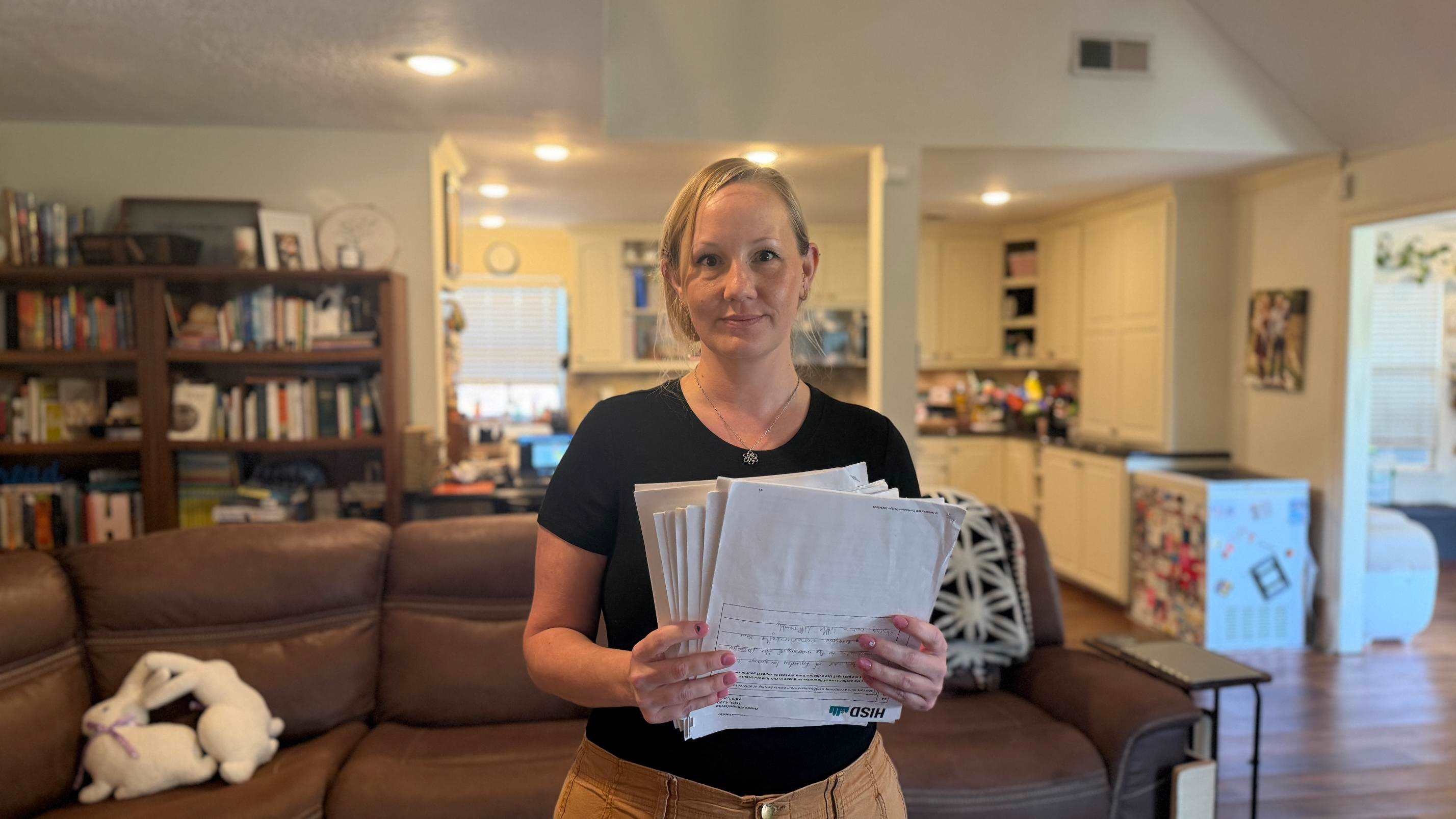 Christine Hurley (KPRC 2)
Hurley believes some of the material may have been created using artificial intelligence. KPRC 2 has not independently confirmed whether AI was used to create the specific worksheets she showed us.
“Where is there any proofreading done on any of this stuff?” Hurley said. “Like within worksheets that have stories, there’ll be inconsistent names. So then how are the kids supposed to answer questions when all of the names are changing within the story of the characters?”
A fear that children could lose their love of learning
Hurley said she is not opposed to schools teaching children about artificial intelligence. She recognizes that students will need to understand how to use the technology responsibly as it becomes more common in school, work and everyday life.
Her concern is what happens when AI-generated material replaces established instructional resources and is given to children without being carefully reviewed.
She pointed to reading worksheets that she believes contained AI-generated writing. With centuries of published literature and poetry available, Hurley questioned why schools would rely on newly generated material that she described as less engaging.
“It’s just very subpar,” Hurley said. “And the kids are bored to death. My daughter, she went from loving reading to hating reading because it was so boring. And it was just it was depressing, honestly.”
Hurley said that change in her daughter is at the heart of her concern.
“I’m concerned that we’re taking away the joy of learning for an entire generation of kids,” Hurley said. “They’re just going to see it as another tasks to do. They’re just going to read to find the answers. They’re not going to care about what they’re reading.”
She also worries that repeatedly encountering errors could make children question whether accuracy matters.
“If they’re being taught this by someone like an authority figure and they’re presenting this wrong information, well, why does it matter to be correct?” Hurley said. “Why do we need to know that the capital of Texas is Austin? Like why would we need to know that? Why would we need to know how to spell it?”
Hurley said younger students may not yet have the background knowledge or research skills necessary to recognize when something is wrong.
“It is very scary because they don’t know what’s true and not true,” Hurley said. “They don’t know how to question it or use it responsibly.”
An additional burden for parents
Hurley said she talks with her children about questionable material and helps them identify mistakes. She is concerned, however, about families who may not have the time or ability to examine every assignment in depth.
“I do worry about all of the kids and HISD parents who don’t have the time, or the ability to go through all this in depth, because it is a lot of time and it is a lot of work,” Hurley said. “And I’m sure we’re missing a lot of things.”
She described the added responsibility as exhausting.
“And this is like another thing that we now have to worry about, we now have to be concerned about,” Hurley said. “And it’s exhausting…I want to know that they’re learning, that their brains aren’t shrinking, that they’re going to be able to do more than just get masters on STAAR.”
Hurley said parents also want more transparency about what AI programs are being used, how students are using them and how AI-generated classroom materials are reviewed.
“Yes, I think transparency would be a huge help if parents understood specifically what AI was being utilized by the children, how it was being used, how they’re teaching the kids about it,” Hurley said. “I have no idea.”
She said parents may hesitate to report a problem because they do not want a teacher blamed for material provided by the district.
“Parents who are going to take the steps to contact, understand that you have to weigh: Is this going to come back on the teacher?” Hurley said. “Are they going to get in trouble for this even though it’s not their fault?”
What HISD’s AI guidebook requires
HISD has published a 20-page Generative AI Guidebook outlining how students and employees should use the technology.
On Page 7, the guidebook instructs users to review all AI-generated content for factual accuracy and bias. It warns that AI can “hallucinate,” producing answers that appear correct but are not.
Page 12 provides additional expectations for district employees. It says they should:
Use generative AI to enhance, not replace, their professional expertise and creativity.
Critically evaluate AI-generated content for bias and inaccuracies.
Revise AI output to reflect their own expertise and judgment.
Disclose the use of AI in formal work products and public-facing documents.
Ensure AI-generated content does not replace district-vetted, high-quality instructional materials.
The guidebook also says teachers may not use unapproved generative AI tools directly with students. New tools must go through a district review for safety, privacy, accuracy, accessibility and alignment with curriculum standards.
Expert says AI should support educators, not replace them
Amanda Bickerstaff is the CEO and co-founder of AI for Education, an organization focused on the responsible adoption of generative AI in schools.
Bickerstaff said her organization worked with HISD in 2024 to help develop the district’s generative AI guidelines. It also reviewed some student-facing curriculum and provided professional development and consulting support during the first year.
She stressed that AI for Education did not create a system for HISD to generate worksheets and has not been involved in developing the district’s current instructional materials.
“As far as the curricular, like what people are developing within Houston, we really haven’t been a part of that,” Bickerstaff said.
Bickerstaff said AI can produce material that appears polished and authoritative while still containing significant errors.
“These tools make mistakes,” Bickerstaff said. “They are predictive. They can look really authoritative and still be wrong. And so that’s why it’s so important that you’re not offloading your thinking to these tools.”
She said educators should only use AI to create material they are qualified to review.
“You should not be using generative AI for something that you cannot evaluate the output,” Bickerstaff said. “If you don’t have expertise in something and you’re not able to evaluate the output, you’re not able to see the inaccuracies or the problems that come with that.”
Bickerstaff said every piece of AI-generated material must be checked before students receive it.
“If you’re using generative AI, you must double check everything,” Bickerstaff said. “And so what we’ve been hearing so much from students, actually, is that sometimes they’re getting worksheets or quizzes that are inaccurate because it looks like a quiz, right? But then it is something in which some of the answers are wrong.”
She said the incorrect map described by parents illustrates how easily someone can be given a false sense of security.
“We’ve been doing the map example of the inaccuracies for over a year and a half now, and we did that in all of our trainings because it’s a perfect example of how these tools can look accurate and be completely inaccurate,” Bickerstaff said.
She said AI should enhance an educator’s work rather than replace the knowledge, creativity and judgment that a teacher brings to the classroom.
“AI is only here to enhance or augment,” Bickerstaff said. “The problem becomes when it replaces. When you believe that GenAI can replace something that needed to be you up until three years ago. That’s where the problems come.”
What parents can do right now
Bickerstaff recommends that parents use an AI-related error as an opportunity to teach their children why the technology can appear confident while still being wrong.
Parents can then contact the teacher or district and ask:
Was AI used to create this material?
Who reviewed it before it was given to students?
How will the error be corrected?
Are other students still receiving the incorrect material?
What safeguards will prevent similar mistakes?
Bickerstaff said the conversation should focus on correcting the problem rather than immediately blaming an individual teacher.
“I think that part of that is people being just really transparent and having conversations when something goes wrong,” Bickerstaff said. “It’s not like an accusation, because this is really new for everybody, but it’s like, ‘Hey, we noticed something. Can we talk about it?’”
She also encouraged concerned parents to ask whether they can join an AI committee, work through their school’s parent-teacher organization or participate in district discussions about how the technology should be used.
“If you’re a parent and this happened to you, advocate to be part of an AI committee, to support a PTA conversation, to work with the district,” Bickerstaff said. “If you see this and you care about it, advocate for coming together and actually be part of that plan.”
HISD’s guidebook says families should first contact their child’s teacher with questions or concerns. The district also lists an AI Support Team email: AI_Support_Team@Houstonisd.org.
KPRC 2 awaiting a response from HISD
KPRC 2 reached out to HISD to ask whether AI was used to create the materials Hurley showed us, how the district reviews AI-generated classroom content and how incorrect materials are corrected or removed.
HISD released the following statement:
“Generative AI is increasingly used across education and other industries, and HISD permits its responsible use as a supplemental tool. It does not replace professional judgment, established instructional resources, or authoritative sources, and all student-facing materials must be accurate and age appropriate.
In this instance, AI was used to help create a more visual and accessible representation of the content, but the generated material did not accurately reflect the source information, and the errors were not identified before it was made available. The material has been corrected, and the District is reviewing where it was distributed or accessed.
HISD is tightening its process for updates to existing District coursework to provide greater oversight of changes to student-facing content. AI-assisted materials will continue to require human review and verification against reliable sources before being used with students.”
Copyright 2026 by KPRC Click2Houston – All rights reserved.