
San Antonio’s largest hospital system is “stepping into the fray” of turning medical school graduates into licensed doctors amid physician shortages and concerns about medical “brain drain,” when highly trained professionals leave for better prospects.
Across the U.S., residency programs — necessary for medical school graduates to obtain licenses and specialization in their chosen field — have not kept up with demand. The problem is even worse in San Antonio, where on average just a quarter of graduates from UT Health San Antonio stick around to complete their residency in the city.
Methodist Healthcare officials hope to help. Its graduate medical education or GME program is in its second full year, with its first resident physicians graduating this year. With 38 resident physicians total, the program is in its infancy. But officials have ambitious goals.
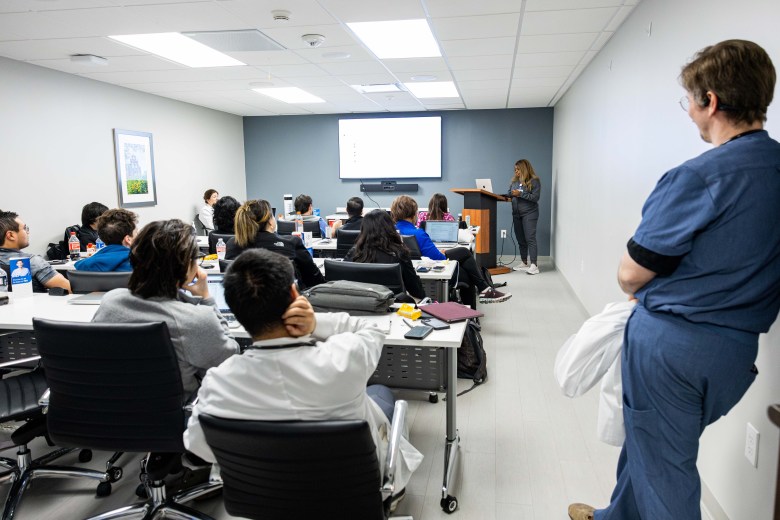 Dr. Andrew “Hunter” Wright, right, listens in on a lecture as part of the training included in his graduate medical education and residency program at Methodist Healthcare. Credit: Amber Esparza / San Antonio Report
“Our plan is to be one of the largest GME providers in the next decade in South Texas,” Methodist President and CEO Dan Miller said. “The majority of graduates stay in the communities they train. And so what that’ll mean for not just Methodist, but all the health systems in South Texas, will be tremendous.”
Methodist Healthcare System, a 50-50 partnership between nonprofit Methodist Healthcare Ministries of South Texas and Nashville-based HCA Healthcare, operates 11 hospitals in the San Antonio area.
Brain drain
According to Dr. Justin Williams, an emergency medicine physician who oversees the Methodist residency program, Texas has in previous years been a net-exporter of medical school graduates. The landscape has trended in a better direction more recently, but he worries that it could slide back without more investments.
A 2024 report prepared for the Texas Legislature found that the state is faring better in retaining medical school graduates than other states. But while Texas has dramatically increased the number of medical schools in the last decade, more investments will be needed to ensure residency programs can keep up pace.
The problem, though, seems to be more severe in San Antonio.
San Antonio is home to two of 16 medical schools in Texas: UT San Antonio’s Long School of Medicine and the University of the Incarnate Word’s School of Osteopathic Medicine, which was fully accredited in 2021.
Among UTHSCSA’s 2025 class of medical school graduates who applied for residency (205 graduates), just 26% did so in San Antonio, according to data from the university. Overall, 62% percent of those students completed residency in Texas.
“The problem is even more acute here in San Antonio,” Williams said. “There’s definitely a need for training physicians here in San Antonio so we can keep them and have a more adequate physician population so we don’t have a shortage of doctors going into the future.”
 Resident Physician of Internal Medicine Dr. Andrew “Hunter” Wright reviews practice questions on his phone for an exam he’ll be taking in July of 2026. Credit: Amber Esparza / San Antonio Report
A 2024 American Association of Medical Colleges report predicts that the U.S. will face a shortage of 86,000 doctors by 2036 without more investment in graduate medical education programs.
State support
Bexar County’s public hospital system, University Health, is the largest training ground for resident physicians in San Antonio. With its Level One trauma center, University Health hosts hundreds of graduates, most of them from UT Health San Antonio, the University of the Incarnate Word, and Houston’s Baylor College of Medicine.
The number of resident physicians in its hospital system can reach as high as 950, according to Dr. Bryan Alsip, University Health’s chief medical officer. The hospital has taken advantage of state grants, established in 2013, to support hospitals creating residency programs.
But even with the grants, “hospitals have to make an investment,” Alsip said, “which is why it can be expensive and can be challenging.”
One problem with the grants is that they typically don’t apply to some of the higher-end medical specialties that San Antonio needs, Alsip added. That includes most of the “ologies,” like gastroenterology, ophthalmology and rheumatology, as well as neurosurgery, vascular specialities and ear, nose and throat doctors.
“Those are the ones where we do clearly have a shortage,” Alsip said. “A lot of these funding streams that have helped in the last four or five years bolster some of the primary care residencies for San Antonio, which has been helpful, [but] we don’t have as many higher-end or more specialized residencies, particularly fellowships, that are needed to serve the most acute care patients that we have.”
Methodist’s residency program currently offers internal medicine, general surgery, podiatry and starting next year, OB-GYN.
In addition to the residency program, Methodist Health is partnered with the Galen School of Nursing, which opened a new campus early this year. And hospital officials are working with faculty at Alamo Colleges District on health care training programs.
“There’s a workforce that wants jobs, we have a job open, but there isn’t the training,” Miller said.