
The Dallas Police Department says it overspent its overtime budget by nearly $3 million, prompting some city leaders to demand tighter controls on overtime spending.
But department payroll records obtained by NBC 5 Investigates raise questions about whether cutting overtime for some of the department’s highest-paid officers could worsen the city’s budget challenges.
Those records reveal the massive amount of overtime some officers earn.
Forty officers each collected six-figure overtime checks last year — and that’s just in overtime pay.
But the payroll records also show many of the department’s biggest overtime earners are assigned to the department’s Dallas Love Field security division and the Dallas PD traffic unit, where much of the overtime is reimbursed through federal aviation security grants and traffic safety grants.
The records analyzed by NBC 5 Investigates show 13 officers assigned to the airport security division each logged more than 1,000 overtime hours in 2025. Four worked more than 1,500 hours of overtime, each collecting more than $120,000 in overtime pay.
One officer assigned to Love Field made $166,000 in overtime alone.
In the department’s traffic unit, some overtime checks were even bigger.
Five traffic unit officers each made more than $135,000 in overtime last year, according to payroll records.
One traffic sergeant — the department’s top overtime earner — collected more than $200,000 in overtime pay while logging almost 2,000 hours of overtime.
“Some officers are in certain divisions where you get a lot of overtime,” Dallas Police Chief Daniel Comeaux said in an interview with NBC 5 Investigates.
Some of the overtime is now causing frustration at Dallas City Hall.

Edward Ayala, NBC 5 InvestigatesEdward Ayala, NBC 5 Investigates
“That’s not overtime. That’s not using resources efficiently. That’s padding incomes,” Dallas City Council member Adam Bazaldua said at a city council meeting last month.
Some council members have taken the chief to task since the department revealed it went $2.7 million over budget on overtime, at a time when the city has been working to close a $51 million budget gap.
“The city has laid off over 100 employees, we still have a police department that expects a blank check for overtime,” Bazaldua said.
Asked how much pressure he is facing from City Hall to crack down on overtime, Comeaux told NBC 5 Investigates that the issue has his attention.
Edward Ayala, NBC 5 InvestigatesEdward Ayala, NBC 5 Investigates
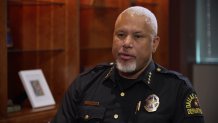
Dallas Chief of Police Daniel Comeaux talks with NBC 5’s Scott Friedman about police overtime.
“Look, I’ve definitely received phone calls and we talk about overtime, but I think everyone at City Hall knows that it’s a focal point,” Comeaux said.
Comeaux said he’s directed supervisors to scrutinize overtime and make staffing changes, including scheduling some homicide detectives to work weekends rather than calling them in for overtime.
He’s also vowed to fix an ancient payroll system he said makes overtime harder to track.
“Here at the Dallas Police Department, the overtime cards are still handwritten,” Comeaux said. “It’s time for us to get in 2026 and have a few more checks and balances and some accountability.”
But tightening controls may not reduce some of the department’s biggest overtime checks.
Records show 40% of the officers working more than 1,000 overtime hours are assigned to Love Field and the traffic unit, where federal aviation security grants and traffic safety grants help pay for overtime.
Edward Ayala, NBC 5 InvestigatesEdward Ayala, NBC 5 Investigates
So if the city cuts those overtime hours, it could lose outside funding that helps cover overtime costs.
In fact, the department said that about a quarter of all Dallas PD overtime hours are reimbursed with grant money.
That leaves fewer places to cut from, like the patrol division that answers 911 calls.
Experts said it’s often harder to reduce patrol overtime because crime is often unpredictable.
“We’re not going to tell the family of a homicide victim, well, we’ll be back tomorrow, right, sorry, we will be back tomorrow, my eight hours is up,” said criminologist Tim Bray, who studies policing and public policy at the University of Texas at Dallas.

Edward Ayala, NBC 5 InvestigatesEdward Ayala, NBC 5 Investigates
Criminologist Tim Bray.
Bray said scrutinizing overtime stemming from every shooting or car crash that happens near the end of an officer’s scheduled shift also risks frustrating officers.
“All of a sudden, now you’re looking deeply into every decision about whether an officer stays an extra 15 minutes, or 20 minutes, or an hour,” Bray said.
Dallas Police Association president Sean Pease said the overtime crackdown already left some officers deeply frustrated, and he worries some may leave.
“Eventually, it gets to the point of, you know what? I just don’t need, I don’t to deal with this every day,” Pease said.

Edward Ayala, NBC 5 InvestigatesEdward Ayala, NBC 5 Investigates
Dallas Police Association President Sean Pease.
About a quarter of all officers are eligible to retire.
Pease said that more departures would mean less staff and more overtime expense.
NBC 5 Investigates asked Comeaux about the union’s concern that increased scrutiny could affect officer retention.
“The numbers are showing that we’re not having an issue with retention right now, and we’re doing a phenomenal job hiring,” Comeaux said.
The Dallas Police Department has hired about 300 new officers this year, but the newest recruits are still in the police academy and not yet on the streets.
Meanwhile, records show 164 officers have left the department in the last 10 months.
Some council members also point out that a year ago, the City Council reduced the police overtime budget.
“The fact that you’re over budget is because we budgeted wrong,” Dallas City Council member Cara Mendelsohn said during a recent council meeting. “We took away $10 million as you told us you’re understaffed. So, I think you’ve done an incredible job.”
“The problem’s not overtime. The problem is staffing. And this city has traditionally always made up for being understaffed with overtime,” Pease said.
Comeaux said he remains confident the department can both increase staffing and save taxpayers money on overtime.
“It’s just being more efficient,” Comeaux said.
But Bray said balancing all those demands can be difficult.
“Think of it as spinning plates,” Bray said. “Everybody can probably spin one, some of us can spin two, but now we’re asking chiefs to spin three, or four, or five.”
The department is also still seeking federal reimbursement for overtime worked during the FIFA World Cup and the Republican midterm convention, which is being held downtown.
The chief said he believes the money will arrive, but told NBC 5 Investigates, regarding the convention reimbursement, he had nothing in writing yet.

Edward Ayala, NBC 5 InvestigatesEdward Ayala, NBC 5 Investigates
Dallas Chief of Police Daniel Comeaux talks with NBC 5’s Scott Friedman.
Meanwhile, the policing of overtime hours continues within the department, even as records show many officers do not work large amounts of overtime.
In fact, the payroll data shows the average was only about 180 overtime hours per officer last year — which amounts to just a few hours per officer, each week, on average.
That means a smaller number of officers account for a significant amount of overtime spending.
And many of those officers are working overtime that’s covered by outside funding.