
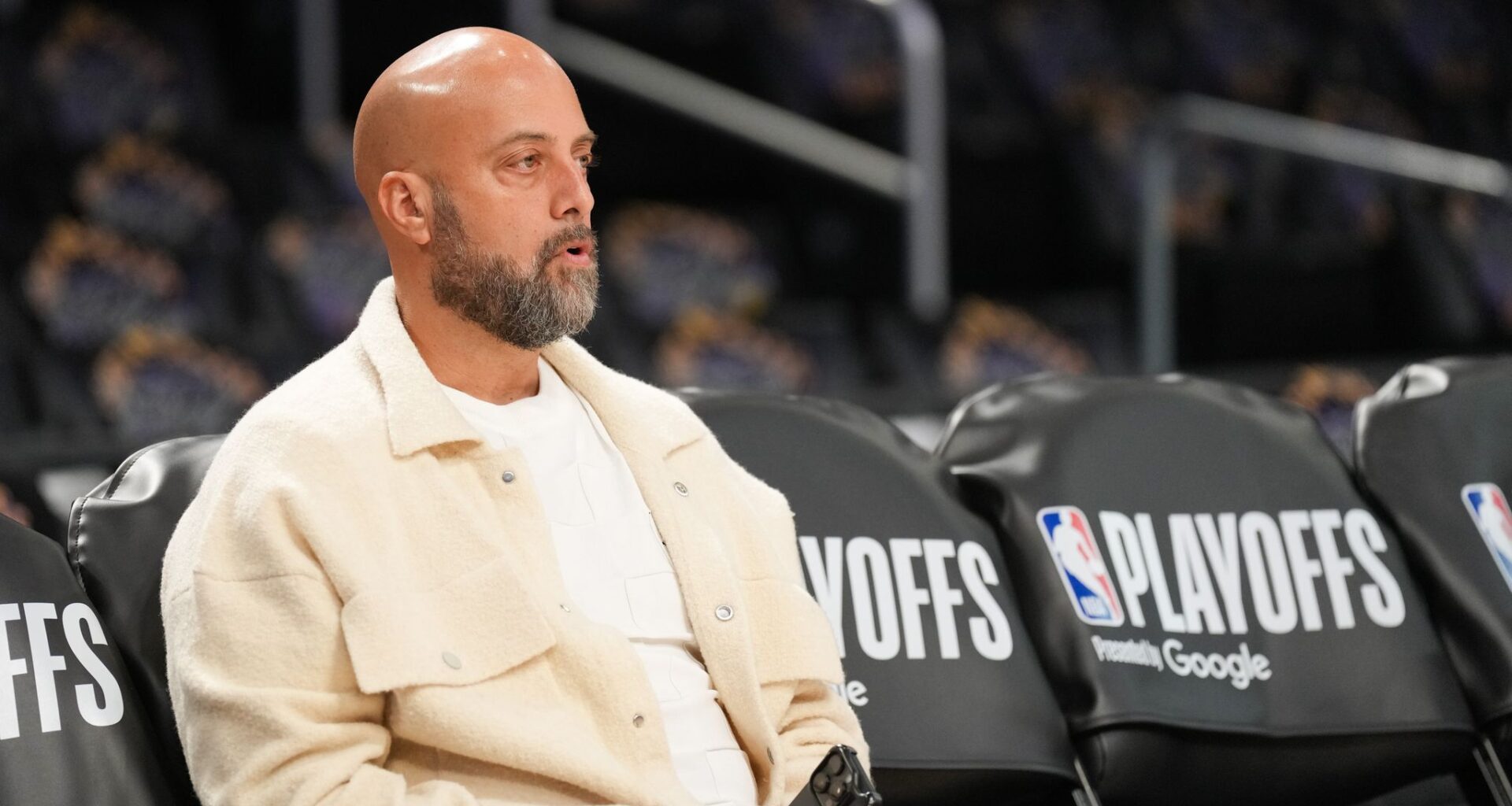
Houston Rockets General Manager Rafael Stone watches warm ups before the second game of the first round of the Western Conference playoffs against the Los Angeles Lakers at Crypto.com Arena in Los Angeles on Tuesday, April 21, 2026.
Elizabeth Conley/Houston Chronicle
Now that most of the NBA offseason is over and the Houston Rockets have wrapped up their last major piece of business by extending the contract of Amen Thompson, it’s a good time to step back and evaluate general manager Rafael Stone’s moves.
Let’s start with the big picture and what the Rockets didn’t do: trade for a star.
Stone foreshadowed Houston’s measured offseason at his end-of-season news conference. He said that if Houston largely brought back the same group, it would benefit from players returning from injury and continuity. He also said he expected the Rockets to improve because he expected growth from the team’s young core — Thompson, Alperen Şengün, Jabari Smith Jr., Tari Eason and Reed Sheppard.
Article continues below this ad
CONTRACTS: Status for each player going into the 2026-27 season.
A couple of big-name players — Giannis Antetokounmpo and Jaylen Brown — were traded for packages Houston likely could have beaten. The Rockets chose not to make a deal, an understandable, if risk-averse, decision.
If Stone had packaged some of Houston’s young players and draft picks for either player, he might have increased the Rockets’ short-term championship equity.
But even if such a move put Houston in the same conversation as the Oklahoma City Thunder and San Antonio Spurs, the Rockets would be the oldest team of that trio. They’d be the team most likely to suffer an injury or see a key player’s performance decline, and least likely to improve through internal development.
Article continues below this ad
Such a move also would shrink Houston’s competitive timeline and eliminate most of its long-term flexibility.
But that conservative approach did mean that just about every path that offers Houston championship upside requires members of that young core to take sizable steps. If that doesn’t happen and the Rockets’ young core doesn’t yield a true centerpiece, a trade for a star remains available to the team next offseason.
The Rockets can help their young players grow — and win more games — by surrounding them with an ecosystem that plays to their strengths and minimizes their weaknesses. Generally speaking, that means adding shooting, ballhandling and playmaking. Last year’s team didn’t have enough of that, both because of injuries and underperformance.
Houston’s offseason is evaluated using those criteria. Each of the Rockets’ major moves is given a letter grade and, to extend the collegiate metaphor, assigned one to three credits depending on the move’s importance. (The moves are ordered chronologically.)
Bruce Thornton defends Philadelphia’s Labaron Philon Jr. during the NBA’s Summer League.
Allen Berezovsky/Getty Images
Moving up for Bruce Thornton
The details: Rockets trade the 39th and 53rd picks and a 2029 Sacramento Kings second-round pick for No. 31 (used to take Bruce Thornton) and No. 55 (traded for cash)
Article continues below this ad
The Rockets turned three second-round picks into Thornton and cash.
Thornton has some things going for him. In college, he scored at all three levels and rarely turned the ball over. He already has a sturdy build that should ease his acclimation to the professional game and has earned impeccable reviews for his character.
But there are some questions. At 22, he’s an older prospect and, at 6 feet, a smaller guard who likely won’t offer much positional versatility.
The Rockets believed in their draft evaluation of Thornton enough to ensure they landed him, investing more in him than the average second-rounder to do so. He very well could reward their belief — but draft evaluations are projections and, therefore, filled with uncertainty.
Article continues below this ad
Houston Rockets forward Dorian Finney-Smith (2), from left, Kevin Durant, and Fred Vanvleet (5) watch the final minute of Game 6 of a first-round NBA playoff basketball series against the Los Angeles Lakers at the Toyota Center in Houston on Friday, May 1, 2026. Los Angeles Lakers won the game 98-78 ending the Rockets season.
Elizabeth Conley/Houston Chronicle
Moving out Dorian Finney-Smith
The details: Rockets trade Dorian Finney-Smith and three second-round picks (2027 Memphis, 2028 Houston, 2033 Houston) for cash and a traded player exception
This trade, in isolation, is an acceptable use of low-tier resources to move off a mistake. But the move can’t be entirely untangled from the ones before it, when the Rockets used cap space on a player whom they had to essentially pay another team to take off their hands after just one season.
Article continues below this ad
The three second-round picks aren’t especially valuable, especially because Houston is set to receive surplus draft capital in 2027 and 2029. But if the Rockets decide to get aggressive in the trade market at some point, they could regret shipping out opportunities to acquire valuable, inexpensive depth.
There also is the opportunity cost involved. Much of Finney-Smith’s issues stemmed from offseason ankle surgery that didn’t heal as quickly or as well as he or the team wanted. What if the Rockets had a better understanding of that and spent on a different player in free agency? Hindsight is 20/20, but what if Stone, after realizing the extent of the injury, had traded Finney-Smith at the deadline? His salary, along with draft capital, could have netted the Rockets a rotation piece.
Instead, Houston maintained faith in a player who didn’t reward it.
Los Angeles Clippers guard Bogdan Bogdanovic, center, shoots as Houston Rockets forward Tari Eason, left, and forward Jae’Sean Tate defend during the first half of an NBA basketball game Wednesday, April 9, 2025, in Inglewood, Calif. (AP Photo/Mark J. Terrill)
Mark J. Terrill/Associated Press
Adding Bogdan Bogdanovic
The details: The Rockets sign Bogdan Bogdanovic to a one-year, $3.52 million contract (veteran minimum)
This is the exact kind of move you should make as a team whose two best young players, Thompson and Şengün, are paint-bound.
The Rockets just didn’t have enough consistent floor spacing last season. Houston took the fifth-fewest 3-pointers in the league, according to Cleaning the Glass, and other teams often felt empowered to double-team Şengün and Kevin Durant or swarm Thompson on drives inside because they weren’t worried about the threat of kickouts.
Bogdanovic should help with that. He has consistently been above average in 3-point rate during his career and has made 38.1% of his long-range attempts. Interestingly, most of those 3-point attempts have been more difficult ones from above the break or self-created attempts. He also has been effective shooting from the corners and on spot-up attempts.
It is easy to see how Bogdanovic fits in Houston as a floor spacer and secondary creator. He also offers some positional flexibility at 6-foot-6.
But at 34, he’ll probably be a below-average defender and also comes with injury risk — he has played just 77 games combined over the last two seasons. It’s a solid, low-risk swing with decent upside if he can stay healthy.
Houston Rockets forward Tari Eason (17) dunks against the Los Angeles Lakers during the second half in Game 4 of a first-round NBA playoff basketball series at Toyota Center in Houston, Sunday, April 26, 2026.
Brett Coomer/Houston Chronicle
Keeping Tari Eason
The details: Rockets sign Tari Eason to five year, $81 million contract extension. Fully guaranteed with a player option for year five.
Stone did it again. The Rockets lead executive had already built a reputation for signing Houston’s young players to team-friendly contract extensions, and Eason’s extension gave people another chance to post a photo of the general manager with laser eyes along with fire emojis.
At the draft combine, some around the league wondered if Eason’s average annual salary as a restricted free agent would eclipse $20 million. But his market never materialized, and the Rockets were able to lock him up for great value.
Eason is a limited but massively positive player for two main reasons. It starts with his strong defense up and down the opposing lineup. Houston used him against perimeter threats like Luka Doncic and Devin Booker and against big men like Victor Wembanyama and Karl-Anthony Towns — versatility that empowers the Rockets’ switch-heavy scheme.
Eason is also crucial to Houston’s offensive rebounding prowess. Over his first four seasons, the forward has consistently been at or above the 95th percentile at his position in offensive rebounding percentage, per Cleaning the Glass.
Why the minus? Two reasons. Eason has dealt with injuries over the last three seasons after playing all 82 as a rookie. He played just 22 games in his second campaign, which ended because of a growth on his left leg, and played 57 and 60 games over the last two years due to hip, ankle and lower leg injuries.
The second: Not coming to an agreement before the 2025-26 season let the pending restricted free agency hang over Eason and the Rockets all season, something Stone acknowledged at Summer League.
“I didn’t like that we weren’t able to get one done and I’m really excited this year that we were,” he said. “I do think that — especially when you’re looking for your first big deal — there’s real pressure that comes with it that I would rather guys not have to go through.”
Los Angeles Lakers guard Marcus Smart (36) reacts in front of the Houston bench after hitting 3-pointer during the second half in Game 6 of a first-round NBA playoff basketball series at Toyota Center in Houston on Friday, May 1, 2026.
Jason Fochtman/Houston Chronicle
The big move: Signing Marcus Smart
The details: Rockets sign Marcus Smart to two year, $13 million contract. Second year is a player option
So, the Rockets have a type.
You could see it in 2023, when they hired Ime Udoka and acquired Fred VanVleet and Dillon Brooks. Houston wanted to force opponents to either match a high level of physical and mental intensity night after night or wilt.
With Brooks traded to Phoenix and VanVleet out for the season, the 2024-25 Rockets didn’t have that consistent edge. Who could blame them? Few players can tap into a seemingly endless supply of trash talk and hustle to motivate themselves and teammates like Brooks. Smart can count himself among that group.
“Checks a lot of boxes that we lacked at times last year,” Udoka said to Space City Home Network at Summer League. “ … Sets a tone, a lot of what we’re missing with Dillon leaving. [Smart is] one of those guys that brings a certain level of toughness, physicality.”
Past the intangibles, Smart also gives Houston another impact defender it can throw at ballhandlers up and down the lineup. His ability to guard up will allow him to play alongside either VanVleet or Reed Sheppard and should create a new “Terror Trio” for the Rockets alongside Eason and Amen Thompson.
On offense, Smart is a shaky shooter but a capable lead ballhandler and distributor. His teams have been better with him on the floor for most of his career, including last season — the Lakers net rating (point differential per 100 possessions) improved by almost nine points per 100 possessions with him on the floor versus off the floor.
Predictive advanced metrics love Smart. Last year, he was in the 88th percentile of Estimated Plus-Minus, and in the 89th percentile of DARKO plus-minus, both of which attempt to estimate a player’s future impact using on-off, tracking and box score data. The latter stat valued him at $29.9 million per season. Getting in at $6.5 million is a steal.
Houston’s young guards and Smart should have a symbiotic relationship. Sheppard and Thompson should benefit from going against Smart’s tenacity in practice while the veteran guard, who has struggled with injuries in recent years, can bank on Houston’s guard depth to manage his playing time in the regular season and keep him healthy for the playoffs.
Chip Engelland and Grant Hill attend the gold medal game of the Paris Olympics between France and the U.S.
Jean Catuffe/Getty Images
A new face on the bench
Details: The Rockets hire assistant coach Chip Engelland
Engelland comes to Houston with a clear track record of helping players improve as jumpshooters. The Rockets have a few players, namely Thompson and Alperen Şengün, who could hit new levels if they become reliable threats from the mid-range and 3-point line.
How much can Engelland, who was hired in July, help Houston’s players improve before this season? To be determined. Thompson and he are already in the lab.
We’ll see if it ends up working but this is a major investment — Engelland has long been one of the league’s highest paid coaches — by the Rockets to try and unlock the next level of their young core.
A big deal for Amen Thompson
The details: Rockets sign Amen Thompson to five year, $208 million extension. Fully guaranteed, no options.
Thompson has been a two-way force throughout his career and took on more lead ballhandling responsibilities last season with VanVleet out. It wasn’t perfect but he was still above average as a creator, increased his assist percentage and decreased his turnover rate.
Houston outscored opponents by about seven points per 100 possessions with him on the floor last season, continuing a career-long trend. Thompson was in the 92nd percentile among all players in DARKO’s plus-minus metric.
If the 23-year-old’s shooting comes around, this contract could look like a steal in a couple seasons — Thompson hitting his ceiling makes him an MVP candidate.
Houston Rockets guard/forward Amen Thompson (1) drives to the basket against the Los Angeles Lakers during Game 6 of a first-round NBA playoff basketball series at the Toyota Center in Houston on Friday, May 1, 2026. Los Angeles Lakers won the game 98-78 ending the Rockets season.
Elizabeth Conley/Houston Chronicle
And even if Thompson doesn’t hit that offensive ceiling, he should still produce enough to make this a solid contract for Houston as long as:
He defends at a truly elite level, something he did in his first two seasons before dipping to just-very-very-good last season (perhaps because of that expanded offensive role).
He remains relatively healthy (Thompson’s availability has been a strength — he has played at least 60 games every season and led the league in minutes last year) and retains his exceptional athletic gifts (a decent bet, considering he’ll only be 28 when the deal expires).
Ultimately, Houston extended a player who could soon become its best on a sub-max contract and did so well ahead of the deadline.
The final grade
Final GPA: 3.4 (about a B+)