
JULIA REIHS / KUT
In Texas, misdemeanor marijuana possession carries possible jail time and fines.
Speaking to reporters on Wednesday, Houston Mayor John Whitmire blamed a sharp spike in misdemeanor marijuana arrests on Harris County District Attorney Sean Teare, whose office prosecutes crimes in the city.
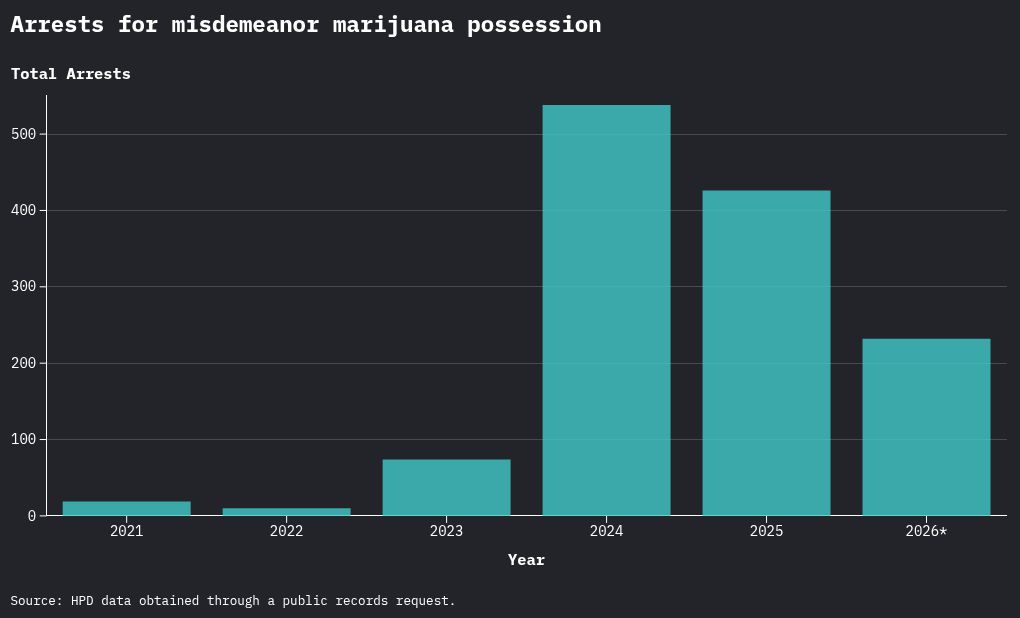
His comments came days after Houston Public Media reported a nearly 1,200% increase in misdemeanor marijuana arrests by the Houston Police Department under Whitmire compared to the three years before he took office.
“It’s a very complex issue, and certainly you’re playing loose with those numbers,” Whitmire said on Wednesday. “It’s largely the change in district attorney. Charges don’t come about without talking to the district attorney.”
Sign up for the Hello, Houston! daily newsletter to get local reports like this delivered directly to your inbox.
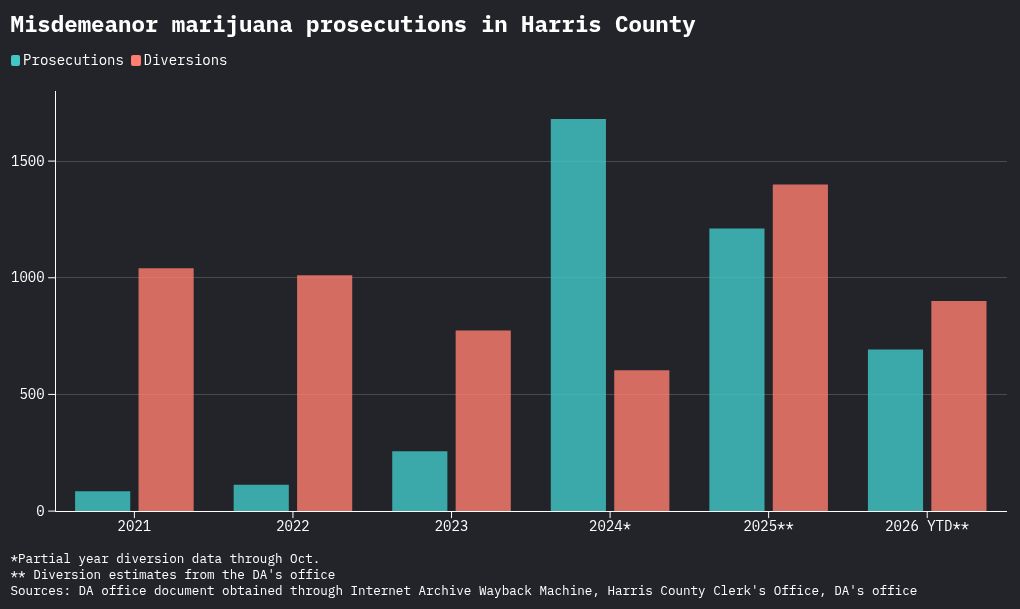
According to an analysis of Harris County criminal court records, the Harris County District Attorney’s (DA) Office ramped up prosecutions of misdemeanor marijuana cases in 2024 — from an average of 151 in the preceding three years to more than 1,600 — before Teare took office.
Kim Ogg ran the office until Teare took over in 2025 after defeating her in the Democratic primary. Prosecutions have remained elevated under Teare, with more than 1,200 last year and nearly 700 so far this year.
Shifting policies in the DA’s office
Ogg implemented a diversion program for misdemeanor marijuana possession in 2017, offering a path away from jail if alleged offenders agreed to complete 90 days of community supervision and a cognitive course.
“It was a negotiated compromise [with law enforcement leaders] so that we could keep cops on the street longer and stop ruining individual work and school opportunities through unnecessary convictions, especially when marijuana was legal in so many states,” Ogg told Houston Public Media on Wednesday.
But in Aug. 2023, Ogg issued a memo stating her office would “now evaluate every drug possession case … for the direct filing of charges,” citing “the increasing public safety threat of fentanyl.” In 2024, the first full year after the memo, prosecutions surged by more than 550%.
Teare’s office shared the memo with Houston Public Media in response to questions about the spike in marijuana prosecutions — but Ogg argued it wasn’t relevant.
“That has nothing to do with marijuana. It has zero to do with marijuana,” Ogg said. “It was all directed at control substances, namely fentanyl or white powdery substances that could have been fentanyl, but weren’t known to police until and if lab tests were done.”
Ogg attributed the spike in prosecutions to “arrests reaching a pre-COVID normalcy.”
A spokesperson for Teare said the memo “absolutely corresponded with the spike in marijuana prosecutions.”
After Teare took office, he expanded eligibility criteria for the diversion program. Participation has increased while prosecutions have ticked down — but his office is still accepting misdemeanor marijuana cases at an elevated level compared to 2023. Teare was not made available for an interview.
“I want to strongly emphasize that DA Teare has long been on record as opposing the use of law enforcement resources to go after low-level non-violent drug charges,” a spokesperson for DA Teare said in a statement. “But he still has to operate within the clear confines of state law.”
In 2023, the Texas Legislature curtailed local prosecutors’ ability to not pursue certain crimes — like low-level marijuana possession. Potential penalties include removal from office.
The DA’s office prosecuted more than 7,400 misdemeanor marijuana cases in 2016, before the diversion program began, and a spokesperson for the office said those types of cases currently comprise “a miniscule number — .021% — of misdemeanor charges we now take.”
Does HPD have discretion?
On Wednesday, Whitmire argued the DA’s increased willingness to prosecute low-level marijuana offenses drove the spike in arrests.
“Personal use of marijuana is not a priority of HPD,” Whitmire said. “The officers use discretion when they discover personal use of marijuana. We talk to the district attorney’s office, and they make the final decision whether anyone will be accepted in intake. I know you might not like that number, but those are the facts.”
According to former DA Kim Ogg, Whitmire shouldn’t be held responsible for the spike in arrests.
“The question shouldn’t be directed to Mayor Whitmire — it should be directed to the police department about what their internal policies are,” Ogg argued. “How much discretion do law enforcement agencies have over whether or not to arrest or issue a citation if the DA’s office is accepting the charges and not referring someone to a diversion program?”
How officers respond to small amounts of marijuana is “totally dictated” by department leadership and the DA’s office, according to South Texas College of Law assistant professor Tom Hogan.
An HPD spokesperson did not respond to a question about the department’s marijuana policies.
HPD officers used to be able to avoid charges altogether by forcing people caught with small amounts of marijuana to “trash it or dispose of it,” said Houston Police Officers’ Union President Douglas Griffith.
“You can’t do that anymore with body cameras,” Griffith argued. “You’re considered tampering with evidence. So now everybody has to deal with the diversion program or get charged.”
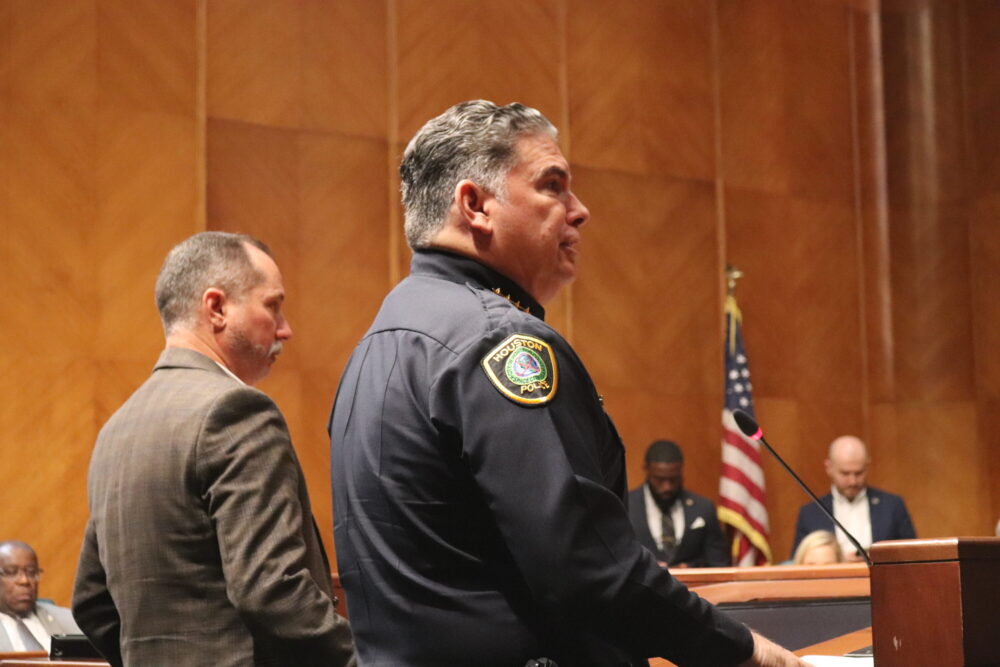
Dominic Anthony Walsh/Houston Public Media
Houston Police Chief Noe Diaz, right, and Houston Police Officers’ Union president Douglas Griffith speak at a Houston City Council meeting on Wednesday, May 21, 2025.
Griffith opposes a local proposition on the November ballot that would instruct HPD to make “misdemeanor marijuana possession its lowest possible enforcement priority.” On Wednesday, Whitmire agreed it wasn’t needed.
“Houstonians will get to speak, but even before the ballot initiative, it is not a priority of HPD,” Whitmire said. “You know it, I know it, and most of us realize that.”
Related: Houston voters to consider deprioritized enforcement of cannabis laws, ban on no-knock warrants
In 2025, HPD arrested 426 people for misdemeanor possession of marijuana — comprising about a third of the more than 1,200 such cases prosecuted by the DA’s office last year. Other cases came from the county sheriff and constables, school district police departments and other law enforcement agencies.
More people participated in the diversion program — about 1,400, according to the DA’s office — than were arrested by all law enforcement agencies. HPD cases accounted for more than a third of the diversions, referring 534 people to the program.
The DA’s office sits “at the bottom of a funnel for dozens and dozens of law enforcement agencies that can arrest you in Harris County,” said Jeff Reichman, principal consultant at January Advisors, which published an analysis of Harris County marijuana prosecution data in August.
“At the end of the day, we’re not seeing the level of arrests that we were seeing in 2016 and before, but we know that marijuana use is definitely up in the last 10 years,” Reichman said. “So ultimately this is a policing issue. This is whether or not police choose to arrest for these offenses.”