
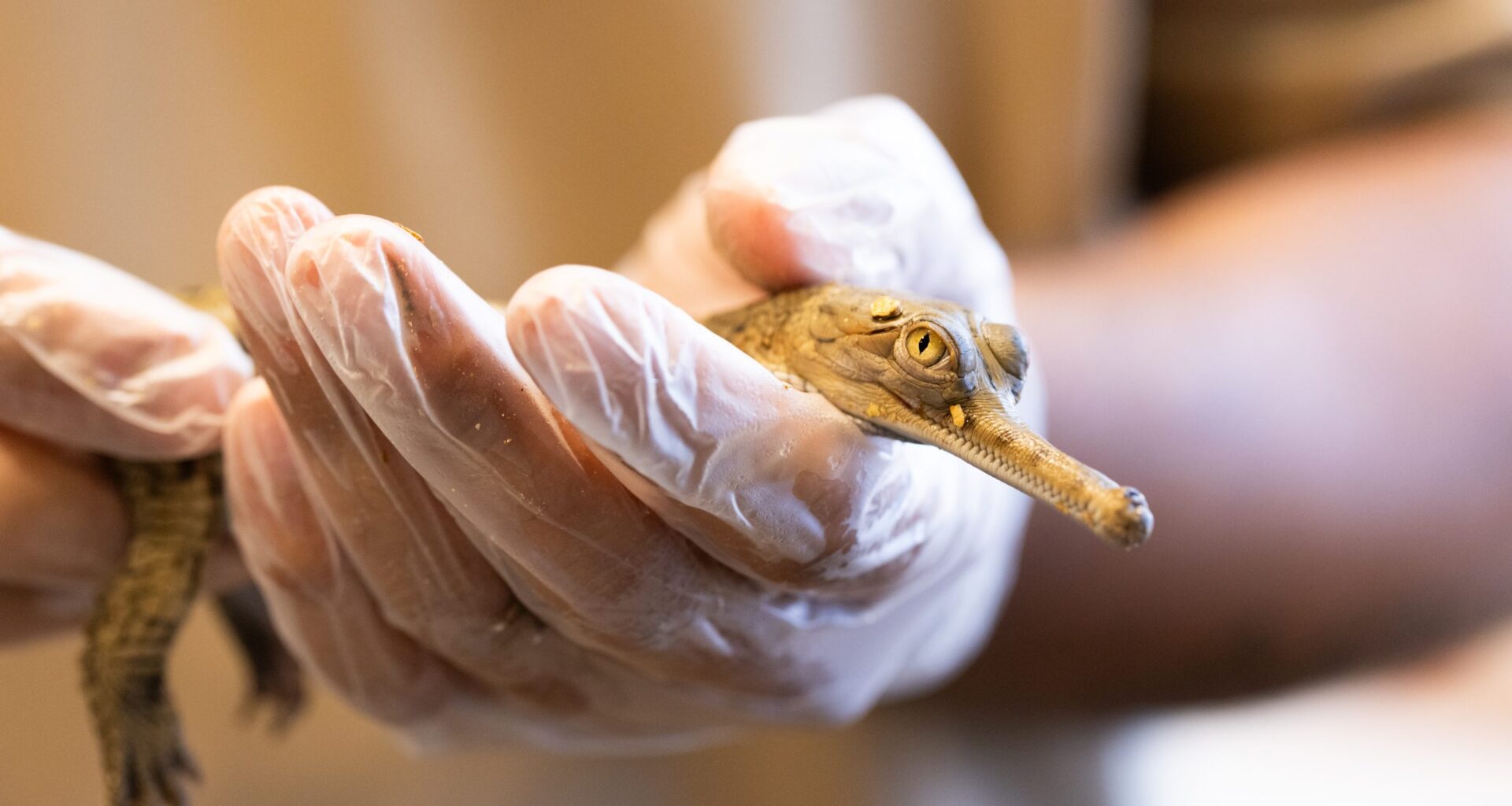
The Fort Worth Zoo is celebrating a record-breaking fourth consecutive year of gharial crocodile hatchings, with eight gharials hatching this summer. The milestone further solidifies the Zoo’s leadership in gharial conservation: Fort Worth Zoo remains the only institution in North America to have produced multiple offspring of this critically endangered species and the only institution to have successfully repeated the achievement in consecutive years.
Small adjustments have been made each year to fine-tune the breeding, incubation and husbandry processes. This year, for example, the Zoo added additional heated nesting logs to the adults’ outdoor habitat and zookeepers continued to carefully adjust incubator temperatures of the eggs as well. (For gharials and many other reptiles, incubation temperature plays an important role in determining the sex of the offspring.) While experts can’t point to one specific adjustment that led to this year’s high hatching rate, they believe the cumulative effect of these modifications year over year has contributed to the Zoo’s continued success.
“It’s very rewarding to have another year achieving the healthy hatchings of these unique and vulnerable crocodiles,” said Vicky Poole, associate curator of ectotherms at the Fort Worth Zoo. “Every successful hatch gives our team another opportunity to refine our techniques and deepen our understanding of this remarkable species. The knowledge we gain through this work is an important part of the Fort Worth Zoo’s contribution to gharial conservation that we can share with our partners around the world.”
For now, this year’s hatchlings remain behind the scenes at the Zoo for close monitoring of their growth and development. Guests can see juvenile gharials hatched from previous years in their indoor habitat within the Zoo’s herpetarium, Museum of Living Art (MOLA). This is the only place in North America where guests can observe and appreciate juveniles of this critically endangered species!
This multi-year success of gharial hatchlings is the product of more than 15 years of dedicated effort to reproduce this species, grow the population and diversify the gene pool. This year’s gharials hatched from June 3 to 26 and from clutches representing two different females’ genetic material.
The Zoo’s adult gharial habitat, located just outside of MOLA, was specifically designed in 2010 to promote conservation and breeding success. These breeding-focused features include regulation of water temperature, gently sloped waterfront to provide easy access to both wet and dry areas with their short legs and heat coils in the sand to ensure the sand stays hot enough for the females to lay eggs.
The gharial is one of the largest crocodilian species, known for its long and thin snout, which makes it particularly skilled at hunting and eating fish. The gharial is a great swimmer and spends most of its life in a cool underwater environment. While the hatchlings are just over 12 inches now, they will quickly grow, and their snouts will continue to elongate. Male gharials can grow to 16 feet and weigh nearly 1,500 pounds, while female gharials stay slightly smaller. The gharial crocodile is critically endangered for a variety of reasons including habitat destruction, pollution and river fragmentation, making it challenging for gharials to survive in their native habitats.
Related
Fort Worth Report is certified by the Journalism Trust Initiative for adhering to standards for ethical journalism.