
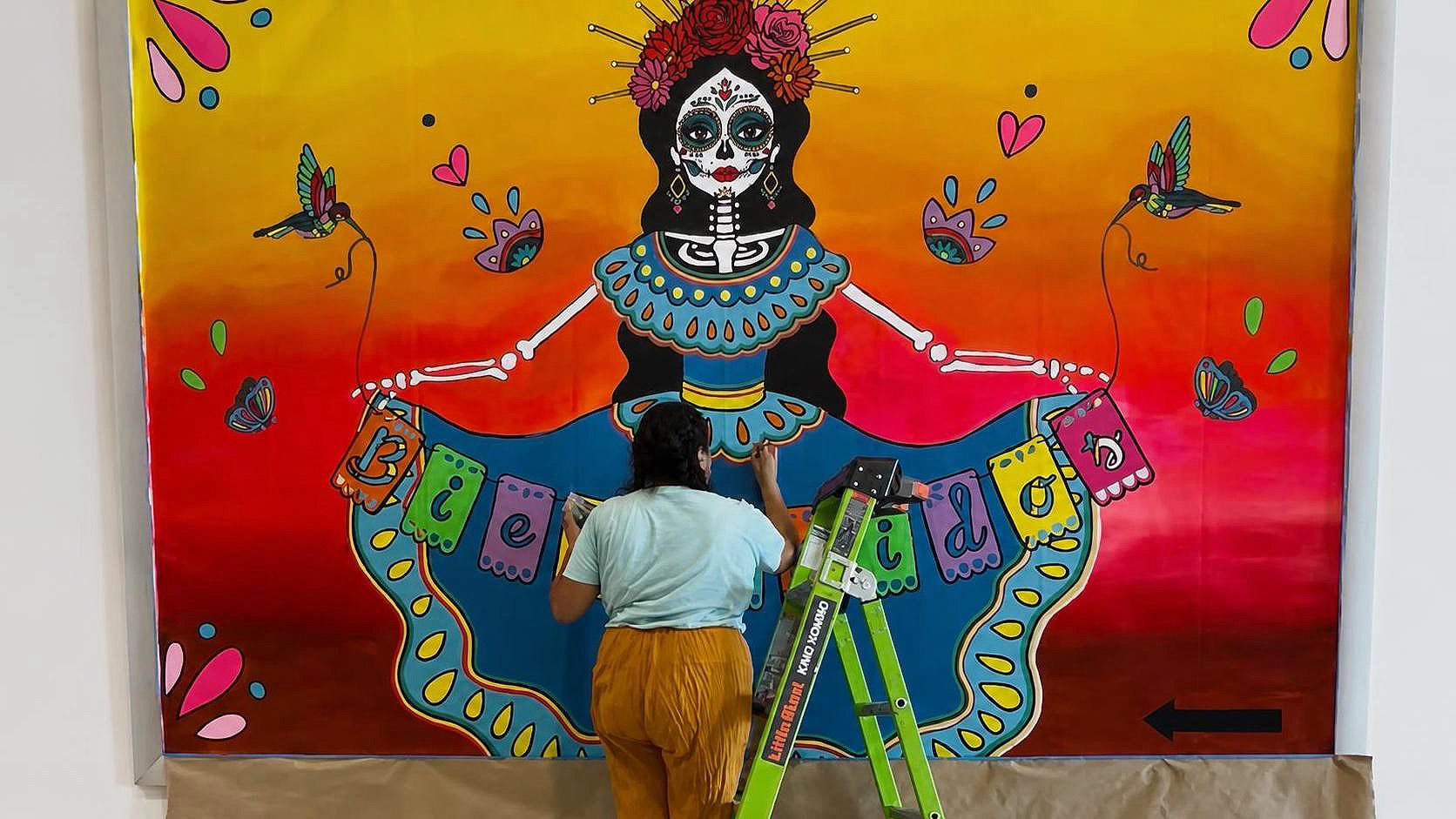
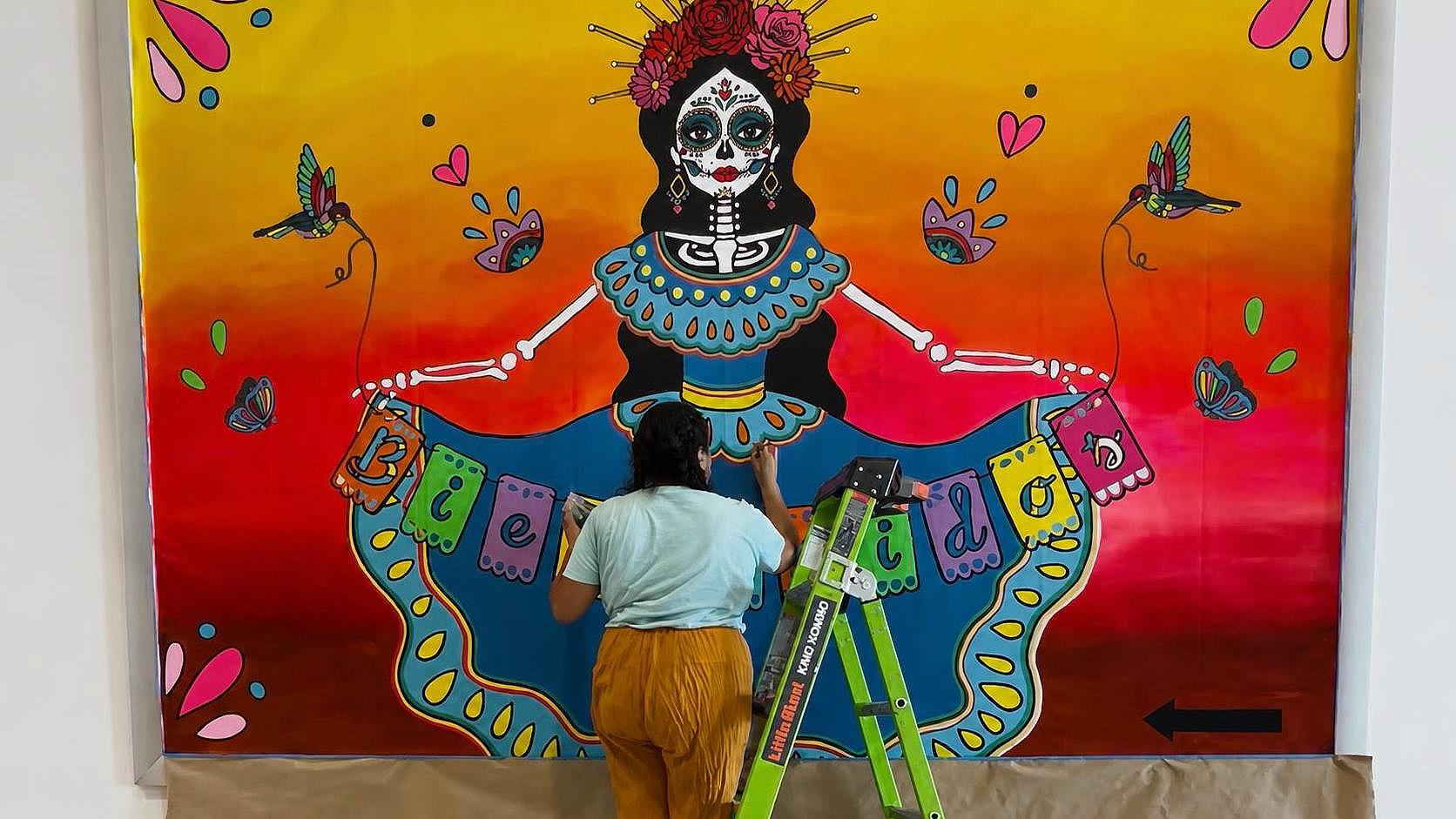
Mixed media artist Kimberly Bernal, pictured painting a mural, is among
the nearly 30 artists featured in “Mi Familia.”
Photo provided by
Bungieo Art
Curators Ariel Esquivel and Junanne Peck have made the J. Erik Jonsson Central Library the setting for “Mi Familia: Día de los Muertos,” a community-centered group exhibition where remembrance, healing and cultural tradition meet contemporary art. Running now through Nov. 1 on the library’s fourth floor, “Mi Familia” gathers works from nearly 30 artists specializing in painting, printmaking, photography, mixed media, fiber art and sculpture.
At the heart of the exhibition sits Esquivel’s interactive community ofrenda, an altar that continually honors someone new. Visitors are invited to add to it: a photograph of someone loved and lost, a handwritten letter or any other tribute. Over the run of the show, the altar grows the way memory grows, layer upon layer. The genius of the piece is that it dissolves the wall between viewer and artwork.
Nearly 30 voices, one shared table
Sign up for the Arts & Culture newsletter to get the latest stories delivered to your inbox
THANK YOU!
You’re all set.
CLOSE
The artists arrive, each carrying their own history, and their stories run through the veins of the exhibition. Among the almost 30 voices represented are local multidisciplinary artists Xeomara Ortiz Montes, Laura Carrasco and Angeles Garcia Aguilar, each bringing their own cultural perspective and vision of familal rememberance.
DFW mixed media artist Kimberly Bernal frames her practice as an act of devotion.
“My work comes from a place of love and remembrance,” she says. “Even when someone is no longer here, the love we have for them never goes away. We remember, we honor and we carry that love with us, always.”
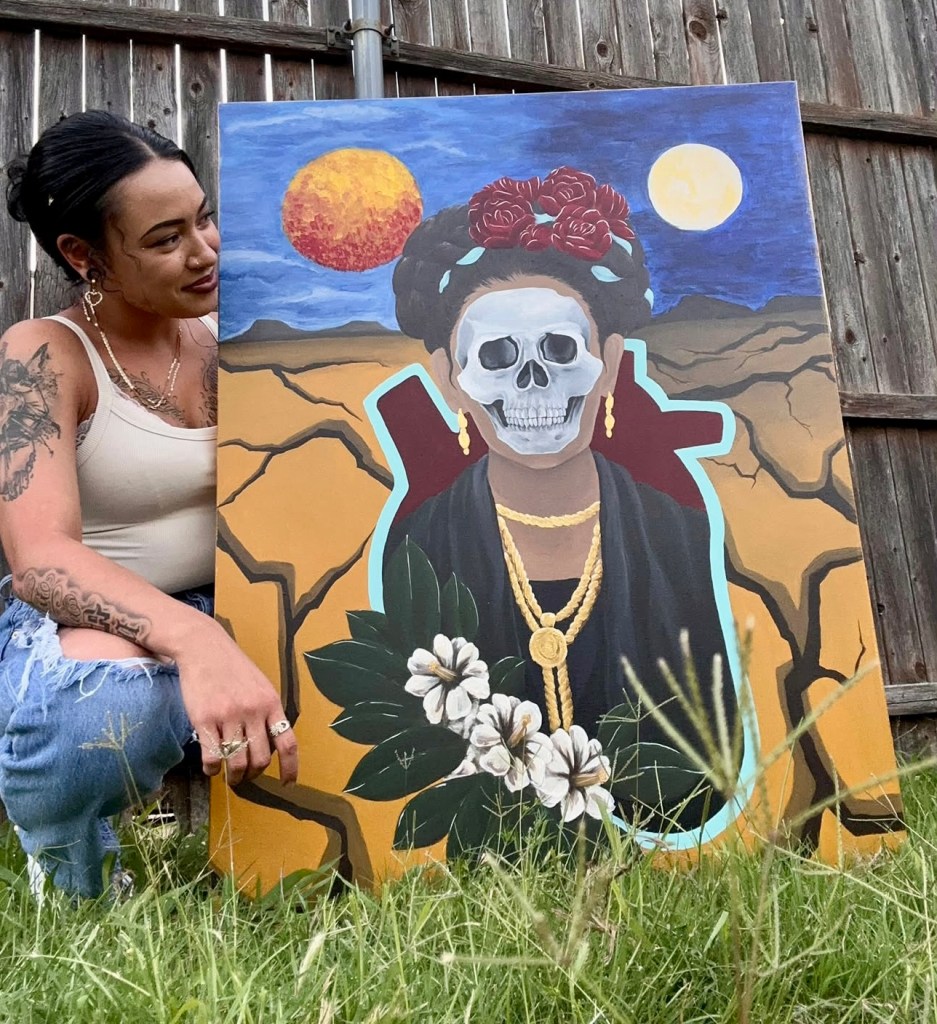 Fort Worth painter and tattoo artist Dani B poses with her Frida Kahlo-inspired work that will be featured in “Mi Familia.”
Fort Worth painter and tattoo artist Danica Benitez, known to many as Dani B, is drawn to how the holiday brings people together.
“The art, the food, the music, the love, is so strong like our people,” she tells us. Her contribution honors an icon who was controversial in life and immortal in memory: Frida Kahlo.
Dallas visual artist Barú, also known as Braulio Lazón Conde, pushes the tradition into sharper territory. His woodcut triptych, “The Migrant’s Ofrenda,” unfolds across three panels: “Consumed by the Root,” “Water’s Sacrifice” and “The Beast’s Line.” For Barú, the altar is “a living platform to raise awareness and honor our community’s endurance, from the heavy realities carried across borders to the deep roots anchored in this soil.” His work reclaims the ofrenda as an active site of critique and memory around migration and displacement, proving the form can mourn and challenge at once.
The ofrenda that belongs to everyone
For co-curator Peck, Día de los Muertos was a revelation that arrived in adolescence.
“Growing up in a white culture, all we ever did was visit our relatives and friends’ graves,” she recalls.
A move to New Mexico in middle school changed everything.
“[I learned] to celebrate death and passing with respect and joy,” Peck says. This year, her work honors her little brother Bevo, who died of cancer at just six years old. “Día de los Muertos and Mexican culture has given me so much,” she adds.
A curatorial approach built on trust
If the names Esquivel and Peck sound familiar, they should. Earlier this year, they curated a Chicano exhibition at Art on Main that brought culture, vibrant color, and lowriders to the East Dallas gallery. The two return to collab by celebrating their culture and the artists who continue to preserve it. That is the quiet through-line of their partnership: the spotlight remains on the artists, the community and the people who are no longer here to speak for themselves.
Most group shows begin with a call for entries, a submission portal and a spreadsheet. “Mi Familia” began more informally. For this exhibition, Esquivel skipped the usual maze of applications and email chains, instead bringing artists together through a mix of personal invitations and an open-ended note on Instagram that prompted others to reach out.
The result is a room assembled by instinct and relationship rather than bureaucracy. Each artist was given the freedom to bring work that honors a memory, a loved one or their own understanding of Día de los Muertos. No prompts. No prescriptions. Just trust.
That trust has grown into something the curators didn’t fully plan for. The participating artists now share a group chat that hums daily with progress photos, encouragement, questions and the ordinary tenderness of people building something together. They cheer each other on. They keep one another going. What started as a checklist of names has become, fittingly, a family.
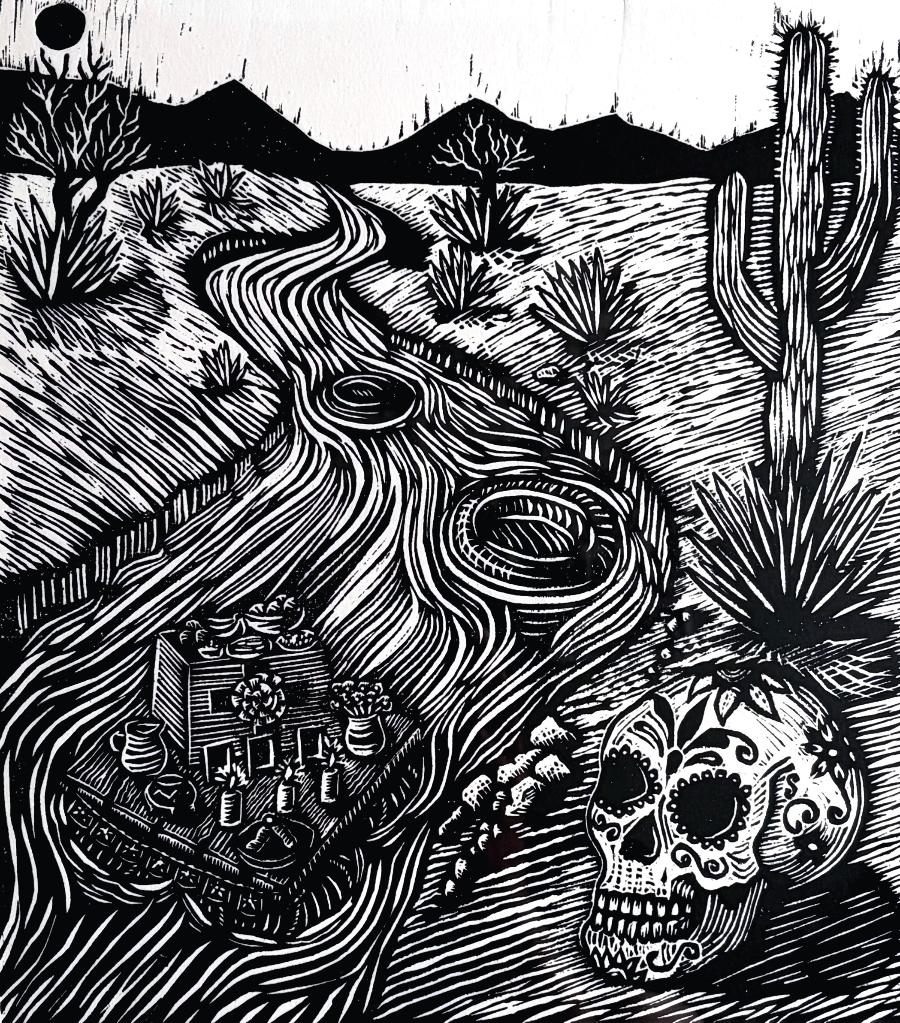 “The Migrant’s Ofrenda,” a three-part woodcut triptych by Dallas visual artist Barú, is featured in “Mi Familia.”
“We’re all family. We’re all connected. We’re all here together,” Esquivel says.
She envisions the show as a place where people can gather, connect, learn, heal, grieve and celebrate life all at once, ensuring that those who have passed are honored rather than forgotten. It’s a generous premise, and “Mi Familia” delivers on it at scale.
“Mi Familia: Día de los Muertos” is on view at the J. Erik Jonsson Central Library (1515 Young St.). The exhibit is free, viewing hours can be found on the library’s website.