
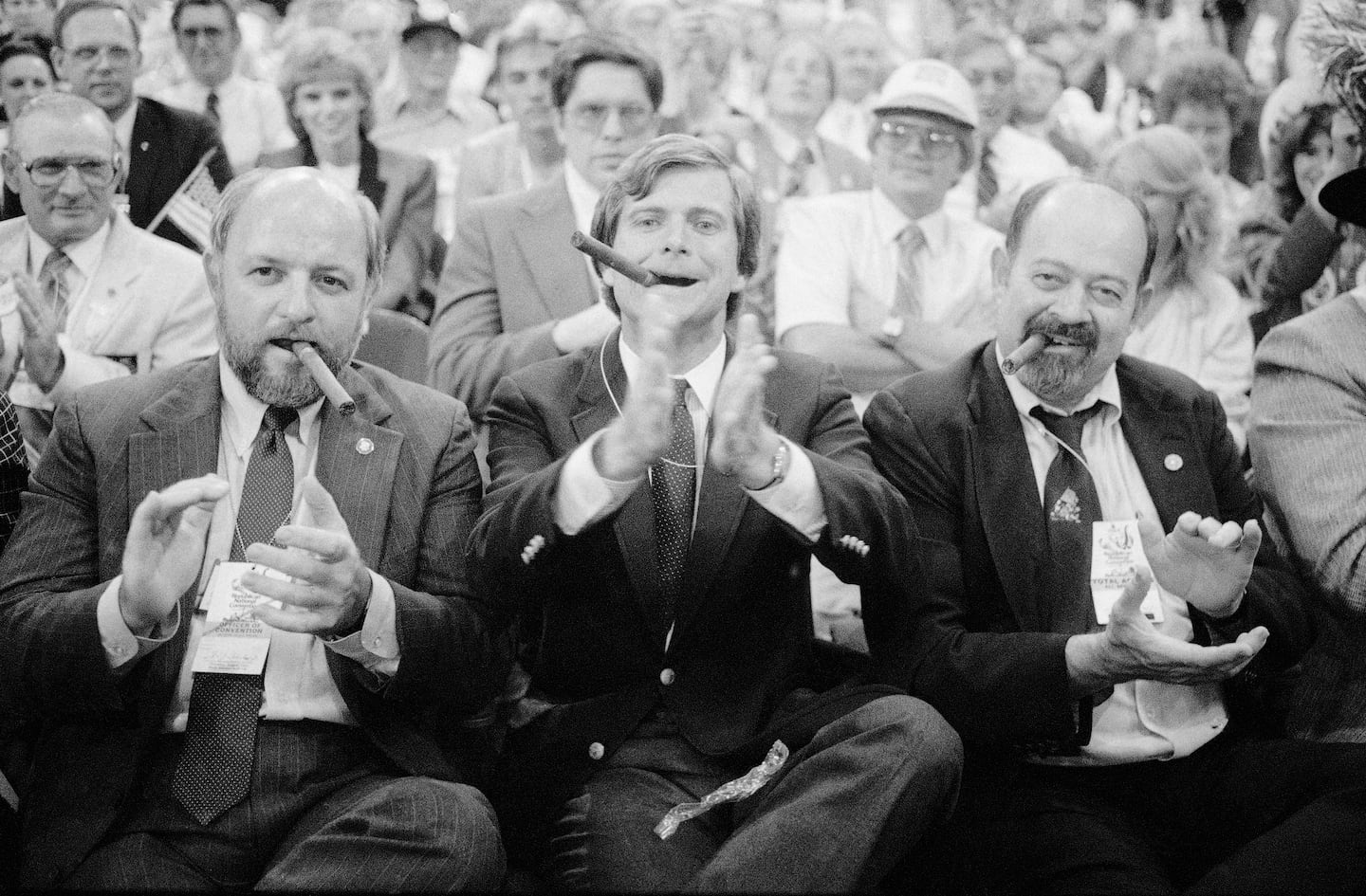
Longtime Massachusetts Republican operative Ron Kaufman has attended every Republican National Convention since 1976. The 1984 convention in Dallas, he said, is one of his favorites. (He is in Maine this week instead of Dallas.)
Get Starting Point
A guide through the most important stories of the morning, delivered Monday through Friday.
“It was uplifting,” said Kaufman, who was active in the Reagan White House and the RNC during Reagan’s first term. “To be clear what is happening this week is not a convention. But it appears to raising a lot of money, which is a good thing, and you can’t blame them for trying to change the conversation nationally.”
The lack of unity was one of the most glaring differences.
In 1984, former president Gerald Ford, who was primaried by President Reagan in 1976 when he was seeking reelection, spoke and united the party. In addition, Barry Goldwater, who was the nominee 20 years before, spoke in terms of how the long arc of the GOP led to the Reagan presidency.
Does Trump have a Gerald Ford-like figure to call up to try to unite the party? Why, yes. There IS a former Republican president with whom he has a beyond-frosty relationship whom he could call up to unify the party. His name is George W. Bush. He actually lives in Dallas. It turns out he was in town Wednesday because he held a Sept. 11 event with former Secretary of State Condi Rice at his presidential library during the first night of the convention.
A trip to the George W. Bush Presidential Center on the second day of the convention was full of elementary school children on a field trip, but no RNC delegates to be seen. Indeed, the Massachusetts Republican delegation organized a tour to the site where President Kennedy was killed, but not to the Bush center.
But the respective brands of Republican are a fracture that isn’t going to mend this week. Instead, it’s not hard to imagine Bush receiving the same treatment as Senate leader John Thune, who was booed by the convention goers as he stood on the floor among them.
Attempting to appeal to female swing voters, Reagan’s campaign put six high-profile women on stage, including Treasurer Katherine Ortega, who gave the keynote, Jeane Kirkpatrick was the “life-long Democrat,” and Transportation Secretary Elizabeth Dole. This year, just five of the 47 listed speakers are women and none are currently in the administration. (They are former press secretary Karoline Leavitt, three House member, and a House candidate.)
Of course, the goals of a presidential convention are different from those of this invented midterm one.
The goals of this midterm convention appeared to be to raise gobs of money and have a message only for the Republican base to drive turnout.
There could be some sense in doing that. Midterm elections are often about convincing those base voters who already agree with you to get out and vote.
However, there are many ways to do that that don’t involve using up valuable national television time, where the message could be broader.
The 1984 convention also had a message about what the current administration had already done and what it wanted to do next. The 2026 convention is very much not consistently talking up even some popular themes, like the Trump Accounts for children, or talking about how they will address affordability concerns or even trying to spin the Iran war as a good thing. Those things were rarely even mentioned.
Instead, mocking and demonizing Democrats appears to be the one unifying principle, other than, of course, Trump himself.
One thing we do know is that the formula at the 1984 convention worked. Reagan won 49 out of 50 states in his reelection weeks later. Whether anything positive for Republicans comes out of the 2026 convention is something we will have to wait and see.
James Pindell is a Globe political reporter who reports and analyzes American politics, especially in New England.