
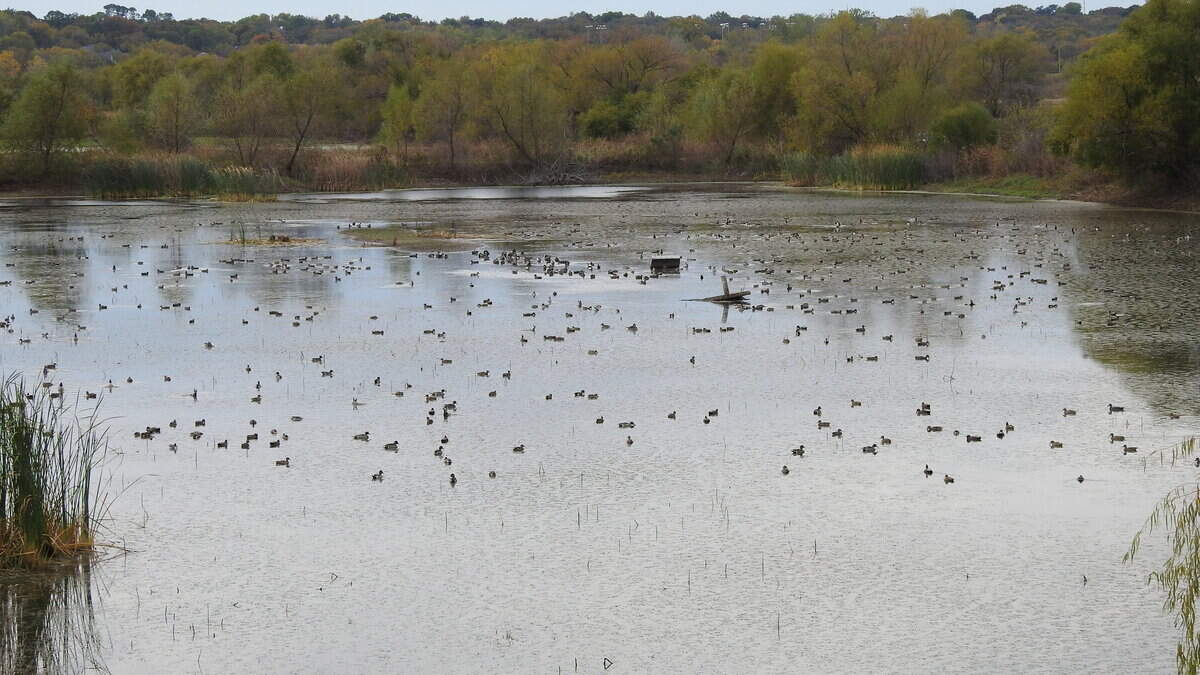
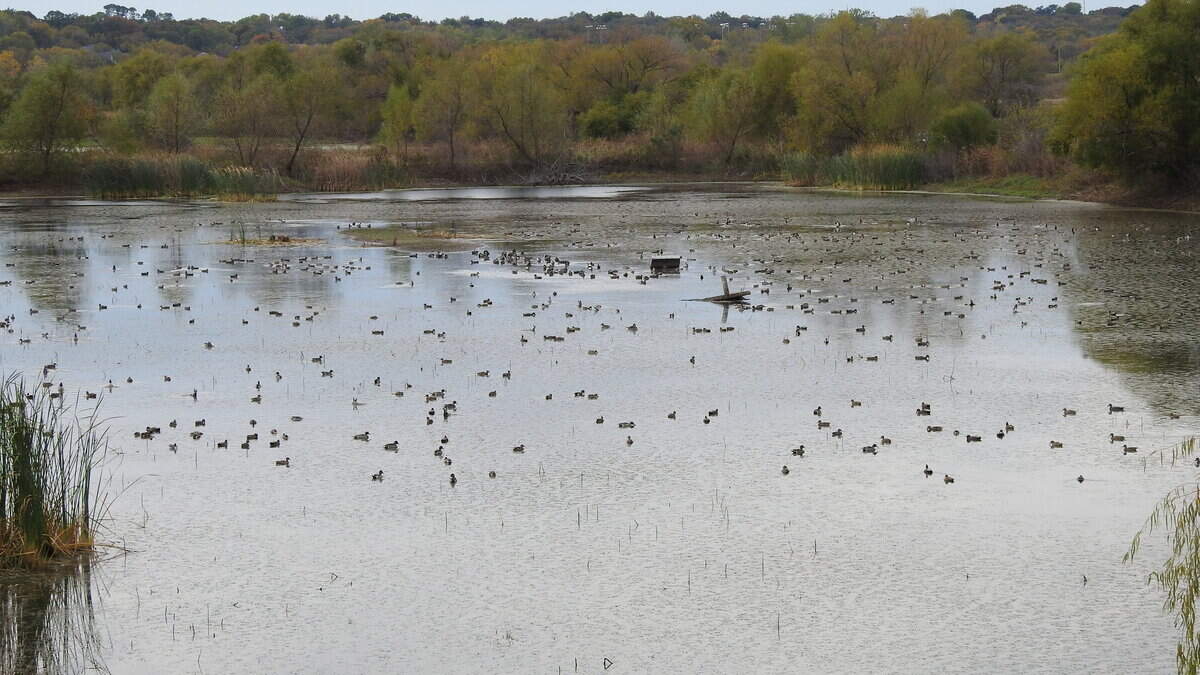
Wetlands at Fort Worth’s Village Creek Water Reclamation Facility have long provided a refuge for waterfowl and migratory birds. Here, ducks populate a pond on the site in November 2024. In recent months, these wetlands have dried up, meaning a loss of habitat for avian species.
Colby Ayers
Courtesy of Colby Ayers
For years, marshy land east of Fort Worth’s Village Creek Water Reclamation Facility was the prime destination in Tarrant County for bird watchers, offering a chance to glimpse a wide array of avian species from across North America.
Today, though, the site is dry. What were previously wetlands for parts of the year have been overtaken by vegetation, making the area less hospitable for birds and other creatures. Now, a local birder wants to know why the city of Fort Worth hasn’t done more to protect what has long been documented as an important bird habitat.
On the west side of the property, which Fort Worth owns, there are tanks and other equipment for receiving, clarifying and treating wastewater before it is discharged into the nearby West Fork of the Trinity River. Part of that process involves removing solid waste from the water, which is treated and converted into what’s called biosolids. That material is then dried and used for fertilizer.
On the east side of the property are drying beds for the biosolids. When not in use, the beds would fill with rainwater, and bird enthusiasts went there to view shorebirds, waterfowl and other species that used the site as a stopover point during migration seasons.
According to a database maintained by Cornell University, more than 320 bird species have been recorded at the Village Creek water treatment site.
At least once, during a period of drought five or six years ago, birders worked with the city’s Water Department to fill the drying beds with water to accommodate avian visitors.
Everything changed last year.
In May 2025, a nearby oil pipeline owned by Energy Transfer, a Dallas company, leaked 6,800 barrels of crude oil into a sewer line that fed into the Village Creek water treatment plant. As part of the remediation process, wastewater sludge that was contaminated with oil was moved to the drying beds until it was dry enough to be hauled away to landfills.
At that time, the property was closed to bird watchers and others who used the area for recreation, with the city citing safety concerns. More than a year later, it’s still largely closed to visitors, except on certain occasions. Last December, for instance, birders were allowed inside to conduct the Audubon Society’s Christmas Bird Count.
Colby Ayers of Euless is an avid bird watcher who frequented the Village Creek drying beds for two decades. In recent years, he was a daily visitor before access was restricted.
For more than a year, he’s lobbied the city to restore that access, but even if that can’t happen, he’d like to see Fort Worth restore the wetland area on the east side of the property so it is once more attractive to migratory birds.
“Water has been out here for 50-plus years,” Ayers said. “In the wintertime, we’re talking thousands of ducks and waterfowl. Multiple species use Village Creek as their wintering ground. Birds have site fidelity: they recognize sites, and if they get used to a site, they come back to that location.”
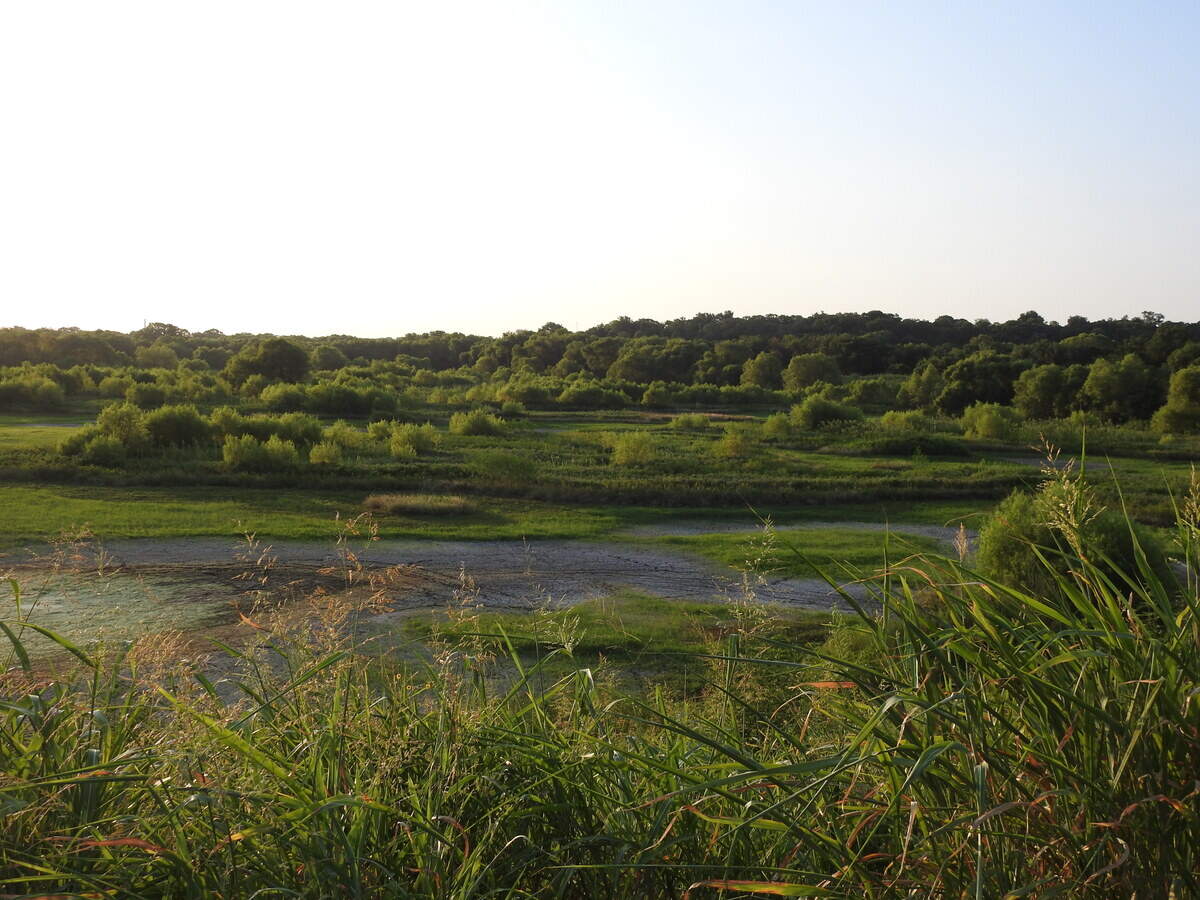 The biosolids drying beds on the east side of Fort Worth’s Village Creek Water Reclamation Facility haven’t held water this summer, making them less attractive to birdlife. A city official said there are no plans to reintroduce water to the site to accommodate migratory birds and waterfowl. Colby Ayers Colby Ayers
Shane Dubay, an assistant professor of biology at the University of Texas at Arlington, said birds follow migration paths with established stopovers. Dubay compared these to roadside stops where drivers can get a snack and a coffee and fill up on gas en route to their destinations.
Likewise, sites like Village Creek are safe havens where birds can rest and refuel for journeys that can be thousands of miles long. When those disappear, it has consequences.
“With migration already being demanding, losing important stopover sites is known to impact survivorship and [birds’] ability to make this journey,” said Dubay.
A study published in 2019 found that the North American bird population had shrunk by about a third since 1970. That equated to about 3 billion fewer birds, researchers said. Habitat loss was cited as the main driver.
Dubay said losing migratory stopover sites only adds to the stress on bird populations. When one site disappears, it might not be fatal, but when a site is lost in conjunction with others, the cumulative effect does have an impact, said Dubay, who pointed to the larger issue of wetland loss across the country.
“The drying beds don’t exist in isolation,” he said.
When asked about the current situation at the Village Creek property, Mary Gugliuzza, spokesperson for Fort Worth Water, said the wetland area dried up naturally, but unlike in previous years, there was no plan to refill the drying beds.
While the beds aren’t always in use, Gugliuzza said, filling them with water would make them unavailable if needed. The focus is on keeping the site ready for operational needs.
As has been the case since last year, birders can contact Gugliuzza to request access to the drying beds. That access is generally granted to bird-watching groups on designated days.
That doesn’t sit well with Ayers. He hears the city’s position, but he doesn’t see how allowing bird watchers to visit the site unimpeded will affect operations, especially after it was done for so many years prior to the oil spill without incident, at least from his perspective.
More importantly, Ayers fears that if the city does nothing to maintain the wetlands, Village Creek will cease being a temporary home to so many species of birds that might not otherwise be found in North Texas.

Fort Worth Star-Telegram
Matt Adams is a news reporter covering Fort Worth, Tarrant County and surrounding areas. He previously wrote about aviation and travel and enjoys a good weekend road trip. Matt joined the Star-Telegram in January 2025.