
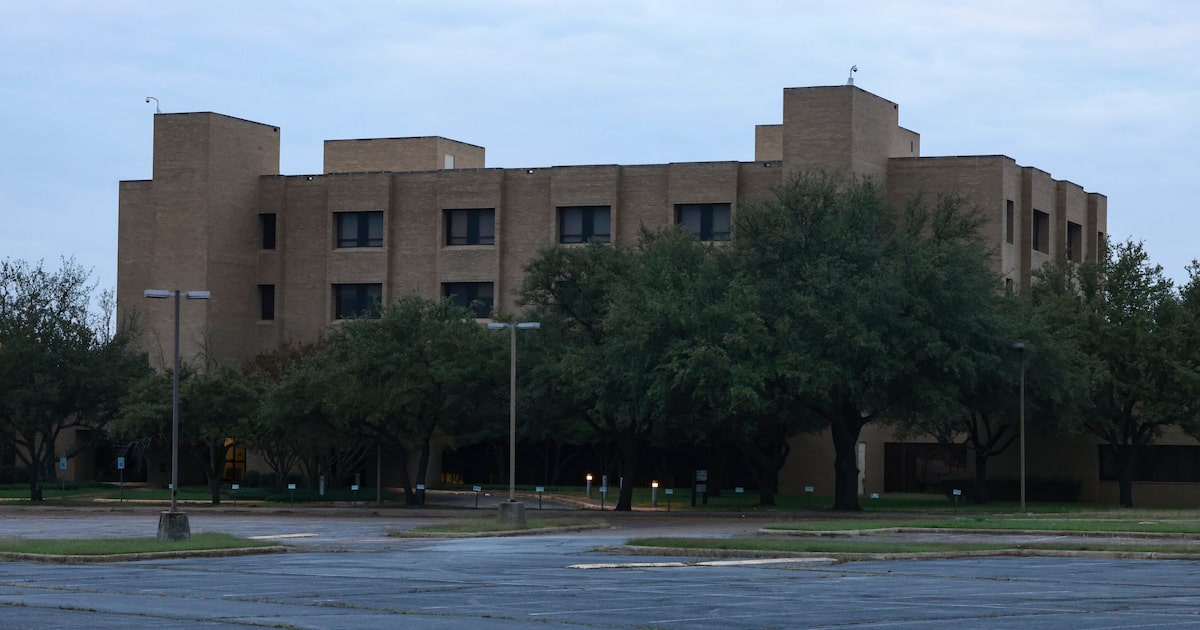
The future of a vacant Oak Cliff hospital, which has drawn contention in southern Dallas over the years, is up for grabs.
Community members resisted city plans to put homelessness services there. Dallas made the purchase in 2022, shocking neighbors with the hospital’s proximity to an elementary school, a library and Kiest Park.
Now, Dallas is looking to sell the nearly 14-acre property it bought for about $6.5 million. Residents say they don’t want to see southern Dallas treated as a dumping ground for other parts of the city. Several said they want retail or housing that would be a step toward amenities that put them on par with areas north of Interstate 30.
Related

“For so many years, so many decades, so many generations, the city of Dallas has not had a positive vision for this part of town,” said Anga Sanders, a longtime resident and community activist.
Political Points
The property’s sale could mark progress in changing this narrative, depending on what it becomes. Buyers will have to make an offer Nov. 14. According to city staff, the council could be briefed on the offers in executive session, along with staff recommendations, before the end of the year. The city’s decision to sell would mark the beginning of a process to transform the vacant space.
The hospital could turn into a mixed-use space with housing and businesses, spurred by a local developer in southern Dallas. Another idea, an independent living community for people with disabilities modeled in Illinois, has drawn criticism. Still, the site could become something entirely different, as it’s still early in the process. All ideas may not be public.
The controversy surrounding the site at 2929 South Hampton Road has been misconstrued, said council member Zarin Gracey, whose district includes the hospital. He added that there’s a need to make up for historical neglect that is driving community priorities rather than a distaste for other services.
“It’s not really a ‘not in my backyard,’” Gracey said. “It’s more of a, ‘We’ve been asking for this for the longest, and then you’re giving us a homeless shelter versus making this an asset.’”
Gracey said, based on what he’s heard from the community, he’d like to see a property that connects Kiest Park with the nearby Oak Cliff Nature Preserve, library, senior living and other community aspects. People who frequent the busy park would have a space to stick around and spend their dollars, grabbing a coffee or a bite to eat, he said.
On Tuesday night, Michael Poulakidas, CEO of JTE Real Estate Services, and Richard Irvin, who has been involved with Illinois politics and now leads Stone Construction Development, along with others involved with the project, held an open house. They explained why the hospital was well-suited for an independent living community, including for seniors, and took in-person feedback after receiving criticism online. The meeting was across the street from the hospital, at the Hampton-Illinois Branch Library.
On Thursday, community members gathered at the Kiest Park Recreation Center to hear from developer Monte Anderson of Options Real Estate and planner Patrick Kennedy in a meeting organized by Sanders. She said she was not working for Anderson or Kennedy, but “doing it from the heart” after being convinced of their vision.
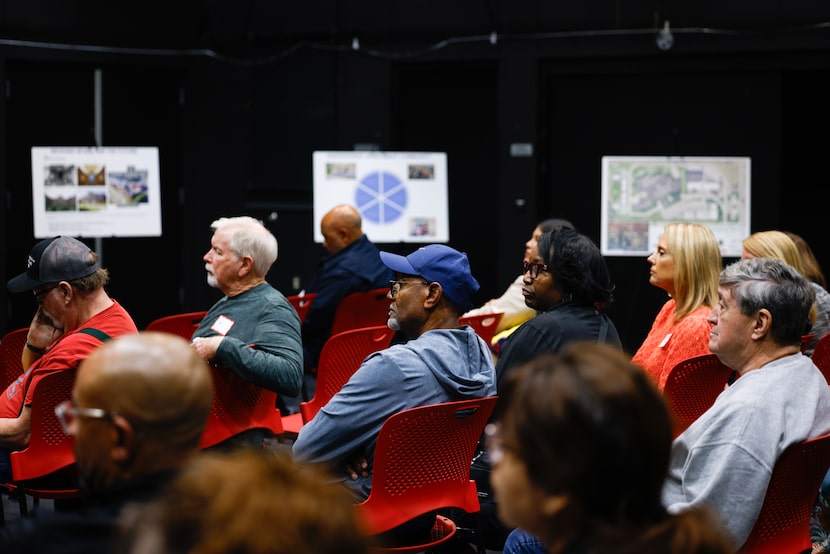
Community members attend a open house for the Hampton Road development Tuesday, Nov. 4, 2025, in Dallas.
Christine Vo / Staff Photographer
For some, the independent living option was seen as more of the same, despite the developer’s assurances that it would take into account safety concerns. The community would mirror one in Illinois, which is also in a former hospital building and near a school, and could include a clinic.
The communities are designed for people with intellectual, cognitive or developmental disabilities who have shown they can learn and are healthy, receiving a risk assessment as part of being at the community, said Andy Hubble, Executive Director at Weston Bridges, the community in Illinois.
Hubble said he was aware of the online criticism the site has received, but the apartments would not be for people with mental illness or struggling with homelessness. In Illinois, most residents are employed, Hubble said, adding that thousands in the Dallas area could need independent living.
“We’re a community that’s designed for individuals to thrive with a disability,” Hubble said.
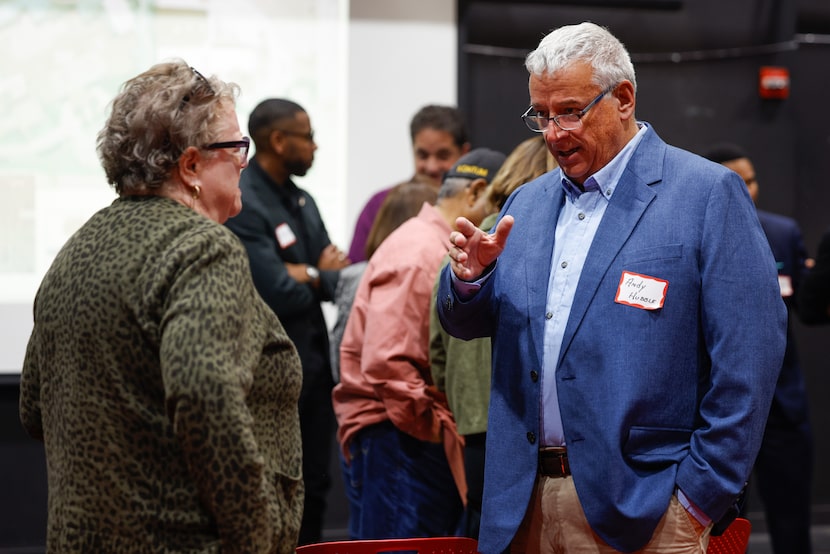
Andy Hubble, Independent Apartment Communities managing partner, (right) speaks with Cathy Lauer, 60, after a community open house for the Hampton Road development Tuesday, Nov. 4, 2025, in Dallas. Lauer said, as a resident who has lived 1.2 miles from the proposed site for 32 years, she is very invested in what happens in the area and demands the city include the community in these decisions.
Christine Vo / Staff Photographer
James McGee, president of the Southern Dallas Progress Community Development Corporation, was at the meeting Tuesday. He said he was intrigued by the independent living concept, seeing it as a unique asset. Though he said the area should have more retail, McGee said there are people in the community who could benefit.
“It’s a subset of people that do need housing that’s never really talked about,” McGee said. “I have a good friend, his son has special needs.”
With the property’s history, McGee called it a “high-animosity situation,” adding that community members need clarity on what could happen to the property in the future. But he said it wasn’t fair to assume people with high needs add danger to the community.
Sandra Alridge, president of the Singing Hills Neighborhood Association in southern Dallas, said if she believed the area already had top-tier services and housing, she would feel better about the independent living option.
“Why is this place only good for a shelter for homeless people or somebody with disabilities?” Alridge said, adding, “We’d like to get something without a catch, something nice that everybody would appreciate and envy.”
On Thursday, Alridge said she felt the plan for a mixed-use development came without an “asterisk,” or challenges she saw with Tuesday’s idea.
A preliminary plan for the mixed-use site creates a “village” that includes rental apartments and could have amenities like restaurants, dance studios, salons or medspas. Anderson noted the hospital has quality infrastructure, like water lines and elevators, that could be repurposed. He and Kennedy pointed to where they hope to create green space and add more walkable areas, connecting streets in the area.
“The thing that we have in southern Dallas that we’ve never focused on enough is building wealth, building ownership,” Anderson said. “That’s what a lot of this is about, people actually owning. Not just the developers building wealth, but ownership.”
Included in the plan was the possibility of the parking lot transforming into small, detached townhomes. They would be deed-restricted, meaning one person could own each home, rather than a business buying several, and homeowners would hold neighboring buildings accountable, Anderson said.
Related
Anderson suggested the city hold onto its control of the property and not close on a deal until there’s a finalized plan. He added that, regardless of who gets the property, the community could get a zoning attorney to represent them.
The most important part of the project is that it makes money, Anderson said, but “doing good is equal.”
Gracey, the council member, said there has been a “huge interest” in the hospital. He encouraged developers to reach out to the community.
Gracey said the process involves a risk that community members may like an idea that won’t make it. The city will first consider the dollar amount offered, followed by how the property would be used, he said.
“We’ll just have to wait and see,” Gracey said, adding, “We don’t know what else is out there, and that’s just the risk you run in this.”
This reporting is part of the Future of North Texas, a community-funded journalism initiative supported by the Commit Partnership, Communities Foundation of Texas, The Dallas Foundation, the Dallas Mavericks, the Dallas Regional Chamber, Deedie Rose, Lisa and Charles Siegel, the McCune-Losinger Family Fund, The Meadows Foundation, the Perot Foundation, the United Way of Metropolitan Dallas and the University of Texas at Dallas. The News retains full editorial control of this coverage.