
As a new school year opened in San Antonio, the number of students in neighborhood public schools dwindled yet again as more families sought out different ways of schooling.

The changes may be driven in part by Texas’ new school voucher program or mounting state pressure on public school districts to improve test scores — either way, families have more options than ever before. They’re leaving neighborhood schools to escape bullying, find smaller classes, have more flexible schedules, pursue more rigorous academics or give children a head start on their future careers.
The Express-News’ coverage of innovation in schools receives financial support from City Education Partners, a nonprofit that works to improve educational opportunities and student outcomes across San Antonio. The Express-News retains complete editorial control over articles produced through this partnership.
In the past three years, 37 neighborhood schools have closed across the area. Charter growth and declining birth rates are driving falling enrollment at 12 of the metro area’s 19 school districts. At the same time, population growth on San Antonio’s outskirts is fueling demand for new neighborhood campuses. This school year, two districts — one suburban and one more remote — opened new high, middle and elementary schools.
Article continues below this ad
For longtime parent advocate Maribel Gardea, the expanding list of options presents families with a mixed bag.
“I’ve always been an advocate for school choice,” she said. “So I think growing and learning with parents in that way is going to be helpful, helping them understand what their options and what they actually look like and how they feel in these schools.”
Gardea, who lives in the San Antonio Independent School District, considered using a voucher for her 15-year-old son Voozeki but ultimately decided against it. She worried private schools would limit her family’s autonomy over their son’s education.
She also worries students in low-income neighborhoods near the city’s urban core may not have access to the same range of options as families in more affluent areas — where private schools may be more plentiful and families have fewer barriers to getting their children to school.
Article continues below this ad
Regardless, what school looks like in San Antonio is changing. For some students, more rigid classroom routines designed to boost test scores strictly structure the school day. Others learn alongside kids several years older and younger or log into class from their living rooms. New schooling models are reshaping what families expect from school as public districts compete to keep students enrolled.
A poster featuring students’ answers to the question “How do you want to feel in school?” hangs in the third- through fifth-grade classroom at Primer University Heights in San Antonio on Tuesday, Aug. 25, 2026.
Sam Owens/San Antonio Express-News
Microschool expansion
Before this fall, campus leader Samantha Sanchez moved from Miami to San Antonio to expand national microschool operator Primer into Texas.
Article continues below this ad
Microschools typically enroll 20 to 100 students across an entire campus but vary greatly in format depending on who runs them.
Some campuses turn homes into schools, while others find small spaces in strip malls or former small businesses. The microschool model — which has no universally accepted definition — is gaining traction nationally. The common thread is a focus on a small group of students.
One of the larger national microschool operators, Primer launched in Florida in 2019 and has since expanded its compact schooling model to Alabama, Arizona and Texas.
Instead of being grouped by traditional grade levels, Primer students learn alongside peers of similar ages. Kindergartners through second graders learn together, while third- through fifth-graders share another classroom. Middle school students are grouped together in a separate space.
Article continues below this ad
Beyond the mixed-age classrooms, Primer looks much like a traditional school. Laptops sit open on students’ desks as some work independently while others take part in small-group lessons.
Students work independently in the sixth- through eighth-grade classroom at Primer University Heights in San Antonio on Tuesday, Aug. 25, 2026.
Sam Owens/San Antonio Express-News
Top left, Campus leader Samantha Sanchez , top right, Student Jenna Firwana, and bottom left, Primary leader Edrina Kallashi at Primer University Heights in San Antonio.
Sam Owens/San Antonio Express-News
“Parents are excited. They want choice. They want to be able to choose where they send their child, and we’ve offered them another choice in San Antonio,” Sanchez said. “We’re not charter, we’re not public, we’re private — but not even traditional private — we’re offering a different type of model that the parents haven’t seen before.”
Article continues below this ad
After trying charter and neighborhood schools, Nicki Heiner enrolled her 9- and 13-year-old kids at Primer’s University Heights campus on San Antonio’s North Side. They previously attended their neighborhood public schools.
Heiner said her oldest son had been struggling with bullying, recalling one time he was “beat up and photographed” on the school bus. That was enough for her. As Primer signs began appearing around the city before the new school year, she decided to take a closer look.
“There’s a big stigma with leaving the public school,” she said. “People tell you you’re making the wrong choice.”
But the switch has paid off. She credits the school’s small classes, camaraderie among students, educators’ swift and calm approach to addressing bullying and a newfound ability to closely track her son’s progress.
Article continues below this ad
As it expands into Texas, beginning with three San Antonio campuses, Primer used a mix of philanthropic funding and vouchers to make attendance free for most families during their first year. A spokesperson declined to say how many families received or used vouchers.
The microschool covered Heiner’s kids’ tuition for the first year.
Eighth grader Charlie Reynolds, right, and other students read “A Long Walk to Water,” a novel by Linda Sue Park, in the sixth- through eighth-grade classroom at Primer University Heights in San Antonio on Tuesday, Aug. 25, 2026.
Sam Owens/San Antonio Express-News
Third Future
Not every new education model is driven by parents seeking choice outside the public school system.
Article continues below this ad
Across town, San Antonio Independent School District is banking on a different approach to improve academics at one of its struggling middle schools. Tafolla Middle School looks the same from the outside as it did last school year. But inside, nearly everything has changed.
Over the summer, SAISD handed day-to-day control of Tafolla to charter operator Third Future Schools in an effort to quickly raise student achievement and avoid state intervention. While traditional district campuses resumed classes Aug. 12, Third Future — now operating three SAISD campuses, including Tafolla, and one in Edgewood ISD — began instruction Aug. 4.
Some parents didn’t realize management of the campus had shifted until about a week into the school year, Principal Marcus Franklin said. Students continued returning to campus after classes began.
Eighth-grade math teacher Naomi Casiano instructs students at Tafolla Middle School, Tuesday, Aug. 18, 2026, in San Antonio. San Antonio ISD handed management of the low-performing middle school to charter operator and turnaround specialist Third Future Schools in an effort to improve test scores.
Sam Owens/San Antonio Express-News
Almost all of Tafolla’s staff is new. Most teachers came from charter schools, Franklin said, and almost none of the previous teachers remained. To eliminate unnecessary distractions, the classrooms now feature bare walls. At the back of each room, three trays hold assignments tailored to students working either above, at or below grade level.
Article continues below this ad
Class periods are split into two parts. About half of the way through, students complete an exit ticket to show what they’ve learned. Those who master the material head to the campus’ team center, a supervised study room, while others remain behind for more support. Team centers are sometimes in repurposed classrooms, or in other cases, former libraries.
Just before 9 a.m. on a Tuesday in August, Tafolla’s hallways fell silent — even with every classroom door open. A handful of students filed into the team center. Most stayed behind in their classrooms for 40 more minutes of instruction.
Hallway movement is tightly managed, with students leaving cones outside restroom doors to indicate the bathrooms are occupied and quiet, single-file transitions between classes. All the while, teachers are coached closely to maintain order in their classrooms.
Students wait in a single-file line while changing classes at Tafolla Middle School, Tuesday, Aug. 18, 2026, in San Antonio. Third Future Schools took over management of the San Antonio ISD school this fall.
Sam Owens/San Antonio Express-News
As Franklin moves from classroom to classroom during the school day, he offers teachers immediate feedback. Occasionally, his supervisor, Third Future Central Texas Director Jeremiah Willis, stops the principal to point out ways to improve instruction.
Article continues below this ad
“We want to make sure instruction is the number one factor that’s going to help these kids,” Willis said. “We don’t wait until the planning period to do it.”
Cerairr Davis’ son is part of San Antonio’s newest class of Third Future students. While she said he loves the school, she feels communication has with parents has been lacking or left until the last minute as the new staff adjusts to the campus.
“It was better — to be honest — it was better last year, because I was more informed on stuff,” she said, adding she feels like things are “all over the place.”
Davis also questions whether her son is being challenged academically.
Article continues below this ad
“It seems like he doesn’t do any work and I ask him all the time — he’s very smart — he’ll be telling me what he does in class,” she said. “He is saying that they (the teachers) chill a lot.”
Michelle Rodriguez, a learning coach at Tafolla, acknowledged there may be communication hiccups with families as staff adjust to the new model.
“We just started so they’re getting into the groove of things,” she said, adding that Third Future’s approach may appear to involve less work but is more intensive. One of the few staff members who worked at middle school before the transition, Rodriguez said she believes the campus is headed in the right direction.
“I was with SAISD for eight years, and so I saw the difference,” she said.
Article continues below this ad
Davis believes the school’s structure is healthy for her son. She said the way each day’s lessons build on the previous day’s material helps him better understand what he’s learning. She also said the school’s closely monitored hallways and structured environment help keep him focused by providing a safer place to learn, though Davis said her son generally stays out of trouble regardless.
“Now he gets to every class on time, and he said they can’t even hang around in the hallway at all, so they got to get straight to class,” Davis said.
Learning coach Michelle Rodriguez, center, asks students to recall what they learned in class before entering the team center at Tafolla Middle School, Tuesday, Aug. 18, 2026, in San Antonio.
Sam Owens/San Antonio Express-News
Sixth-grade teacher Jonathan Viramontes instructs a student at Tafolla Middle School, Tuesday, Aug. 18, 2026, in San Antonio. San Antonio ISD handed management of the low-performing middle school to charter operator and turnaround specialist Third Future Schools in an effort to improve test scores.
Sam Owens/San Antonio Express-News
Third Future more than doubled the number of Texas schools it runs this year as districts increasingly turn to the charter to avoid state intervention. Under a Texas law, five consecutive failing grades at a campus prompts the Texas Education Agency to either close the school or replace district leadership. School districts can partner with outside entities — including charters, nonprofits and universities — to buy struggling campuses more time to improve before being hit with harsh state consequences.
Article continues below this ad
Tafolla has received F ratings for years — and did so again on the latest ratings release — making it one of sereval campuses inching the district closer to state intervention. When the board voted to partner with Third Future Schools, some local activists, teachers and parents pushed back asking the district to keep their schools the same. However, most parents at Third Future’s San Antonio schools kept their kids at their previous schools as the charter took over.
Before Third Future took over Edgewood ISD’s Brentwood, Edgar Ybarra was contemplating taking his daughter out of the school. He said she was getting picked on often and wasn’t being challenged academically. He’s glad he stayed the course and now works at the campus as a custodian.
“What I’m seeing here at the school, it’s a whole 180,” Ybarra said. “Everything is just turned around. The students are listening. They’re enjoying their time here at the school.”
Virtual schooling
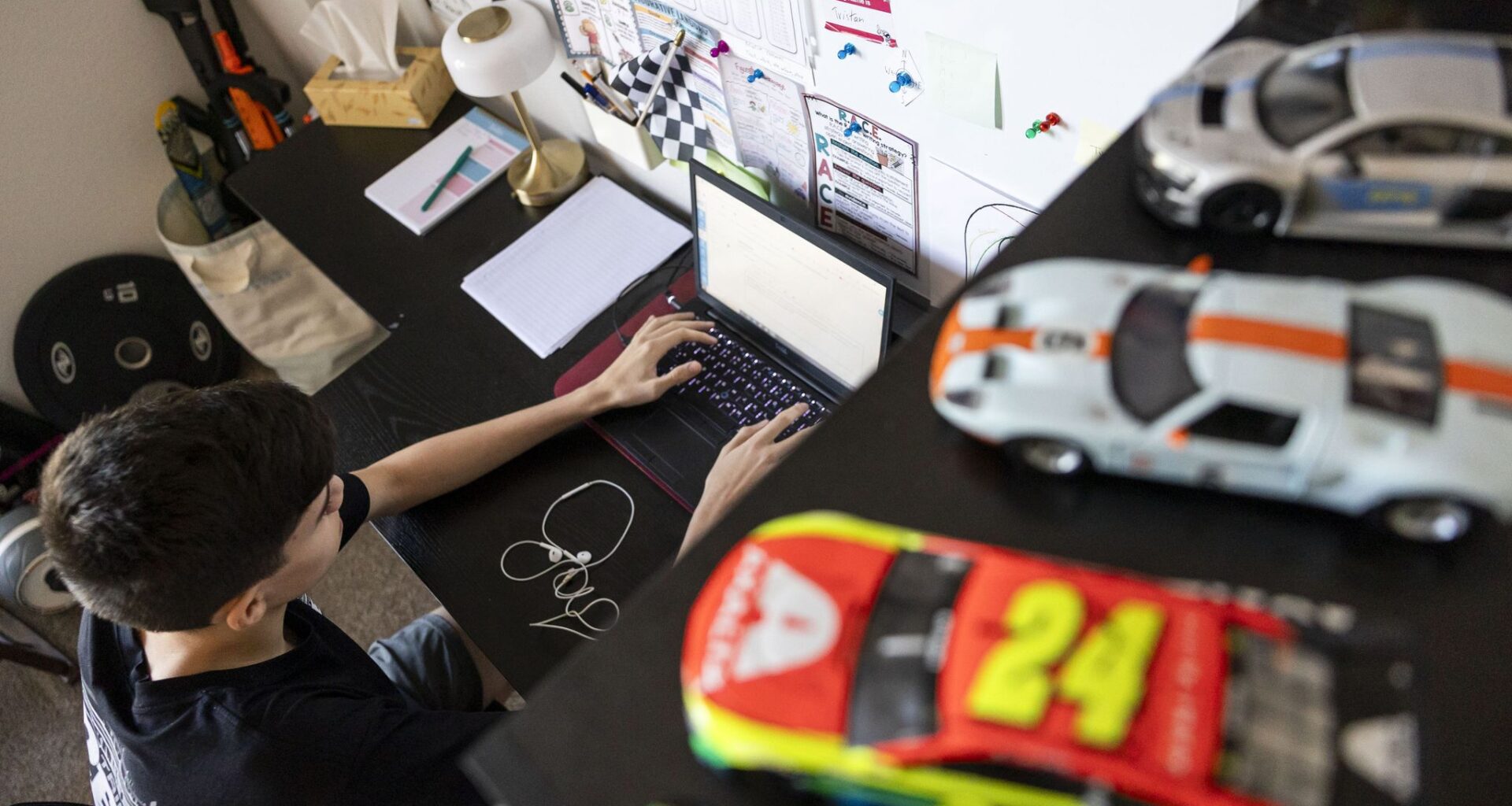
While Third Future speeds toward improving student performance, across the city, 15-year-old Tristan Peña is racing toward a different goal.
Article continues below this ad
The San Antonio junior has attended virtual school since the pandemic, giving him the flexibility to train and compete as he chases a career in professional racing.
Virtual learning isn’t new, but public school districts are increasingly embracing the model by opening their own online campuses to compete for students. Northside ISD launched a virtual high school this year, enrolling about 200 students. Other districts across Texas are exploring similar programs as they compete with online schools and other education models for enrollment. Over 62,200 students across the state were enrolled in virtual schooling in 2024-25, according to the Houston Chronicle.
A junior at the public Texas Online Preparatory School, Tristan said the flexible schedule of virtual classes allows him to keep up with school while traveling once or twice a month to North Carolina, where he races year-round.
“I’m able to travel with my laptop and being able to do school from anywhere (it) just really helps me stay ahead,” he said. “If I was just doing a regular brick-and-mortar school, I’d be behind on quite a bit of schoolwork whenever I’m gone for racing.”
Article continues below this ad
Tristan Peña, a 10th grader at Texas Online Preparatory School (TOPS), completes schoolwork at his home in San Antonio on Tuesday, Sept. 8, 2026. Peña is a competitive Pro Late Model race car driver, and the flexibility of online school allows him to keep up with classes and assignments while traveling for races.
Katina Zentz/San Antonio Express-News
Miniature cars are shown at the home of Tristan Peña, a 10th grader at Texas Online Preparatory School (TOPS), in San Antonio on Tuesday, Sept. 8, 2026. Peña is a competitive Pro Late Model race car driver, and the flexibility of online school allows him to keep up with classes and assignments while traveling for races.
Katina Zentz/San Antonio Express-News
On a Tuesday morning, Tristan finished his graphic design class — which he said helped him design the look of his race car — from a laptop in the loft area of his family’s home before tackling assignments ahead of a 1 p.m. algebra class. Most days, he is finished with school by 3 p.m.
Those classes are called Class Connect sessions, where teachers deliver online instruction and students interact with classmates. Students then complete the lesson and corresponding coursework before a due date.
Article continues below this ad
Staring at his trophies sitting on a mantle at his family’s Scenic Oaks home, Tristan knows the odds of making racing a full-time career. Even after spending much of his childhood behind the wheel, he still sees the value in education — even if attending college is his backup plan.
“They say like 1% makes it to the big time,” Tristan’s father, Jason Peña, said. “I think we’re all cognizant of that, and I think that’s why, as a family, we stress the academics so much, and making sure that no matter what happens, that we get a good education.”
Tristan Peña, a 10th grader at Texas Online Preparatory School (TOPS), completes schoolwork at his home in San Antonio on Tuesday, Sept. 8, 2026. Peña is a competitive Pro Late Model race car driver, and the flexibility of online school allows him to keep up with classes and assignments while traveling for races.
Katina Zentz/San Antonio Express-News
Losing choice?
Not everyone sees the rapid growth of new schooling models as a positive for families.
Article continues below this ad
As more students have turned to options outside their traditional public school districts, school boards have shuttered neighborhood campuses that were previously the default choice for those living nearby.
It’s a concerning trend for Carrie Griffith, executive director of Our Schools Our Democracy, an advocacy organization that opposes private school vouchers and advocates for more funding for traditional public districts. She worries that expanded schooling options available to parents won’t necessarily add to all families’ menu of choices.
“I think it’s really important to qualify that adding publicly funded options in an ecosystem doesn’t necessarily mean that you’re expanding choice,” she said. “Because the only system that’s publicly funded that is a true choice … for all families is public schools, ISDs.”
Classroom guide Lisa Kedrowski, left, helps her student Elena Cantu set up a computer for a spelling lesson in the kindergarten through second-grade classroom at Primer University Heights in San Antonio on Tuesday, Aug. 25, 2026.
Sam Owens/San Antonio Express-News
Like Gardea, Griffith said San Antonio’s less affluent families may not be able to take advantage of the growing number of education options available locally, especially if they come with high tuition costs or barriers like requiring parent-provided transportation.
Article continues below this ad
As districts grapple with enrollment losses, funding tied to student numbers and increased competition, Griffith said campus closures further reduce families’ options, undermining the idea of expanding educational choice.
“Every time a neighborhood public school closes, a family loses a choice,” she said.