
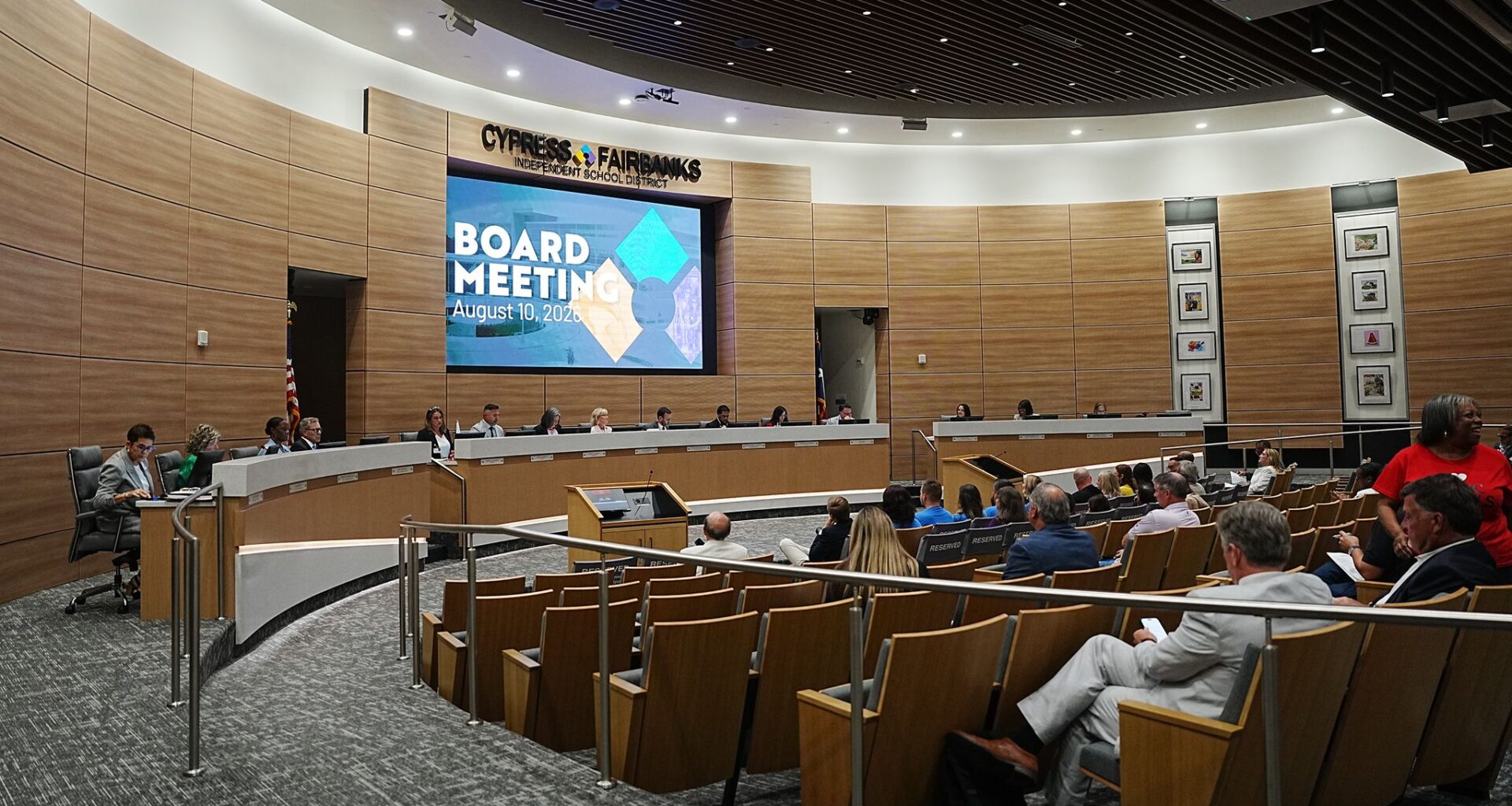
Cy-Fair ISD first board meeting of the year at Mark Henry Administration Building in Cypress on Monday, Aug. 10, 2026. The district is asking voters to consider a 12 cent tax rate increase, yielding $103 million in extra funding to shore up the district’s $80 million deficit, and a $1.6 billion bond measure in four propositions this November.
Elizabeth Conley/Houston Chronicle
Five Houston-area school districts are asking voters for a combined $137 million in new revenue this November to shore up multi-million dollar budget deficits driven by declining enrollment, inflation and rising insurance costs.
Voters in Cy-Fair, Channelview, Huffman, La Porte and Spring ISDs can expect to see a voter-approved tax-rate increase, or VATRE, measure on the Nov. 3 ballot.
At least two other Houston-area districts considered holding a tax-rate increase election but opted not to. Clear Creek ISD’s board discussed the idea but did not move forward, according to Community Impact, and Aldine ISD’s board declined the measure in a split vote.
Article continues below this ad
While the districts are all asking voters for different tax rate increases, one thing unites them: They are running out of options to pay for rising costs. Enrollment declines have put pressure on revenue, while inflation has risen since the pandemic. Some districts have already closed schools to bring costs down, but closing schools isn’t always a viable solution to solve enrollment and budget issues.
“I do think it’s notable — almost more notable than that these districts are going out for a tax rate election — is that they didn’t for this long,” said Amanda Brownson, deputy executive director of policy and research at the Texas Association of School Business Officials. “They really tried to hold out as long as they could.”
ELECTIONS: Cy-Fair ISD to ask voters for tax rate increase, $1.6B bond in November
The latest batch of districts asking voters for more revenue follows at least four other Houston-area districts that put a similar proposal on the ballot in the last two years. Alief ISD and Montgomery ISD passed tax-rate increases in 2024, while Spring and Magnolia ISDs’ elections for higher tax rates failed the same year.
Article continues below this ad
Spring ISD is trying again for a tax rate increase this year, while Magnolia ISD is not. Magnolia held a successful bond election earlier this year, which did not increase the tax rate, and leaders said in meetings they wanted to keep that promise, according to Community Impact.
How ‘disaster pennies’ have helped
Some local districts have also turned to another option to increase the tax rate without asking voters by accessing “disaster pennies.” These additional cents that can be added to the district’s tax rate if state leaders declared a disaster and districts had to make costly emergency repairs. It can be a back door to more revenue because in many cases, the revenue from the “disaster pennies” can exceed the cost for repairs.
Houston, Fort Bend, La Porte and Cy-Fair ISDs have all utilized disaster pennies to increase revenue at least once in the past two years, although La Porte ISD has done even more than that. The district, which sits on the northwest corner of Galveston Bay, has used disaster pennies seven times in the last 10 years to provide temporary financial relief. Now, the district is asking voters for a permanent tax rate solution.
The tax proposals come as Republican lawmakers are putting extra scrutiny on school district property taxes. Just last week, state Sen. Paul Bettencourt’s office published an analysis showing that four out of 10 Texas homeowners don’t pay school district property taxes at all, and Gov. Greg Abbott has made eliminating school property taxes a key pillar of his plan to overhaul property taxes.
Article continues below this ad
NEWS: Nearly 40% of Texas homeowners pay no school property taxes, Senate analysis finds
Still, the tax rate elections for schools have crossed party lines in some districts. Two members of the Cy-Fair ISD board, who sit in nonpartisan seats but have been endorsed by the Harris County Republican Party, voted in favor of holding the election to raise taxes, saying they didn’t see another option. Only one Cy-Fair trustee voted against the measure last month.
What are some of the factors at play?
State lawmakers increased public school funding in 2025, giving districts $55 more per student in base funding, plus $3.5 billion for teacher raises and $430 million for school safety. But Houston-area district leaders have said it wasn’t enough to offset higher costs driven by inflation since the COVID-19 pandemic, and declining enrollment has worsened their finances.
Article continues below this ad
“Yes, they got new revenue, but costs are also growing really rapidly, right? And so the same inflation that’s impacting families is impacting schools,” Brownson said. “Especially when enrollment has stagnated or started to tick down. It can be very hard to cut costs as fast as you lose revenue if enrollment falls.”
Cy-Fair ISD lost 3,200 students last year which left a $13 million shortfall. But in a large district, enrollment losses don’t immediately mean closing schools or hiring less staff because those losses can be spread out among dozens of campuses.
“That revenue dries up instantly, but the cost takes longer to absorb,” Brownson said. “Before you lose enough students to eliminate a classroom or eliminate a campus, you’ve got a lot of positions that have to be funded to keep those going.”
Some districts that are going out for these elections have already closed schools, including Spring ISD, which closed two schools last year.
SCHOOL CLOSURES: Houston-area districts closed 26 schools over the past year. Here’s a look.
Article continues below this ad
While Aldine ISD’s board decided not to hold a tax rate increase election, the district has closed more campuses than most Houston-area districts. In the past two years, Aldine has shuttered 11 schools due to declining enrollment and the related lost revenue.
“Aldine ISD is facing an approximately $42 million budget deficit. The proposed VATRE could have generated approximately $20 million in additional revenue to help address nearly half of that deficit,” wrote Trustee Kimberly Booker on her candidate social media page. “Now we have to answer the difficult question: How will Aldine ISD close a $42 million deficit while protecting the people, programs, and services our students need?”
Booker did not respond to a request for additional comment.
Making the financial picture more complicated for districts, lawmakers also froze local optional homestead exemptions. Their reasoning: Texans wouldn’t see financial relief from property tax compression and expanding homestead exemptions if school districts removed their local tax exemptions. Now school districts that already had a local optional homestead exemption in place before the 89th Legislature cannot amend or change that exemption to offset rising costs until 2028.
Cy-Fair and La Porte ISDs both offer these exemptions.
What is a tax rate increase election?
Texas school districts can hold elections to increase the tax rate above state-calculated the maximum compressed tax rate, but some homeowners will not see any tax impact due to recent property tax compression and Texas’ increasing homestead exemptions. For example, in Huffman ISD, the voter-approved tax rate for 2026-27 would be the same as last year’s tax rate, even though it is an increase from the maximum compressed rate.
Voter-approved tax rate elections have existed in some form since 2006, Brownson said. Tax rates can’t be raised more than 12 cents, and many Texas districts have already accessed some of those extra cents. School boards can add five additional cents to the tax rate without voter approval. Some revenue from the increased tax rate can be subject to recapture by the state, which collects the money from property-wealthy districts to close funding gaps with property-poor ones.
These elections can only be held in November, and they tend to occur in the year after a legislative session, Brownson said. They generate revenue to a different bucket of funding than school bonds, which are debt and can only be used for capital projects. This is why a district may hold both a tax-increase and a bond election.
BACKGROUND: Knee-deep in budget woes, Houston-area districts plead for increased revenue from taxpayers and the state
The proposals that Houston-area voters will see on the ballot this fall vary by district size and need. But one thing in common is the stated need for more revenue. The five districts have projected over $100 million in combined budget deficits.
For some, the tax rate increase would cover only a portion of the expected budget shortfall for the 2026-27 school year. For others, it will erase the deficits altogether. The elections, if approved, would also potentially stave off a further cuts if the Legislature doesn’t provide additional funding in the upcoming session.
Some voters will also see bond proposals on the ballot, asking if a school district can buy bonds for capital repairs, new buildings, athletics upgrades or other items that are too expensive to cover with general operating dollars.
Cy-Fair, Channelview and Crosby ISDs are all holding bond elections this November. Magnolia, Barbers Hill, Friendswood and Royal ISDs all sought bond elections in May of this year. They were largely successful: all passed except one of Friendswood ISD’s four propositions.
What is each district asking for?
Texas’ third-largest school system is asking voters to weigh in on five ballot items this month. The first is the voter-approved tax rate increase, where the district is asking for the maximum of 12 cents. That would generate about $103.6 million in revenue to erase the expected $80 million deficit this school year.
This deficit comes after Cy-Fair ISD already cut almost $100 million from its budget over the past two years, including eliminating librarian, counselor and instructional support staff positions. Leaders also tried cutting bus transportation one year, but restored it after community protests. A large part of the district’s deficit this year comes from transportation costs.
ALSO READ: Cy-Fair ISD restores some bus routes amid safety concerns
If approved, the total tax rate will increase only by 9 cents because the district lowered the interest and sinking (debt service) tax rate by three cents for the 2026-27 school year. The total rate would be $1.1569 per $100 of valuation. Last year’s tax rate was $1.0669 per $100 of valuation, the lowest in almost 40 years.
Besides offsetting the deficit, the funding would give a one-time stipend to all staff in Cy-Fair ISD. All hourly employees would receive a $2,000 stipend, including paraprofessionals, custodians and bus drivers. All other staff would receive a stipend of $1,000, contingent on approval of the tax increase.
Cy-Fair ISD is also asking for a $1.6 billion bond in four propositions, which was supposed to be on the May ballot but was tabled because Harris County did not have the capacity to conduct the elections.
The four propositions are:
Proposition B: Critical Infrastructure, Safety &Security, & Transportation – $1.3 billion
Life-cycle replacement of roofs, HVAC (heating and air-conditioning), fire alarms, emergency generators, technology and cybersecurity infrastructure, safety and security technology, police radios and vehicles, buses, playground improvements, renovation of Cypress Creek & Jersey Village High School auditoriums, and addition of band storage facilities.
Proposition C: Instructional Technology – $256 million
Life-cycle replacements for student Chromebooks, teacher laptops, interactive instructional displays, CTE/digital art labs, and audio systems.
Proposition D: Existing High School Athletic Stadiums – $60.8 million
Life-cycle replacement of artificial turf & scoreboards, refurbish running tracks.
Proposition E: Existing Pools – $20.1 million
Replastering and replacing equipment at existing district swimming pools.