
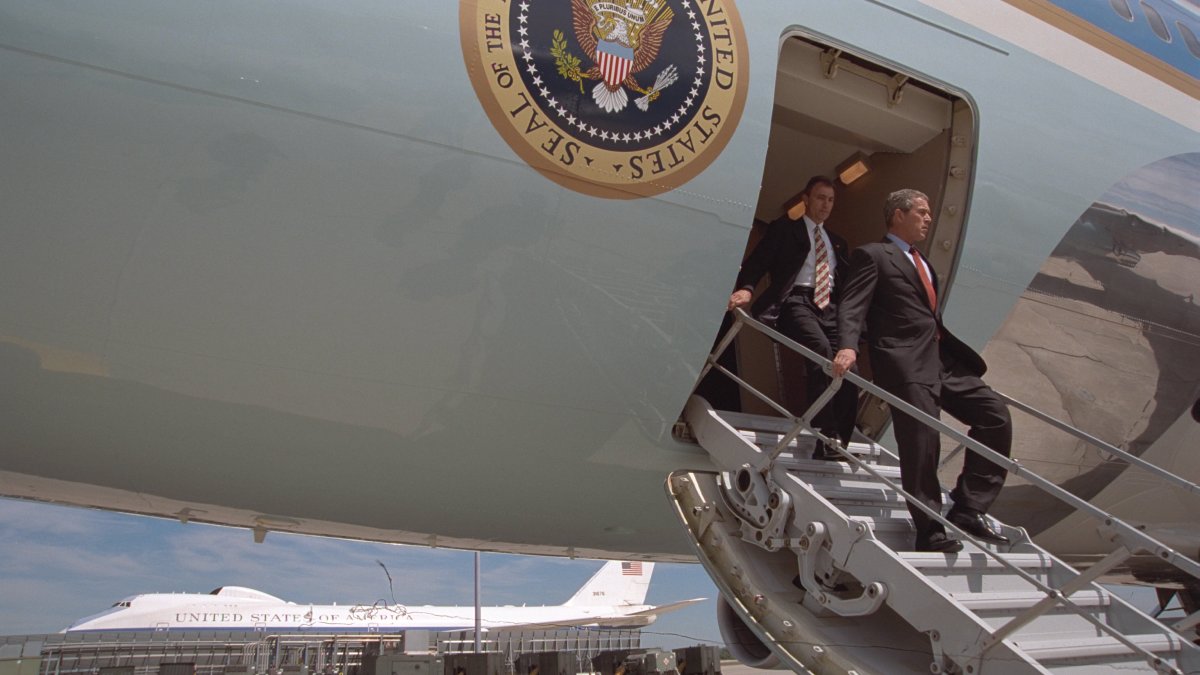
Air Force One is one of the most recognizable aircraft in the world, but much of what happens aboard the president’s plane remains out of public view.
Former crew members offered a rare look behind the curtain during an event at the George W. Bush Presidential Center in Dallas, sharing stories about life aboard the aircraft and the extraordinary missions that put its crews to the test.
The conversation featured retired Col. Mark Tillman, who served as President George W. Bush’s pilot and commander of Air Force One; Reginald “Reggie” Dickson, a former chief flight attendant who spent 19 years serving aboard Air Force One; and retired Chief Master Sgt. Rick Holley, a former communications systems operator who served during the Reagan, George H.W. Bush and Clinton administrations.
Former White House Press Secretary Ari Fleischer moderated the conversation.
What is it really like aboard Air Force One?
First, they cleared up at least one Hollywood myth: No, Air Force One does not have an emergency escape pod like the one depicted in the 1997 Harrison Ford movie.
The real aircraft is designed less as a luxury jet and more as a working White House in the sky.
Dickson described it as a “functional aircraft versus luxury,” designed so the president and staff can continue working while traveling.
The former crew members said Air Force One has 69 seats, plus accommodations for the First Family, compared with more than 400 seats on a standard 747. Holley recalled 100 regular telephones and another 40 secure phones aboard during his time with the crew.
The president also has accommodations not available to everyone else. The crew said the aircraft includes two beds for the president and a private shower.
Fleischer, who traveled aboard Air Force One as White House press secretary, joked that staff members sometimes had better seats on commercial flights in business class.
“But we had better communications and food,” he said.
Behind those lighter details was a mission the crew described as having no room for failure: protecting the president and allowing the commander in chief to continue leading the country under virtually any circumstances.
Air Force One on Sept. 11, 2001
Few days demonstrated that responsibility more clearly than Sept. 11, 2001.
Tillman was the pilot and commander of Air Force One that day. He recalled sitting with the aircraft in Sarasota, Florida, while President Bush visited an elementary school.
Tillman said the crew initially watched television coverage of the first plane striking the World Trade Center and believed they were seeing an aircraft accident. When the second plane hit, that changed.
“Everything has changed at this point,” Tillman recalled. “Now it’s a national emergency.”
As Air Force One prepared to leave Sarasota with Bush aboard, Tillman said Secret Service agents reported someone near the end of the runway who appeared to be holding a long gun. Tillman said he used a steeper-than-normal takeoff to quickly get the aircraft above the possible threat.
The crew later learned the man was there with his children and what had appeared to be a weapon was actually a video camera.
It was one example of the false or incomplete information reaching the president and his team amid the uncertainty that morning.
Later, Tillman said word reached the aircraft that “Angel” — the Secret Service call sign for Air Force One — could itself be a target.
As Air Force One flew over the Gulf of Mexico, Tillman recalled air traffic controllers warning the crew that unidentified fast-moving aircraft were approaching.
They turned out to be U.S. fighter jets from Ellington Field in Texas.
“We’re at your 7 o’clock, and we’re your cover,” Tillman recalled hearing over the radio.
The fighters remained with Air Force One as the president’s team worked to determine where he could safely go.
The aircraft eventually landed at Barksdale Air Force Base in Louisiana, where Bush addressed the country, before traveling to Offutt Air Force Base in Nebraska. By the end of the day, the president returned to Washington.
A secret Thanksgiving mission to Baghdad
Two years later, the Air Force One crew was tasked with another extraordinary mission — this time one that depended on secrecy.
In November 2003, President Bush secretly traveled to Baghdad to spend Thanksgiving with U.S. troops serving in Iraq.
Dickson said the secrecy extended even to much of the Air Force One crew.
Normally, he said, about 10 flight attendants would help prepare meal service aboard the aircraft. For this mission, Dickson recalled handling preparations largely by himself while trying to keep other crew members from discovering what was happening.
That led to one particularly Texas detail.
“In the meantime, I’m running out to Bush’s Chicken in Texas, buying food to get to Andrews to put out an airplane prior to my crew coming out,” Dickson recalled.
Once the crew was aboard, members were finally briefed on the mission and given an opportunity to decline to go. Dickson said there were no takers.
Tillman remembered Bush giving him a characteristically straightforward description of the assignment.
“Tillman, it’s a simple mission,” he recalled the president telling him. “I’m going to Baghdad for dinner, and then I’m coming back to the United States of America.”
The secrecy continued all the way to Iraq.
Tillman said personnel preparing for the aircraft’s arrival were told a USO flight was coming in carrying the Dallas Cowboys Cheerleaders — not the President of the United States.
“So they were very disappointed to see President Bush,” he joked.
The people behind Air Force One
The Bush Center event coincided with a reunion in Dallas for members of the Presidential Airlift Group. More than 80 former crew members and maintenance personnel were in the audience.
For Dickson, seeing so many of them together again was a reminder that the mission created relationships that lasted long after their time aboard Air Force One ended.
“I have lifetime friends that I will always have,” he said.
Despite serving different presidents, administrations, and roles, former crew members described a shared standard of professionalism and responsibility that has been passed down across generations of those entrusted with presidential airlift.