
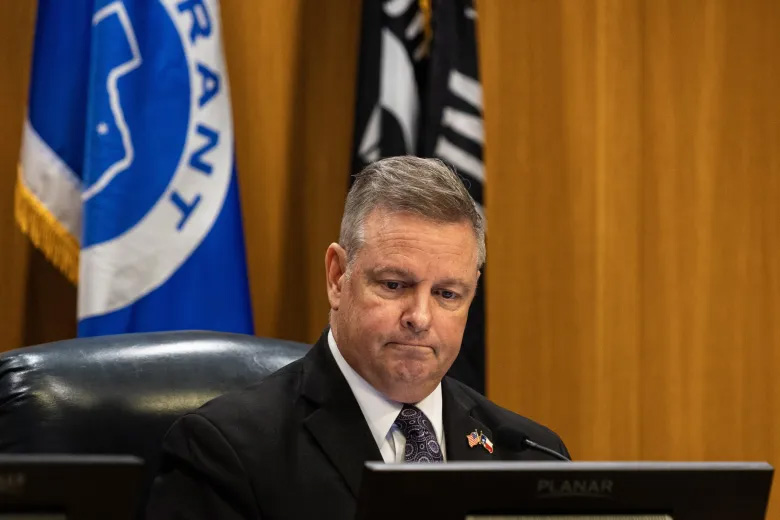
Tarrant County Judge Tim O’Hare at the Tarrant County Commissioners Court meeting on Feb. 10 in Fort Worth. A reader says the court is suppressing votes by closing 92 polling places.
Maria Crane/Fort Worth Report/CatchLight Local/Report for America)
Tarrant County voters
On Sept. 1, the Tarrant County Commissioners Court voted to reduce the number of poll sites for November election from 316 to 224, or by 92 sites. The vote was 3-2 along party lines.
One of those sites is the University of Texas at Arlington campus’ only polling site. Now the closest polling site for UTA students is almost a 30-minute walk away.
Article continues below this ad
The decision to reduce the county voting sites was made after commissioners heard testimony from more than 100 speakers, the majority of whom were opposed to the site cuts, during a meeting that lasted over eight hours.
More than 1.3 million people are registered to vote in Tarrant County. I’d like to see more news about this obvious act of voter suppression.
Kathleen Newman, Richardson
It’s voter suppression
Many claim that Texas Republicans are prioritizing election integrity ahead of November. This is beyond misleading. Let’s call this what it is — the Texas GOP’s ongoing and deliberate campaign to suppress the vote in Texas.
Article continues below this ad
We saw it in March with the Dallas County Republican Party’s insistence on precinct level voting during the primary, and we’re seeing it again with these mail-in ballot restrictions.
Please frame the issue accurately. This is not election integrity. It’s voter suppression.
Yasmin Simon, Highland Park
Get informed and vote
For the past three decades, the Texas GOP has controlled, or been controlled by, five areas: the executive, judicial, legislative, financial and religious fundamentalism. In the period since Ann Richards was governor, the state has excelled in producing billionaires, forcing Christianity into areas in violation of the U.S. constitution and growing mega-churches, while quality of life issues for the average Texan — health care, infant mortality, women’s rights, nutrition programs, wages and education — have dropped to nearly the bottom of the national ratings.
Article continues below this ad
Election campaigns have reached nosebleed heights of spending based on corporate and individual billionaire donations and the obvious quid pro quo that creates.
With some areas like Tarrant County attempting to act to suppress voter access, threats of ICE at polling locations and campaign ads fraught with disinformation, it is incumbent on all Texas voters to sort through the chaff, get informed and get out to vote in November, no matter what your affiliation.
Craig S. Marckwardt, Dallas
Defending IDs
Re: “Not a happy voter,” by Daryl Davis, Sept. 4 Letters.
Article continues below this ad
Davis is unhappy because the secretary of state’s website knew his voter ID but rejected his 39-year-old driver’s license. And for this reason, he plans on voting for the likes of a college-indoctrinated Senate candidate who, when asked to count the sexes, doesn’t know to stop counting at two.
See, here’s the way things are today. When I go to Lowe’s, I show my veteran identification card. Then, I recite my phone number. Then, the store clerk scans the bar code on the back of my driver’s license. Now, I’m all set to get 10% off on a bag of water softener salt.
That’s today’s program. Get with it.
Kenneth K. Ebmeier, Round Rock
Voters demand better
Re: “Ducking the tough questions — Paxton, Talarico platforms cater to base voters,” Aug. 18 editorial.
Article continues below this ad
This editorial criticizing James Talarico and Ken Paxton for failing to address the real issues about which voters are concerned highlights an important concern. Voters who evaluate candidates individually need to understand their positions.
For example, Talarico claims on his website that he is a proponent of strong border security. If that’s true, he should be explaining his philosophy in his ads and on his campaign stops. It could win him votes with independents and some Republicans.
Unfortunately, voters are more likely to hear personal attacks than thoughtful explanations of why either candidate deserves support. Negative campaigning has become the norm in America, but voters should demand better.
Jack Gibson, North Dallas
People over party
I am confused. I always believed that I was voting for and electing someone to Congress to vote for his or her constituents, and not to follow what the party leader demands.
Article continues below this ad
Then there is all this discussion about what to do with the two Democrats who voted for a Republican measure against the wishes of House Minority Leader Hakeem Jeffries.
Who is anyone, Jeffries or Republican House Speaker Mike Johnson, to tell and require my elected representative or senator how to vote? If one person can do this, why have elections since those elected are no longer independent and have to vote as a party leader instructs?
As it now stands, no Republican is allowed to vote for anything put forth by a Democrat, and vice versa. If they do, there will be consequences. This is absurd.
Loyalty to a party over the people has got to stop. It is clear this is taking the country down a path of no return.
Ask for details
Politicians are generally adept at dodging questions or framing answers in a way that advisers and consultants have instructed them to respond. Sorry to say, but most politicians are very practiced in the art of providing vague or nuanced answers that weave a tangled web of nonsense.
One of my pet peeves is a lazy journalist who lets them off the hook during an interview. A tough but fair journalist would not. If the politician refuses to provide specifics, then the journalist should say or write, “Please note that [insert name] was either unable or unwilling to provide a detailed answer.”
For example, we constantly hear office seekers say in an interview, “I’m going to lower costs — affordability is my number one goal — we have to bring costs down.”
Everyone agrees that is a noble, lofty goal, but far too many journalists don’t probe further and ask for specifics. It likely will annoy the politician when asked, “Can you be specific? What’s your plan? Please elaborate.”
The politician will probably begin tap dancing like Fred Astaire and start spinning while doing everything he or she can to avoid a detailed, substantive and cogent answer. That’s an opportunity for a good journalist to shine. Yes, an interviewer must be respectful and not obnoxious, but their job is to ask probing questions, not to appease the politician.
It is both interesting and informative that a candidate will avoid an honest and insightful journalist’s questions.
My thinking is that if a person running for office is incapable or refuses to provide intelligent and clearly articulated answers, they are not worthy of my vote. Correspondingly, a journalist who publishes pure political pablum spewed out by a politician is wasting everyone’s time — including their own.
B.R. Allen, Far North Dallas