
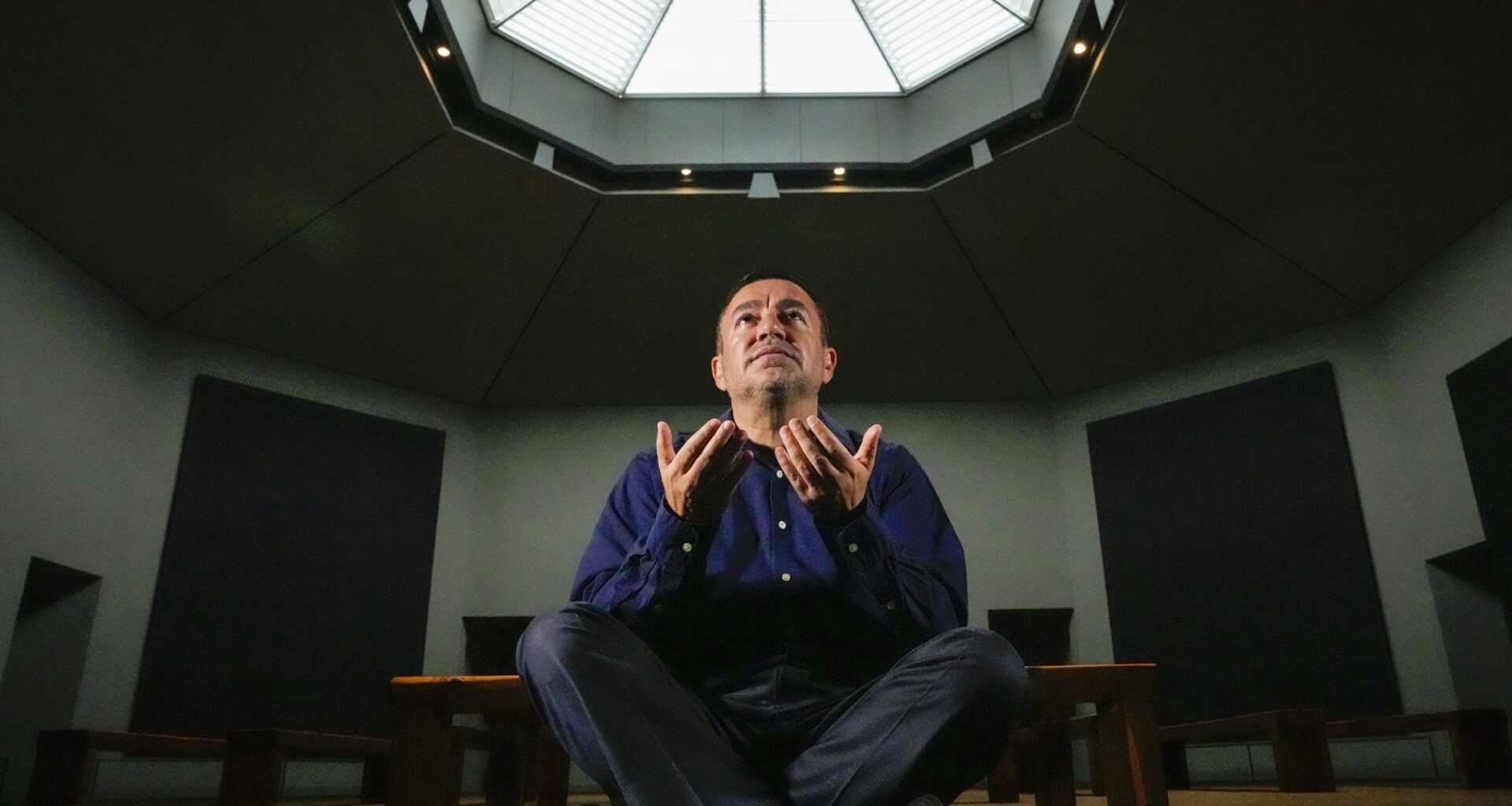
Imam Abdullah Antepli, president of Rothko Chapel, poses for a portrait in the historic spiritual space in Houston, Wednesday, Feb. 11, 2026. Antepli began his role at the Rothko Chapel in September 2025.
Brett Coomer/Houston Chronicle
Houston Stands with Palestine rally participants, including former Houston City Councilman M.J. Khan, in red, pray at Gerald D. Hines Waterwall Park after a march around The Galleria Saturday, May 22, 2021, in Houston.
Yi-Chin Lee, Houston Chronicle / Staff photographer
Six days after the terrorist attacks of Sept. 11, 2001, former President George W. Bush visited a mosque in Washington, quoted the Quran and lamented the attack and the anti-Islam response that followed it.
“Muslims make an incredibly valuable contribution to our country,” Bush said as he stood alongside the co-founder of the Council on American-Islamic Relations. “The face of terror is not the true faith of Islam.”
A year later, Texas’ then-governor, Rick Perry, praised Muslim people when he attended the opening of an Ismaili Muslim center in Sugar Land. “Texas is a better place because of your contributions and sacrifices,” he said.
Article continues below this ad
FROM THE ARCHIVES: Ismaili Muslim center opens in Sugar Land
Texas’ relationship with its growing Muslim population has shifted sharply since then. Twenty-five years after the Sept. 11 terrorist attacks, Muslim leaders in Houston said today’s climate is far worse for their community than the aftermath of attacks that forever changed Americans’ relationship with Islam and Muslim-majority countries.
In the last two years, the state’s Republican political leaders have warned of a “Muslim invasion.” Last year, Gov. Greg Abbott declared the Council on American-Islamic Relations to be a foreign terrorist organization, and said he’d barred members of the civil rights group from owning property in Texas.
Last month, the governor asked the Department of Justice to investigate facilities at Texas airports designed to accommodate Islam’s directive that Muslims wash before prayer. He argued they were unfair to non-Muslims and amounted to religious discrimination.
Article continues below this ad
“Ten Commandments = good. Muslim foot washing rituals = bad. Next question,” U.S. House Rep. Brandon Gill of Flower Mound posted to X after Abbott began criticizing the facilities.
Diplomats, imams and politicians said in interviews that they’re worried rising hostility toward the Muslim community will worsen the United States’ ability to fight terrorism and maintain a healthy democracy. They urged members of their own community to participate as much as possible in American democracy — to build political institutions with a broader focus than fighting Islamophobia, and cultivate coalitions and relationships outside of their comfort zones.
READ MORE: ‘A sense of belonging’: Muslim travelers defend IAH washrooms amid Greg Abbott’s attacks
“It pains me, really, to see half of Texas fearful of Sharia,” said Imam Abdullah Antepli, president of the interfaith Rothko Chapel in Montrose. “They see an image of Islam and Muslims, and they are enveloped with fear, and my community has yet to develop a discourse or counter-strategy in any meaningful and effective way.”
From Sept. 11 to Oct. 7
On Sept. 11, 2001, terrorists hijacked and crashed two planes into the Twin Towers in New York’s World Trade Center, setting the buildings aflame until they eventually collapsed. A third plane hit the Pentagon, and a fourth crashed in a Pennsylvania field, killing everyone on board, after passengers fought the hijackers.
Article continues below this ad
The attacks killed 2,977 people, not counting the 19 hijackers. An estimated 17,400 people were in the two towers that morning, and thousands were injured.
Muslim city leader M.J. Khan said Houston was a “model of interfaith harmony” in the aftermath of those attacks. He praised Texas and national leaders for distinguishing between Muslims as a whole and the actions of radical terrorists.
Q&A: M.J. Khan, Houston mayoral candidate, answers questions from the editorial board
Two years after the attacks, Khan was elected the first openly Muslim member of the Houston City Council.
“I can say categorically that I never faced any kind of hurdles because of my faith or because of my ethnicity running for City Council,” he said. Khan served on the council from 2004 to 2009, representing District F.
Article continues below this ad
Candidate M.J. Khan, standing on stage, gives his introduction statement along with other candidates as Casey Curry, in yellow, moderates during a mayoral candidates forum, sponsored by the Calition for Barrier Free Living and The MayorÕs Office for People with Disabilities, held at the West Gray Multi Service Center Thursday, Sept. 14, 2023 in Houston.
Michael Wyke/Contributor
For many Americans, the horrific attacks were the first time they paid serious attention to a religion that’s been around for over a thousand years, according to Antepli. He said it took time for negative views of Islam to percolate.
“Hate is something learned, and it has a long incubation period,” he said.
He cited a 2002 Pew Research report that found 47% of U.S. respondents said they viewed Muslims favorably, and 29% said they viewed them unfavorably. In contrast, a 2023 report found that only 17% of Americans viewed Muslim people very or somewhat favorably. More than half reported a view that was neither favorable nor unfavorable, or answered that they didn’t know enough to say.
So why has the attitude toward Muslims in the U.S. undergone such a shift?
Article continues below this ad
READ MORE: Fight over Islam is key focus ahead of pivotal high school curriculum vote
All the Muslim leaders who spoke to the Chronicle for this story cited one date as the turning point: Oct. 7, 2023. That was the day Hamas militants attacked southern Israel, killing about 1,200 people, mostly civilians, and taking 251 others hostage, according to the Israeli military.
In response to the attacks, Israel’s military offensive in Gaza has killed more than 73,000 Palestinians, according to the Gaza Health Ministry, which was part of the Hamas-run government. The ministry maintains detailed records that U.N. agencies and international organizations generally view as reliable, according to the Associated Press. It does not distinguish between civilians and militants, but says women and children make up around half of all fatalities.
Muslim leaders didn’t know for sure why the 2023 Hamas attacks had been followed by such a spike in hostility to Islam, but they offered several possible explanations.
Tarek Hussein, the founder of CAIR-Houston, said the slew of negative messaging about Muslims is a tool to distract Americans from empathizing with the tens of thousands of civilians who have been killed in Gaza, whose population is predominantly Muslim. He worried that labeling Muslims as “the enemy” would erode Americans’ empathy.
Tarek Hussein is seen during the Texas GOP Convention at the George R. Brown Convention Center in Houston, Saturday, June 13, 2026.
Jason Fochtman/Houston Chronicle
“It’s very dangerous, very dangerous in anyone to believe that it’s okay that I can kill a child,” he said. Hussein was a delegate at the Republican Party of Texas Convention this summer, but was asked to leave the convention due to his affiliation with CAIR and Muslim identity.
READ MORE: As Texas GOP leaders preached unity, delegates targeted Muslim party members
Antepli described what he called an “Islamophobia industry” — a network of influencers, blogs, and think tanks that focus primarily on sharing provocative, fear-inducing content about Muslim people or communities.
“Their ability to dehumanize Islam and Muslims advances their political agenda and justifies certain foreign policy issues in the United States,” he said, citing foreign policy goals such as war with Muslim-majority countries like Iran.
Islamophobia and its consequences
Sada Cumber, a former diplomat appointed by President Bush, praised how the former president distinguished between terrorists and all Muslims in the aftermath of Sept. 11. At the time, terrorist groups wanted to portray Sept. 11 as the start of a religious war between Islam and the West, according to Cumber. “If America had accepted that framing, we would have strengthened their recruitment narrative and alienated potential partners,” he said.
In 2008, Bush appointed Cumber as a special envoy to the Organisation of Islamic Cooperation, which today includes 57 member states. Cumber said his job was to convince Muslim-majority countries that “the U.S. was not at war with Islam.”
As part of his work, he pressed OIC leaders to condemn terrorism and suicide bombing unequivocally, preventing extremist groups from claiming they spoke for the broader Muslim world. Now, the U.S. doesn’t have a dedicated special envoy to the OIC, though another diplomat is taking on some of those duties.
Cumber said the absence of a full-time diplomat in that role is a loss primarily for the U.S. It “creates space for American competitors and extremist movements to define America’s intentions,” he said.
Antepli agreed that framing Muslims as enemies of the U.S. worsens America’s ability to fight terrorism.
“In so many ways, our wars and our irresponsible foreign policy, our increased Islamophobia, is confirming and making their job easier to recruit devastated, broken people into their evil business,” he said of terrorist groups abroad. U.S. military action that kills civilians or devastates civilian infrastructure in Muslim-majority countries confirms the terrorist recruitment narrative that the “West is our enemy; Islam is at war,” he said.
The way forward
Khan, the city leader, echoed conventional wisdom in the Muslim community in his message for how to fight Islamophobia: Muslims need to “be on our best behavior.”
He urged people to seek to help others and the society around them, and to follow both Muslim and American values. One instance of bad or criminal behavior from a Muslim, Khan said, could reflect poorly on the whole community.
M.J. Khan gives his opening statement during a mayoral candidates forum, sponsored by the Calition for Barrier Free Living and The MayorÕs Office for People with Disabilities, held at the West Gray Multi Service Center Thursday, Sept. 14, 2023 in Houston.
Michael Wyke/Contributor
But he remained optimistic, comparing the stress the Muslim community is facing to the pressure needed to form a diamond. God would use these challenges to crystallize his precious people, Khan said.
Antepli agreed that, though it may be “unfair,” Muslim people need to hold themselves to a higher standard right now. “Unfortunately, they have to take some responsibility in educating their haters,” he said.
READ MORE: 10 years and $52 million later, here’s when Houston’s Rothko Chapel renovation will be complete
Antepli also believed universities could help combat Islamophobia by better teaching students to sit with the complexity of an issue like the Israel-Hamas conflict. As a former educator at Duke University, he called on colleges to teach history, philosophy, and the wisdom of ancient religions with more attention to the value of human diversity and difference. An artistic interfaith space like the Rothko Chapel can help, too, he said, by trying to “slow down people.”
Last month, Cumber, the diplomat, released a 21-page paper on how his community should respond to rising Islamophobia, which he titled “The Missing Muslim Strategy.”
His paper argued that Muslim people need to focus more on building coalitions with others — with the Jewish community, other communities of faith, and people who share at least some common political goals. He urged Muslims to organize and build coalitions around issues beyond terrorism, foreign policy, or Palestine, and to organize around other issues, too, like education, healthcare and technology.
Building relationships outside their own community is essential for Muslims, he told the Chronicle. “If the circle of acceptable partners becomes so narrow that it includes only people who already agree with every conclusion, it is no longer a coalition,” he said.
For Hussein, building relationships outside his own community was what motivated him to attend the GOP convention. “I went to the Republican Party trying to connect, because this is not the comfort zone that most Muslims want to be in,” he said.
His message to American Muslims is to “become more active in the system.”
“You were born here, this is your home, you are not going anywhere,” he said.
Despite the opposition he’s faced, he hasn’t given up on his party. For now, he’s waiting until the November elections are over. He hopes they will be a wake-up call for other Republicans — and that afterwards, friends and representatives in the GOP will be ready to hear him out.