
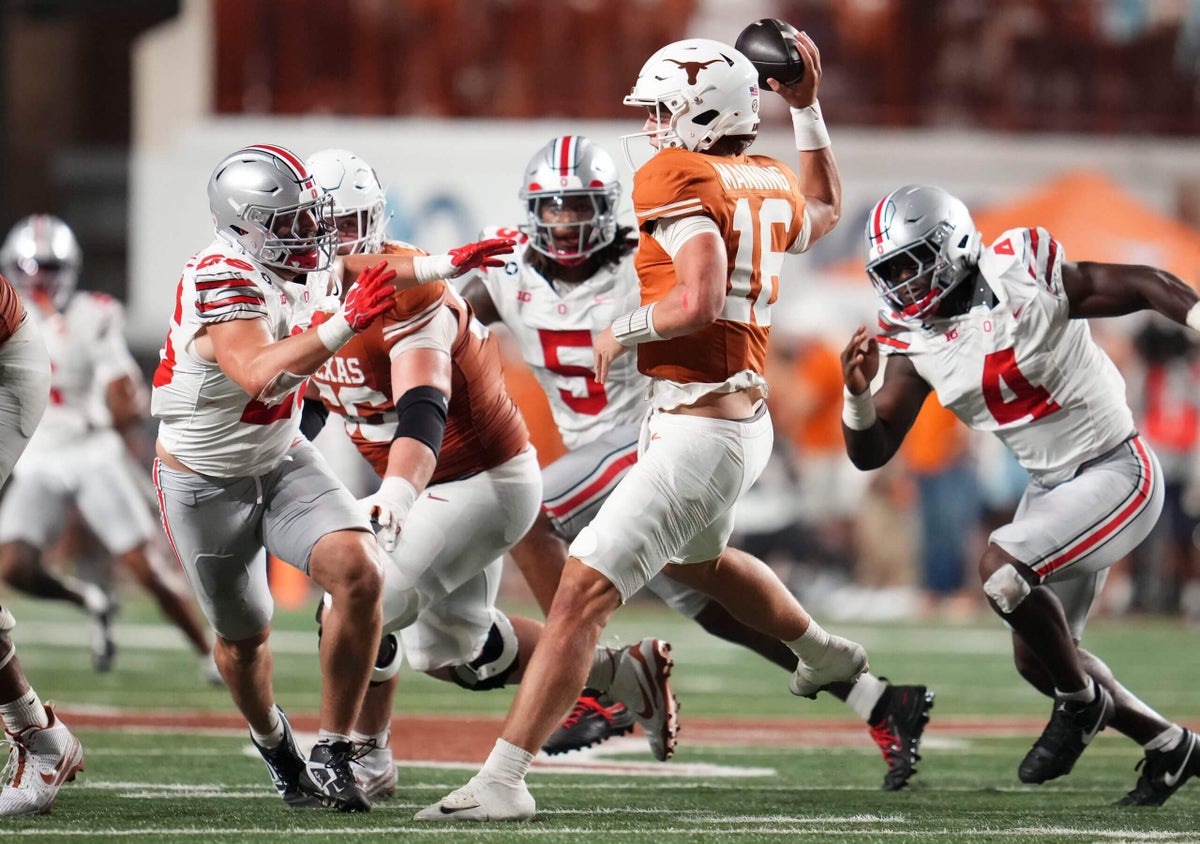
Ohio State blowing a 20-point second-half lead to Texas was so shocking that even rewatching the 24-23 loss still had me shaking my head.
I went into the Sunday review session thinking I would dislike more things than I saw in the stadium live in Austin, but I ended the game with a different perspective on certain things. There are major issues to address, but there are also some positive takeaways. Let’s start with the good news.
Jeremiah Smith had eight catches for 164 yards and one touchdown and looks every bit like a leading Heisman Trophy candidate. He’s 27 catches, 26 yards and six touchdowns away from every career Ohio State receiving record just two games into his third season.
I was impressed with the offensive line, too. I thought they picked up blitzes well and gave quarterback Julian Sayin a good pocket when he needed to deliver the ball downfield.
Texas completes comeback over Ohio State
Chris Vannini
There are some young players who shined, led by a pair of freshmen: cornerback Jay Timmons and defensive end Khary Wilder. Timmons played 60 snaps, and I could be convinced that he should never leave the field. Wilder played just four snaps but had two pressures, according to TruMedia. It’s time to include him in every third-down package because he’s the team’s second-best pure pass rusher.
I really liked what the secondary did in terms of limiting big plays and making Arch Manning uncomfortable about the coverage shells he was looking at. The pass rush was awful, but the secondary caused two sacks.
Lastly, Sayin ran twice for 7 yards. Any gains with his feet are a positive.
OK: Now for the bad, which there’s plenty of. In fact, there’s one thing I think that can doom Ohio State’s season if it doesn’t make an adjustment.
Problem: Losing contain on Arch in the second halfFixable? Yes.
Ohio State gave up only three points in the first half, so the defense wasn’t bad for a while, other than some problems stopping the run.
Things changed when Manning started to break contain. Before the comeback began, Ohio State had given up just 5 scramble yards to Manning and turned him into a pocket passer, which was working in the Buckeyes’ favor. On the third defensive drive of the second half, something changed: Manning started playing backyard football and Ohio State didn’t have an answer.
Manning scrambled for 18 yards on two plays, which seemed to get the Texas offense a spark. At that point, Manning got some rhythm with his legs — and it wasn’t just about him scrambling for extra yards. He was extending plays.
Eight plays after Ohio State started losing contain on Manning, it had a fourth-and-9 when Wilder got pressure and chased Manning to his right. He made a nice play finding tight end Emaree Winston bouncing his route back for the first down.
Wilder rushed the passer from the inside. It left defensive end Epi Sitanilei on the edge to keep Manning in the pocket, and he lost that rep.
Once Manning can get out of the pocket and start playing football freely, he’s hard to wrangle back in and it can also tire out a defense, especially when it thinks it has a stop and Manning makes magic happen.
He didn’t consistently beat Ohio State downfield, but he did a nice job taking his checkdowns and running when he needed to.
Problem: Sayin’s second-half sharpnessFixable? Only time will tell.
I don’t think Sayin had an all-around bad day, but his second half was the worst half of football he’s played at Ohio State. He completed just 5 of 16 for and looked out of sorts even when he wasn’t under pressure.
His miss across the middle to Devin McCuin was the most shocking throw of the day. Looking back at the play, his feet were set and his body didn’t seem to be leaning one way or fading away from pressure. He just missed the throw.
The same was true for the slant he threw behind Smith in the second half: His feet were set, but he just missed the throw. I expect that will be fixed because that’s unlike Sayin.
What is still concerning is that for as good of a processor as he can be, he’s still missing reads to force the ball to Smith. I’m not sure if this is a coaching decision, but there were multiple times in Saturday’s game where if Sayin looked away from Smith, he would’ve found an open receiver for a chunk of yards.
I’m not ready to rule out McCuin as a true No. 2 receiver for Ohio State, because Sayin just looked out of sorts in the second half. At some point he’s got to start showing growth there. Year 1 is understandable, but a second-year starter has to see the seam throws when they are open.
Problem: The defensive line situationFixable? Yes, but will take real schematic changes.
Here’s my biggest concern about this team going forward: The defensive line got manhandled on Saturday.
The Buckeyes generated pressure on just 25 percent of dropbacks, per TruMedia, lower than every game last year but one. My concerns with the rewatch weren’t just about the pass rush, but the run defense, too.
Texas was opening up holes big enough for FedEx trucks to drive through. Texas running backs Hollywood Smothers and Raleek Brown averaged 4 yards per carry, even without explosive gains. That’s not good enough, at least by Ohio State standards.
Give Ohio State credit because it didn’t give up a big run, but that was more because of safety Earl Little. Texas wore Ohio State down in the fourth quarter because it ran the ball well, rarely went backward and could thus keep the tempo up.
This is a personnel issue that will have to be fixed by some schematic changes because Kayden McDonald and Ty Hamilton aren’t walking back in the door.
As good as Larry Johnson’s recruiting class is now, the misses in previous years are showing up, so now Johnson and coordinator Matt Patricia, who is being paid $3.7 million, are going to have to earn their checks.
Ohio State played very basic both against the pass and the run — there were no twists, no stunts and few creative blitzes. That must change going forward.
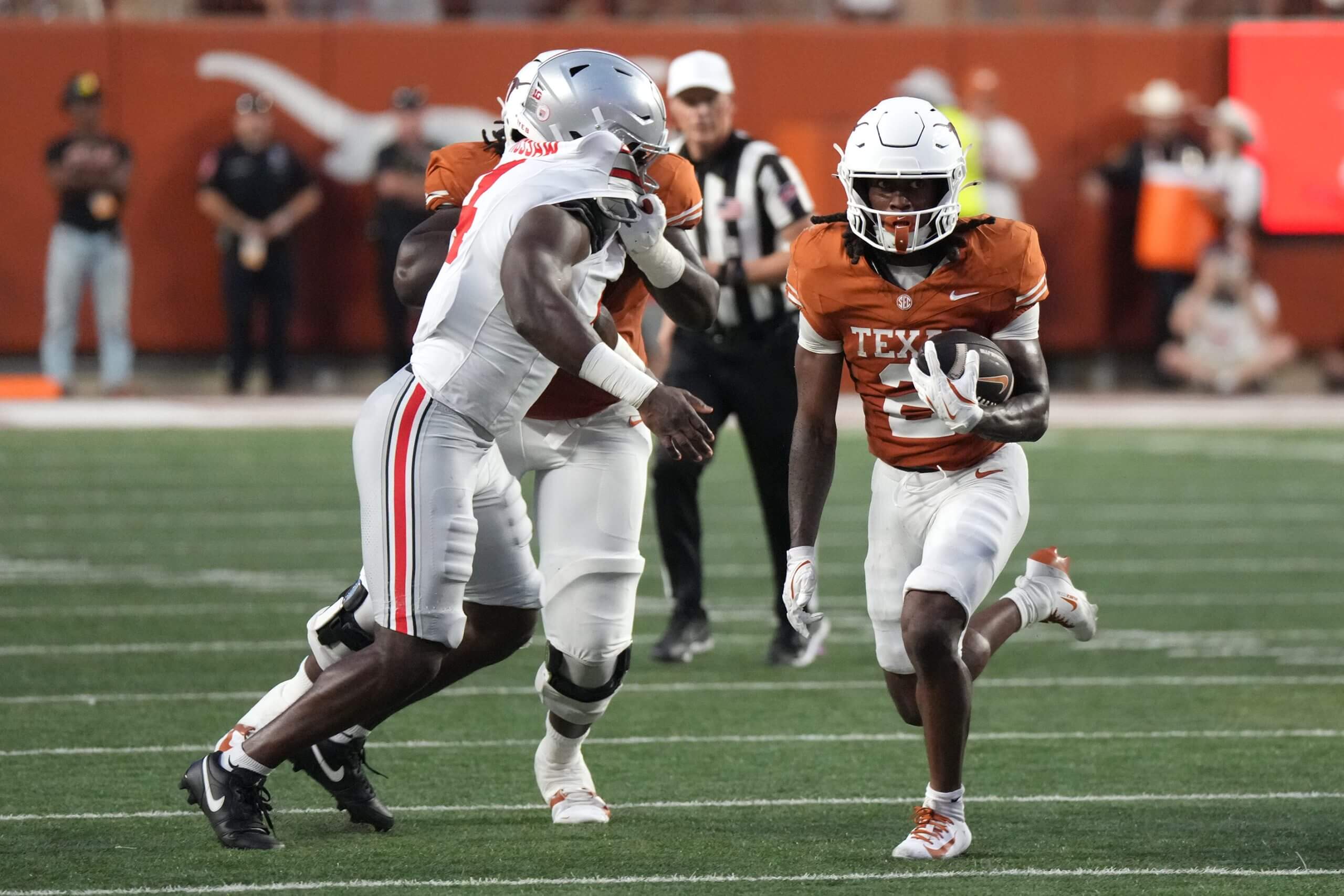
Texas outgained Ohio State 239 to 132 in the second half. (Scott Wachter / Imagn Images)
Problem: Red zone offenseFixable? Yes
Ohio State’s red zone offense left a lot to be desired last year, especially at the end of the season.
The Buckeyes’ final three games were all against top-30 red zone defenses and they scored just four touchdowns in 10 red zone trips. In came new offensive coordinator Arthur Smith, whose NFL background was supposed to help turn those field goals and empty trips into more touchdowns.
On Saturday, Ohio State had the same issues, scoring two touchdowns on five red zone trips.
While there are some schematic things that need to be adjusted across the board, some of these decisions pointed to a coaching staff not playing to its personnel.
Here are two plays that could’ve been avoided:
• On the first drive, with first-and-goal from the 4, Ohio State went with a toss to the boundary. Left tackle Ian Moore, who held up relatively well in pass protection, was beaten easily, pushing the Buckeyes back to the 13-yard line the next play. They settled for a 26-yard field goal.
• Coming out of the 2-minute timeout before halftime, Ohio State lined up and let Moore play one-on-one with arguably the best pass rusher in college football, Colin Simmons, and it ended in a sack. The play had no chance. The Buckeyes settled for a 30-yard field goal.
This can be fixed, but Smith has to start calling plays to his personnel. Abandon the goal-line pitches and instead run inside, give your tackles help on outside runs or use your playmakers at receiver.
Problem: Linebacker playFixable? Yes, but with personnel changes
Texas exposed Ohio State up front, and it wasn’t just because of the defensive tackles. The linebackers seemed to be a step slow.
Captain and starting mike linebacker Payton Pierce looked like he was thinking too much about how to react instead of playing instinctually. Christian Alliegro struggled at times and never seemed comfortable out there.
Riley Pettijohn played the third-most snaps of the linebackers with 35, a number that should rise. He’s not only gifted athletically, but he seems to read plays in the box well and is quick to get around the ball.
His sack was all about instincts, and on Jermaine Mathews Jr.’s fourth-down tackle for a loss, Pettijohn made a heck of a play to get through the line and would’ve single-handedly blown up that inside zone.
I’m not ready to give up on Pierce, and neither is Ohio State, but Pettijohn has to get more snaps.
Final thoughts
This loss doesn’t fall on any one specific person, but if Ohio State is going to bounce back from this, it’s squarely on Ryan Day’s shoulders.
He’s the head coach, so I understand that sounds a bit obvious, but the idea that he admitted to not allowing Texas to score with 1:23 left because he trusted a defense that hadn’t stopped the run all game is mind-boggling. This isn’t 2024 or 2025 — Day and Ohio State don’t have the defensive players to lean on like it did then. This team needs to embrace a killer attitude on offense, and that starts with Day.
If he walks into meetings this week and sets that tone with the offense, it’ll follow his lead. If he continues to be the coach who would rather punt on fourth down inside the 40 in the third quarter, it’ll have problems all year long. Lean on Sayin, Bo Jackson and Jeremiah Smith and let everybody else follow suit.
Ohio State also needs to spend the next month figuring out which players it can count on in big moments. Depth is great, especially in the heat, but in these matchup games against top competition, the Buckeyes need a player or two at each position they can trust to make a play when they need it the most. I don’t think Ohio State knows who those players are yet.