
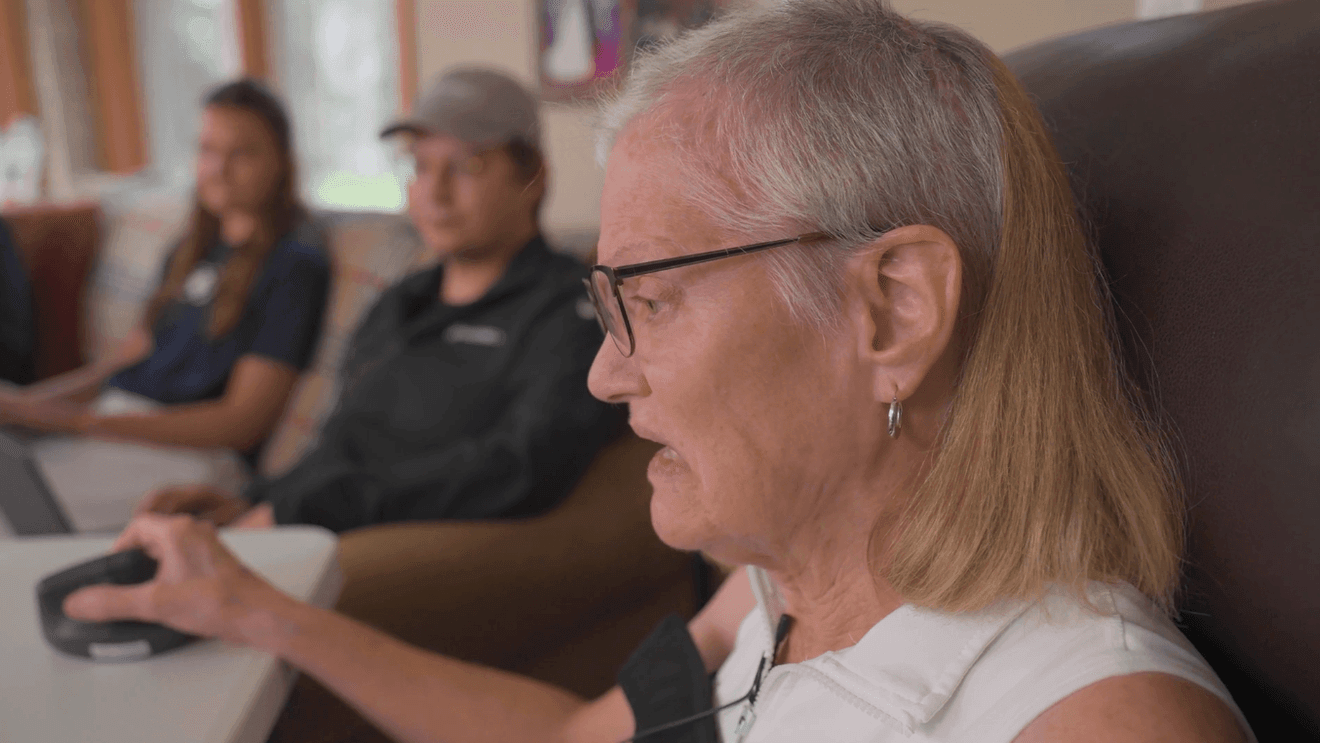
AUSTIN, Texas — An Austin company says it has reached a major brain-computer interface milestone: its first human participant is now using brain activity to generate her own words, answer open-ended questions, and communicate with family in real time.
Paradromics says the participant, a Michigan woman living with a progressive motor neuron disease that has severely limited her speech, recently used the company’s Connexus brain-computer interface to speak through synthesized voice and text during a live phone call with her grandchildren.
Her first freely chosen decoded sentence was simple — and powerful:
“Okay, I have a lot to say.”
Paradromics CEO Matt Angle says the system decoded that sentence in real time, word-for-word, with no errors.
“When we implanted Connexus in June, we crossed the threshold into long-term human use,” Angle said. “We have now crossed another: our first participant is choosing her own words and using neural activity to communicate them in real time,”
The achievement is part of Paradromics’ FDA-approved Connect-One early feasibility study. It moves beyond a patient repeating researcher-selected phrases. The woman is now choosing her own words, answering open-ended questions and using the system to communicate with loved ones.
From Science Fiction to a Human Conversation
For years, the Michigan woman has been battling a motor neuron disease with no cure. Little by little, it has taken away her ability to communicate clearly with her husband and the people she loves.
Now, inside her brain, is a device about the size of a dime. It is designed to read the brain signals created when she tries to speak — and translate them into words a computer can understand.
Paradromics says the system is also detecting distinct neural patterns tied to both attempted speech and imagined speech — language a person generates internally without physically trying to say it.
That could eventually help researchers understand how to restore communication in people whose bodies can no longer carry out the words their minds are forming.
ALSO| 1 Hotel opens in downtown Austin bringing luxury, sustainability and 300 jobs to Waterline
Meet the Device
“This woman is the first person to receive Paradromics’ Connexus device as part of a long-term clinical trial,” says Angle, CEO of Austin-based Paradromics, one of several companies moving brain-computer interface technology from the lab into reality.
I first met Angle last year, when he showed me the device as the company prepared for human trials.
“This is the device that’s implanted on the surface of the brain,” Angle explained. “And here on the edge of the device, you have 421 platinum-iridium micro-wires.”
Those 421 micro-wires are designed to record signals from individual neurons.
The Surgery
In June, neurosurgeon Dr. Matthew Willsey and his team at the University of Michigan implanted the technology in a human patient for the first time as a long-term implant. The surgery took about four hours.
“There was a sense of feeling that if things go well, this could substantially move the field forward,” Willsey said.
First, the team had to pinpoint exactly where to place the array.
“We make a kind of an inverted U-shaped incision,” Willsey said. “We bring the scalp down, then we make a craniotomy — a hole in the bone, a window.”
Through that window, Willsey guided the Connexus implant to the section of the brain involved in producing speech.
“We need to place the array in the area of the precentral gyrus — loosely speaking, the motor cortex — but the part of the motor cortex that controls the muscles that pronounce the sounds of speech,” Willsey said.
From the Operating Room to Her Living Room
A lead from the brain implant runs beneath the participant’s skin to a power-and-data unit in her chest. That implanted unit communicates wirelessly through intact skin with an external receiver and computing system.
Weeks after surgery, testing moved to her home.
When she tries to form a word, the implant captures neural patterns across hundreds of recording channels. Software decodes those signals into text and synthesized speech in real time.
“We started working with her on just initial test sentences and started seeing, wow, these signals are distinctly different depending on what sentences or words she’s attempting to speak,” Angle said. “The device is working as intended. We have the signal we’re looking for.”
In one session, the participant was asked what she would tell someone considering a brain-computer interface and the surgery. Through Connexus, she responded:
“Don’t be afraid. It’s a wonderful experience to be able to help others by your participation in the research study.”
Paradromics says every intended word was correctly decoded.
A Milestone — With Years of Testing Ahead
The company says it is now decoding the participant’s attempted speech in real time — a major step toward natural, flowing conversation through a brain-computer interface.
But Connexus remains an investigational device in a clinical trial. Paradromics will follow its first participant for six years, studying the device’s safety, durability and real-world usefulness.
“We can extract information about their intentions and make that available to a computer,” Angle said. “And we can give them an assistive communication device that is more performant than anything that would be available without an implant.”
Beyond Speech
The implications could one day reach beyond restoring a voice.
“The same kinds of devices that can read out intended speech can read out intended movement,” Angle said. “A lot of almost untreatable conditions that we would think of from a biology standpoint become solvable technology problems.”
Paradromics is also studying how its high-resolution brain recordings could one day help people control computers, advanced prosthetics and AI systems more directly.
For now, the immediate breakthrough is deeply human: a woman who has lost much of her ability to speak is finding a new way to be heard.
“I have a lot to say,” she told the world through a computer.
And we can’t wait to hear it.
Paradromics is looking for more participants for the Connect-One Clinical Study. If you want to know more information, sign up or know someone who might be interested in the study here is a link to the candidate form.