
When Zina Silva first arrived in El Paso 30 years ago, she was taken by its quiet leisure, fresh air and open desert space.
Born and raised in the bustling Queens neighborhood of New York, she was accustomed to the fast-paced lifestyle of that crowded city and found the borderland community an ideal place to begin a new phase of her life.
She had just turned 30, was coming out of a divorce and was ready to join the profession she was determined to claim as her own: a uniformed police officer.
“I said, if I’m going to do it, if I’m going to change my life, I better do it now,” Silva recalled.
After moving to El Paso, she prepared to apply to the El Paso Police Academy but was shocked to learn that the cutoff age for applicants was 29.
“I had just passed that. I wasn’t eligible anymore,” she said. “It was very disappointing.”
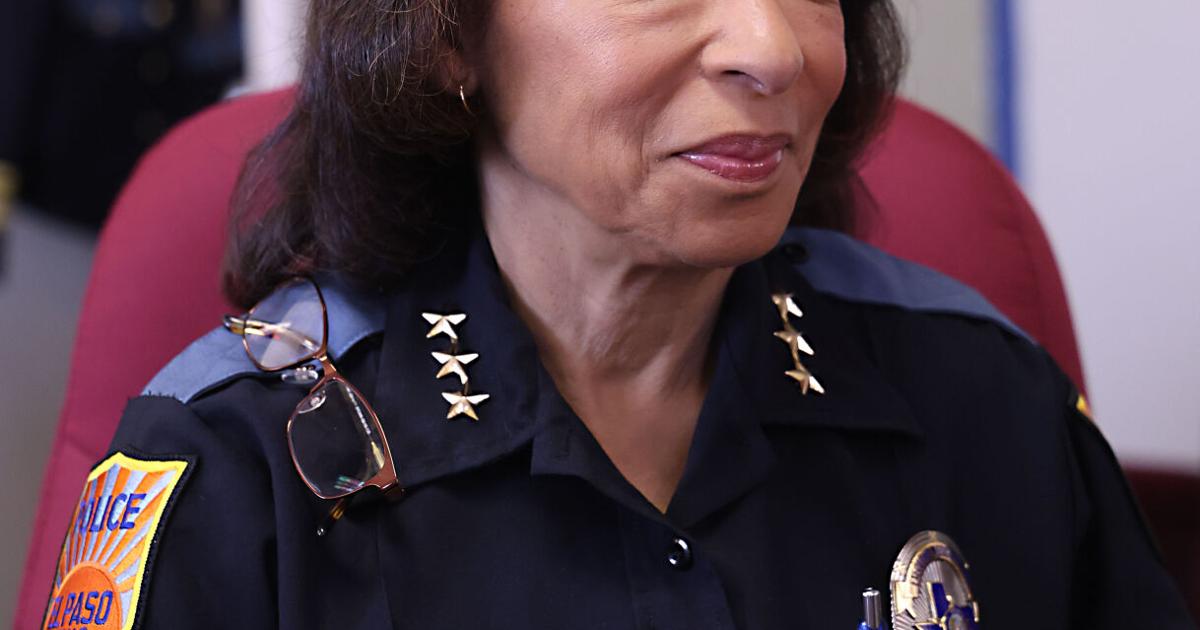
Silva relayed this story to El Paso Inc. recently while sitting at a polished conference table in her large office, wearing the badge, uniform and insignia of the second highest position of the El Paso Police Department: executive assistant chief.
Now 63, she can remember that difficult moment with a proud smile, knowing that this obstacle, and many others in her career, were overcome with the resolve and perseverance that have defined her 30 years in the department.
Silva moved to California when she learned of her ineligibility in El Paso. But later that same year, the age requirement was dropped, and Silva was now eligible to apply. When she told her mother, who had always been resistant to her daughter becoming a police officer, her mom was again hesitant.
“But I told her, ‘This is it. This is what I want to do. There’s nothing else. Let’s do it. Let’s go back and make it happen.’ And my mother said, ‘OK.’ So we drove all our stuff back,” Silva said.
Silva, an accomplished competitive weightlifter and dancer, was accepted into the academy and graduated top of her class in academics and physical fitness. Through the years, she rose through the ranks to become the highest-ranking woman in the police department.
She recently sat down with El Paso Inc. to talk about her law enforcement career, her successes and challenges, her love for dance and weightlifting, and her goals for the future.

Photo by Ruben R. Ramirez
Q: You were promoted to executive assistant chief in 2017, which is the second-highest position in the police force. What’s your role like?
It’s the chief, and then us, and then the assistant chiefs.
This was something that the city came up with as part of the organizational chart for the police department. They wanted to make sure that there were enough leadership positions so that the department could grow.
We basically do all the troubleshooting for the department. So any new initiatives that the department is looking at, whether it’s in the law enforcement sector or organizational strategies, they give them to us to look into, and we decide if we’re going to implement them. We provide the chief with background information, and then he decides whether he wants us to move forward with implementing it.
Right now, my main assignment is the body camera program.
I’m also in charge of the records management system, which is where we type our reports. Sounds simple on the surface. Officers go in and they type their reports, and then it goes to the district attorney’s office as a criminal complaint. But it’s millions and millions of reports in the system. It’s this huge database.
We also have the e-ticketing system. If you get a ticket, the officer goes to his car, he prints it out on this little portable handheld printer and he gives you this electronic ticket. I also work on that project, so there are a lot of electronic projects that I’m responsible for.
Q: Instituting the police body cameras, how did that come about?
One of the things that (former police chief Greg Allen) gave me that was my main focus was to develop the body camera program.
Henry Rivera used to be a police officer, and he retired and became a city representative. One of the things that he wanted in his portfolio was for the police department to have a body camera program, so he came up with a $100,000 (grant) and he gave it to chief Allen.
Rivera said, I want you guys to start a body camera program, robust and department-wide, and here’s some seed money and make it happen. The chief said, “Thank you very much, here you go, Zina, make it happen.”
Q: Police body cameras have been a revolution in law enforcement and the community. There’s a lot more visibility now, so what was implementing that like?
First you’ve got to take a deep breath and say, why me? And then you start putting together your team. I pulled together some people from IT, and I pulled one of the lieutenants, and we sat down and said, well, first of all, what do we need?
Pull quote
“My goal and my message is always, ‘Find out who you are, and find out what you want.”
We started looking at different companies that have body cameras, looked at different police departments that have programs and started looking at policies and procedures. It’s not just one thing; you don’t just buy it and it works. That took months of preparation, policy writing, finding vendors, seeing what it was that we wanted to do.
And $100,000, it’s kind of like 10 cents when you’re looking at electronics. We came up with 34 cameras. It was rough.
So I went back to City Council and I said this is what I’m able to do, this is what we have. And they said, well, that’s not enough. We wanted you to have a robust program.
I said, I’m glad you asked. Here’s what it’s gonna take. I gave this big presentation, and I asked for millions of dollars. They gave it to me, so now we have 800 cameras out in the field.
Q: This position makes you the highest-ranking female officer in the El Paso Police Department. Talk a little about that, and how the role of women in the force has changed over the years.
You know, it’s always been challenging, even from the academy. The first challenge that we had, as I mentioned to you, I was over the age of 29. So the police department really was looking at us as an experiment because they had never had recruits that age come into the academy.
So they wanted to make sure that mentally and physically we were able to withstand the challenges of police work. So that was one.
A lot of women, especially Hispanic women, don’t enter law enforcement. It’s just not a field that’s very well promoted in the Hispanic culture. So it’s difficult as it is.
Some classes may only have a couple of women in it. It makes it very difficult to find a very supportive group while you’re there. You can be very isolated.
And because I’m mixed, I’m Hispanic and Black, it’s even more difficult to find my little group that’s going to be complimentary, and welcoming, and make me feel like I fit in.
Q: So there’s still that element of isolation.
Sometimes I do feel isolated because I’m so interested in being a top-level success story. I’m always pushing to be the best; I’m always fighting to be No. 1. I’m extremely competitive, and that’s just my birth personality. I’m type AAAAA plus.
Being competitive within your own group also sets you apart and makes it a little bit more difficult. And I’m OK with that part.
Photo by Ruben R. Ramirez
Q: Were you always OK with that, or was it something you had to adapt to?
I was always OK with that. I think it’s a natural part of being competitive, setting yourself apart because you can’t always be in a group when you want to win.
Q: Male officers outnumbering female officers, is that still the case?
There are very few women in the police department. The numbers are still very low. I’m talking about in the entire department there are 1,100 officers, and about 200 or 300 are female.
As far as black women, I think there are only three of us.
Q: Why do you think that is?
It’s the culture. My mother didn’t support me. She was raised in Panama where there are very typical roles for women. She would say, “Why can’t you be a secretary? What is wrong with that?”
This is just not a typical role for women.
We’ve been going out and meeting with women, and we do a lot of pictures where we show women, especially women in my size, my shape, you know, small, petite, and still able to go out there and stand next to men and do the job. We’re always trying to promote different sizes, different shapes, but showing men and women alongside each other.
We’re constantly going out there with the schools, telling them, “You can do it.”
Q: You have moved up steadily through the ranks of the police department. How was that done?
I’m a planner, and I think I was born that way. Once I joined the department and I made it past graduation, I’d already had my 20-year plan.
And it was very well set up because the policy says that after two years, you can promote to detective, after four years, you can promote to sergeant, after two years, you can promote to lieutenant, and then two years, commander. And then after that, it’s appointment to assistant chief. So I was going to follow that plan. I was going to go exactly on that process. And it’s all testable. So yeah, that was the plan. They did it for me, and I was just going to follow it.
Q: And you hit all those marks?
No, of course not. That would be perfect. And I quickly realized life isn’t perfect, but I was really close. And it’s not designed for you to hit it right on point.
Q: Tell me more about your dance and athletics background. You’ve found success there.
Hmmm, I’m a world-class powerlifter. I started my competitions in Germany on the German team in 1984. I’ve won the Austria Cup, best lifter in New York and set all the records at the Dallas Police Games in 1996, and quietly retired. I returned to powerlifting at the age of 50 and set the Texas state records.
I’m also a pro figure bodybuilder. I earned that at the tender age of 54. My athletic career began in high school, where I was awarded the PAL, the Police Athletic League award for best female athlete in the school, for gymnastics, volleyball, handball and modern dance.
I didn’t know I would be a police officer then. Last year, I won first place in all five dances in American Rhythm, Cha Cha, Bolero, Swing, Rumba and Mambo, in Hawaii at the Hawaii Star Ball Ballroom competition. I’m also a black belt in Taekwondo.
Q: How has that athletics philosophy translated into policing?
Training for competition translates to training for life. Self-discipline, consistency, perseverance, goal setting and allowing yourself to be judged by others prepare you for real-world experiences. It builds confidence and fortitude. It prepares you for the world stage.
Q: Organizations often come and recruit from El Paso. How did you overcome that draw from recruiters trying to get you out of El Paso?
Early on, the FBI wanted me, U.S. Marshals, Border Patrol. I had my pick at that point. But I’m a planner.
When I selected the police department, I was done. That’s it. So it wasn’t about the highest bidder. It wasn’t about money. It wasn’t about location. I had already decided what I wanted. And that’s why my goal and my message is always, “Find out who you are, and find out what you want.”
It’s not what they offer you because you can always make money. And you can always find a place to live, and you can always buy a house. Those things are going to come. But what is it that you want to do that you’re going to be happy with? Otherwise, you’re always going to be soul-searching because you’re not fulfilled.
If you know who you are, and you know what you want, that job will give it to you. And you’ll get the money, you’ll get the satisfaction, you’ll get the title. Those things are going to come.
Q: What first brought you to El Paso?
I had a friend here, and I was looking for a change of life. New York is very expensive. To make money, you have to really, not just work hard, but you have to be at the top of your game. You have to know somebody. And the lifestyle is very, very fast paced. It’s very difficult to own your own property because the expenses are so high. Everything is bus and train, and living so close together.
Q: What was your first impression of El Paso?
When I came out here to visit, the wide open spaces, just the noise level, the fresh air, I was like, wow. I want to try something different. And I was still young. I was in my 30s, and I said, if I’m going to do it, if I’m going to change my life, I better do it now.
I was excited to have an opportunity to have a different type of lifestyle.
Q: Taking yourself back to that time, newly arriving in El Paso, taking in this new place and culture, what was your big takeaway from that period?
The community part was kind of difficult. El Paso is, and this may be hard for you to hear, but El Paso is a very closed community. It’s very, very family-oriented, but that is within its own family structure. El Pasoans are very nice to outsiders, but the family structure is very enclosed.
Most people are born and raised here, they marry here and the family just sort of extends itself from that central point. But it doesn’t really extend very far out. So getting into that family structure is very difficult.
Q: People are accustomed to hearing about the friendliness of El Paso, but you noticed something more complex.
It is. El Paso is friendly, and I don’t want to misconstrue that. It’s still friendly, sort of at a distance, until you’re accepted into the family or the friendship structure, when you have a quinceañera, or when you have a wedding, or when you have an event, it’s always within the family. You don’t even need to invite friends because you have such a large family, right? Everybody is related to everybody, so it’s very, very hard to connect. So it was difficult.
Q: Do you now feel that you’ve found acceptance here?
I’ve been here for so long now, and I’ve made it my home. When you move to a new community, it’s really about you adapting to the community, and that’s how they learn to embrace you. So that’s what I’ve done.
El Paso has embraced me, and it’s been very good. It’s good living here.
Photo by Ruben R. Ramirez
Q: How would you describe yourself to someone? Are you the competitor? The policewoman? The teacher? The manager?
I think all of us are different people at different times, depending on who we’re with. When I come to work, I’m Chief Silva, no doubt. As soon as I put the uniform on, the persona is, you know, sort of like “lights! camera! action!” This is the position and the role that I’m playing.
And then when it’s time for me to go to dance practice, I’m Zina, and I’m the diva, and now I’m working on moving my hips and making sure that I’m “five, six, seven, eight” on point. And then when my daughter calls me, I’m Mom. And that’s a whole different role. You know, “What do you need? How was your day? What can we do?”
I’m not just one person. I don’t think any of us are. I think all of us play different roles depending on where we’re at and who we’re with at that time.
Q: You obviously have a full-time schedule with the police department, but do you have any hobbies you do outside of work?
Well, I’ve retired from powerlifting. I just retired from bodybuilding. 2021, I think, was my last bodybuilding competition.
I just retired from ballroom dancing last year, but now I’m doing salsa and bachata, so I’ll be competing in that next year. And I like to motorcycle ride. I still go to the gym every day.
I don’t do martial arts as much as I used to, but I like to do a lot of social dancing. That’s what I’m focusing on, just getting ready for competition and Latin dancing.
Q: It seems that everything you do has that competitor’s edge to it. What is it about competition that motivates you?
It gives me a reason to keep taking care of myself, and it gives me something to look forward to. I think it’s just the healthy aspect of feeling really good all the time. When I wake up, I know I have to eat right, and I know I have to do my exercises. At my age, feeling good and being healthy and knowing that it’s going to contribute to my longevity is what I think motivates me.
I want to live healthy into my 80s. I know I can’t compete forever, but if I can live a healthy life, I think it’s really important. My mom is 88, and she still goes dancing.