
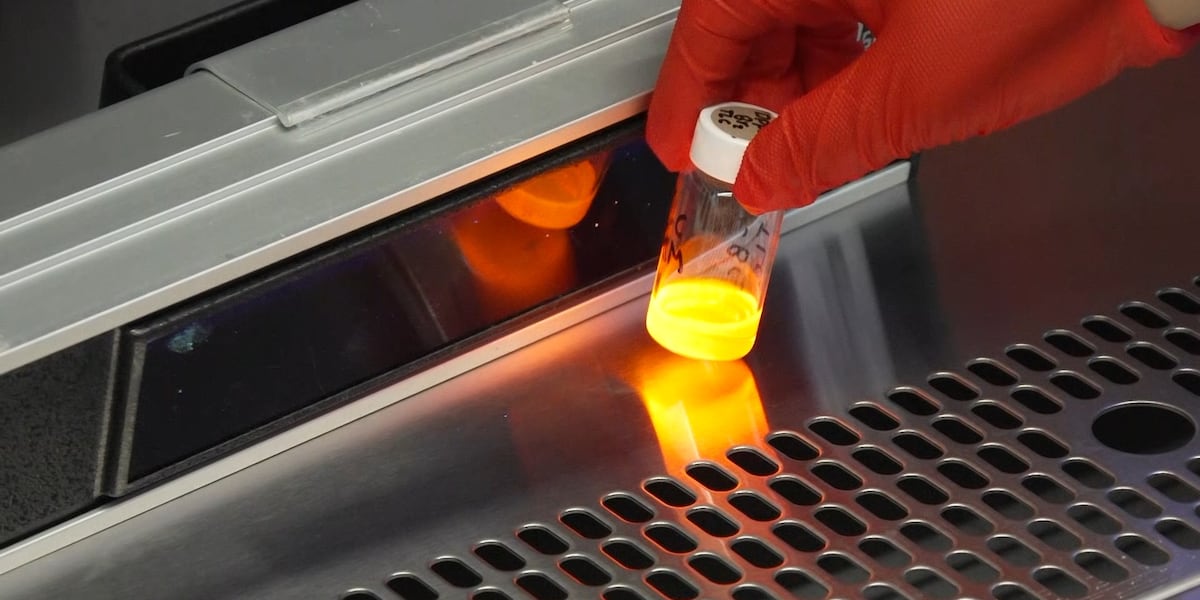
LUBBOCK, Texas (KCBD) – A Texas Tech researcher has developed infrared imaging technology that could be used to triage injuries on the battlefield without CT or MRI machines.
Joshua Tropp is an assistant professor of chemistry and biochemistry at Texas Tech. He recently presented his infrared imaging technology research at the Military Health System Research Symposium.
“And what’s nice about this technology is it doesn’t require CT, it doesn’t require MRI, this requires portable cameras,” Tropp said. “So you could use this in a hospital setting, in a rural or remote place, you could use this, for example, in a military context where you want to triage on the battlefield.”
What started as an academic experiment has now earned funding from DARPA and the Air Force.
Platform technology
“This is a platform technology is what I like to call it,” Tropp said. “So we’re organic polymer chemists and we’ve developed this infrared dye.”
“And once we have that dye working, basically how it works now, we could just kind of modify the surface of these particles and now it could be applied for this application or this application,” Tropp said. “It’s really the glowing dye that has now created all of these different opportunities for not just medical applications, but also environmental applications and defense and energy applications.”
Unlike bulky MRIs or CT scanners, the system is designed to be fast and portable. If a soldier is wounded, a combat medic could inject a special dye that illuminates injuries under a special camera in seconds.
How the dye works
“There’s different kinds of fluorescence that people are familiar with,” Tropp said. “I like the glow stick because almost everybody’s had the experience of cracking a glow stick and seeing that. But the problem is that the glow stick, it glows at a wavelength you could see, right? You could see the green, you could see the blue. But doctors don’t need that. What doctors need are things that glow into the infrared of these wavelengths we can’t see to help guide things like surgeries. So you could use this to label, let’s say, a tumor, and then the doctor could in real time inform their surgical removal or resection of a tumor.”
Tropp’s team is engineering nanoparticle formulations that create that invisible, fluorescent glow. The dye is also biocompatible, meaning it is non-toxic and safe for the body.
The “Thanksgiving table test”
“I have a joke I make with my students that all of our projects have to pass what I call the Thanksgiving table test,” Tropp said. “If I was to talk about this at Thanksgiving, would my family be excited? Would they want to hear more about it or would they change the subject? And to me, to pass that test, you need to work on something that’s applied. There’s the fundamental that enables the applied, but something that has some meaningful impact that we could be proud of years from now. If we’re going to spend all this time and effort on something, it has to make a meaningful impact.”
While current efforts focus on field use for troops, researchers hope this technology will one day be a common diagnostic tool in everyday hospitals.
Copyright 2026 KCBD. All rights reserved.