
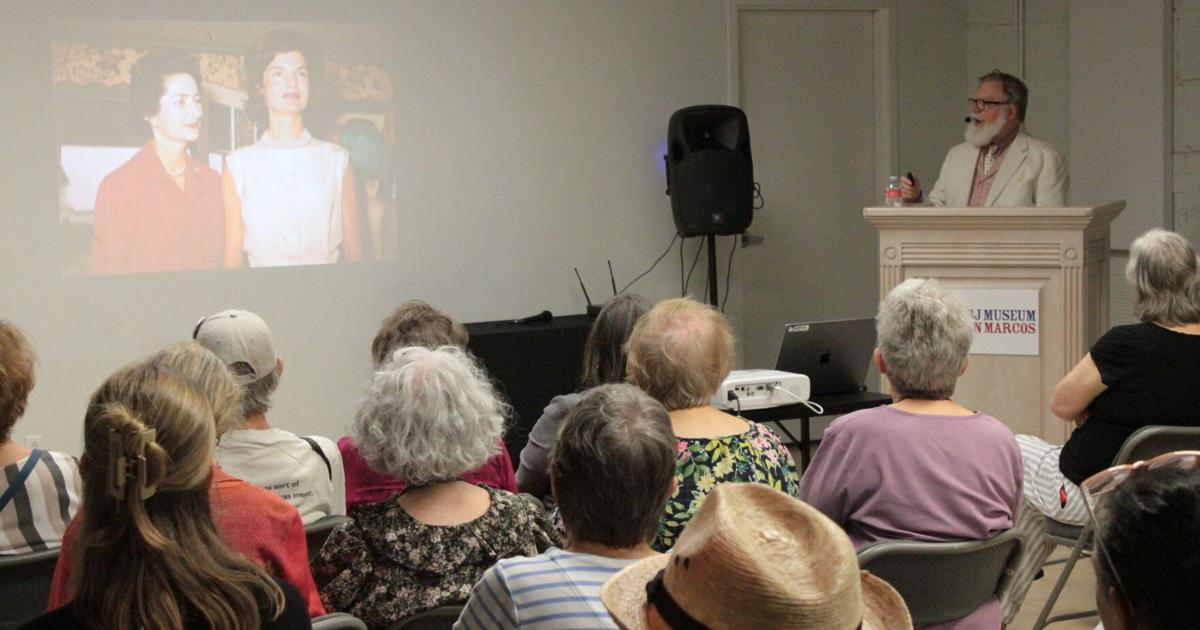

Jack Smith, costume designer and historian, highlighted two of the White House’s most notable fashion icons — Jacqueline Kennedy and Lady Bird Johnson — for a packed house at the LBJ Museum’s Summer Chautauqua. Daily Record photo by Shannon West
This year’s LBJ Museum Summer Chautauqua was all about fashion and its two first lady icons — Jacqueline Kennedy and, of course, Lady Bird Johnson.
Jack Smith is a costume designer, educator and historian who walked attendees through “Fashion’s Impact on the White House.” He teaches at the School of Theater and Dance at Texas State and researches costume history, fashion and politics.
Smith laid out a picture of two stylish women who employed fashion in very different ways. Kennedy’s polished, sophisticated wardrobe was designed to make a visual and diplomatic statement, while Johnson’s practical style emphasized accessibility and American-made fashion with a Texas flair.
“The Jackie look” was defined by clean lines, tailored suits, pastel colors, pillbox hats, oversized sunglasses and a minimal amount of jewelry that included pearls.
Kennedy cemented her image as a style icon during her husband’s inauguration in 1961 when Oleg Cassini, who was a little-known name at the time but a good friend of Jackie’s, designed a beige wool coat with clean lines and a small staple collar.
“Knowing the ceremony would be captured primarily in black and white photographs, she correctly anticipated that her coat would stand out in the crowd of heavy dark furs and dark coats,” Smith said. “This established her enduring legacy of timeless, sophisticated elegance. And you see there a group of first ladies and other dignitaries, and Jackie just shines as an individual little jewel.”
Her relationship with Cassini was central to the development of her public image as he became her signature designer. The look that the two carefully curated together, with a nod to Kennedy’s French roots, would start to define American style. Kennedy did not invent the pillbox hat, but Smith said she helped make it one of the most popular hat styles of the 1960s.
“Now, other first ladies have impacted fashion. That is to be certain. Jackie did it like a surgeon,” Smith said. “She understood every choice she made would be replicated. She understood how it would be seen. She understood the meaning of the clothing. Jacqueline Kennedy was a brilliant cultural diplomat.”
After JFK’s untimely death thrust LBJ into the presidency, Lady Bird Johnson continued work associated with the White House gardens. In a handwritten note, Jackie Kennedy thanked Lady Bird.
“She said she was grateful because it meant that there would always be something of John there to remind them of what a great man is,” Smith said. “It is heartbreaking to me that this has been paved over.”
While the two women shared a love of clean-line tailored suits, Johnson differed from her predecessor in rejecting high fashion.
“Instead, she relied on an enduring functional wardrobe featuring structured pleats and architectural lines designed to connect with everyday middle-class American women,” Smith said. “Her style also reflected her proud Southern roots at the LBJ Ranch, frequently called the Texas White House. She often wore casual jeans, Western boots for public events.”
Smith believes both women fundamentally changed expectations for the role of first lady, with Kennedy being a champion for cultural diplomacy, fashion and historic preservation and Johnson through environmental advocacy and social programs.