
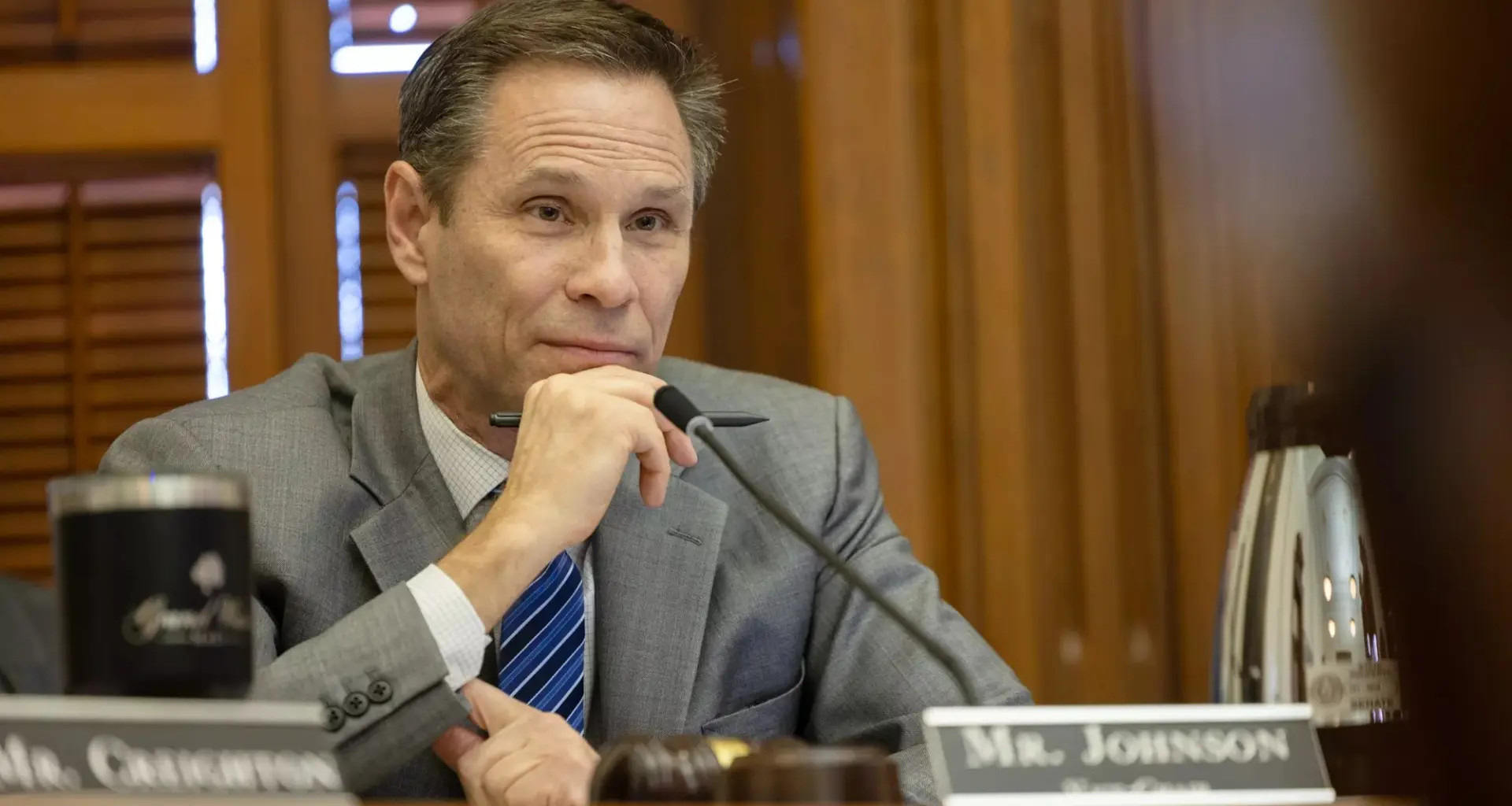
Dallas state Sen. Nathan Johnson says he’ll mark a break from the past if elected Texas attorney general this November.
After going to a primary runoff against Joe Jaworski, Johnson advanced to the general election with nearly 60% of the vote in May. The three-term state senator, who represents sections of Dallas, Irving, Mesquite and Balch Springs in Austin, is looking to become the first Democrat to hold the office since Dan Morales in 1999.
Johnson, like other Democrats in statewide races, will hope to ride a wave of momentum ahead of what is expected to be a difficult midterm cycle for Republicans in President Donald Trump’s second term, which has seen his approval ratings plummet to historic lows. Gina Hinojosa is challenging Gov. Greg Abbott as he seeks an unprecedented fourth term, while Rep. James Talarico is pitted against Attorney General Ken Paxton to replace John Cornyn in the U.S. Senate.
A recent poll released by the University of Texas’ Texas Politics Project showed strong support for Talarico, who led Paxton by three points among eligible voters, but Hinojosa and Johnson still trail by five points each in their respective races. But the polls also consistently place about 10% of the electorate in the undecided category, and in an interview with the Observer, Johnson said those voters could want a change from the status quo, especially in the attorney general race.
Sign up for the This Week’s Top Stories newsletter to get the latest stories delivered to your inbox
THANK YOU!
You’re all set.
CLOSE
“A lot of people in that category want somebody who’s independent-minded,” Johnson said. “And I can tell you what I’ve heard loud and clear is that people are disgusted by the politicization of the attorney general’s office, and that’s why I’m pretty confident I will pull 70 to 80% of the uncommitted votes.”
On his opponent and corruption
Like Talarico, Johnson has made fighting corruption a major campaign plank. He said the attorney general’s office has turned overly partisan to the detriment of respect for the law, a problem exacerbated under Ken Paxton. In 2023, the Texas Senate voted not to remove Paxton from office on impeachment charges of bribery and misuse of public office for allegedly helping a major donor.
Middleton was one of the senators who voted to acquit Paxton on the charges, which Johnson said should be disqualifying in the eyes of voters.
“When your conservative values are more important than your oath of office, than your oath as a juror, and the rule of law, and corruption in the office you seek, then you’ve got your priorities in the wrong order,” Johnson said.
Under Paxton, the attorney general’s office has been increasingly used to target Democratic-voting cities and political opponents. Paxton has previously sued Denton over an LGBTQ swim party, sought to overturn the results of the 2020 election and used consumer protection laws to target organizations seen as conflicting with GOP goals. A 2023 Texas Tribune investigation also found that he has repeatedly broken with tradition and refused to represent state agencies being sued by conservative groups for “inconvenient” policies.
In an interview with conservative radio host Mark Davis, in which he dubbed himself “MAGA Middleton” and called Trump the greatest president in the history of the U.S., Johnson’s opponent vowed to continue to use the office to further a conservative agenda. That is dangerous, Johnson said, because the agenda may sometimes conflict with Texas’s interests.
“He literally said he has to use every resource and tool in the attorney general’s office to ensure that Donald Trump can enact his agenda,” he said. “Now imagine Donald Trump does something that hurts Texas. Let’s suppose Donald Trump slaps a 50% tariff on Canada, not a hypothetical. And let’s suppose, in doing so, he has violated federal law. Is Middleton going to sue him? No.”
Proposition U
In February, Paxton again used his office to target a large liberal-leaning city. Dallas, he alleged, had failed to live up to the funding and hiring goals set out under the voter-approved Proposition U city charter amendment. Passed in 2024, Proposition U requires Dallas to maintain a sworn force of 4,000 police officers — which the department is still well short of, despite some progress. It also requires the city to devote 50% of new revenue to funding the Dallas Police pension and pay raises. The proposition was part of the Dallas HERO agenda pushed by right-wing megadonor Monty Bennett.
As Dallas faces a $51 million funding gap that has forced city leaders to consider cutting employee healthcare, layoffs and large-scale service cuts, the proposition has only made budgeting harder for city officials, most of whom campaigned against it before its adoption. Johnson said Dallasites were “duped.”
“Monty Bennett crammed through Propositions S, T and U, which were extremely poorly conceived, which were sold to the public in a big fat lie, which are putting extraordinary pressure on the city’s budget,” Johnson said. “Faced with either having to raise taxes or cut services, and it leaves the city in a bad spot, and the lack of state funding for various local projects makes it impossible to grow responsibly.”
Johnson authored an ultimately unsuccessful bill that would have prohibited cities from passing similar amendments and rendered Proposition U unenforceable. He said Paxton’s backing of the charter amendment is part of Republicans’ continued pattern of harassment over enforcement, something which he said he would do differently.
“There’s a difference between enforcement and harassment, and I think that’s the key difference between Ken Paxton and me,” he said. “The attorney general enforces the law, and I will. Ken Paxton uses it as an offensive tool of intimidation and harassment and political signaling. That’s the kind of crap I don’t do.”
On data centers and AI
Johnson has authored over 130 bills that were ultimately passed into law in a heavily Republican-controlled state senate since 2019. He said his willingness to cross party lines and work toward bipartisan policy goals has been instrumental in the process, as it will be as he looks to address data centers and artificial intelligence, two growing concerns for many Texans.
The legislature controls policy, while the attorney general’s office handles enforcement. He said he will actively monitor the ever-evolving space for abuse and corruption, but will also want to engage with lawmakers to keep policy in line with technological advances. On data centers, Johnson said he wants to keep looking at how to re-empower local governments. Notably, county officials have been at a considerable disadvantage in regulating development in their jurisdictions because they lack statutory power.
“A lot of the discussion around whether or not there’s going to be local input, and I think there should be, with respect to data centers, is going to happen out of the legislative body, and with some leadership, hopefully from the governor’s office,” Johnson said.
Republicans have begun to make data center regulation a priority with the election on the horizon. In August, Abbott announced that Texas would pause all new data center connections to the state’s power grid until a full audit could be conducted, and on Monday, he directed the Texas Water Development Board to thoroughly review abuses of the state’s water supply in a move many called an attack on the growing sector.
With AI, Johnson said he would begin reviewing existing Texas law to identify shortcomings ahead of the legislative session, then submit a list of policy recommendations if elected.
“It shouldn’t be viewed as a partisan mission, which again is why I think I intend to represent everybody across the political spectrum,” he said. “But I also want to have the confidence and the vote of people across the political spectrum. That the job of the attorney general is one that I will take seriously and performed well.”
‘An opportune time’
Despite the momentum at the top of the ticket, Johnson still faces an uphill battle to victory in November. He trails Middleton in the polls and has raised only $1.7 million, compared with Middleton’s nearly $22 million in campaign contributions, according to Transparency USA.
However, he said he has experience in overcoming an underdog with considerably less financial backing than his opponent. Johnson first won his state Senate election against Don Huffines in 2018, flipping a seat that had been Republican-controlled for more than two decades with significantly less funding. He said midterm tailwinds and voter disillusionment paid off then, and could propel Democrats like him to success at the ballot box once again this November.
“We’re in worse shape now than we were in 2018, from the standpoint of how separated our politics has become from responsible governance in what the state needs right now,” he said. “From a political perspective… I think it’s an opportune time for Democrats.”