
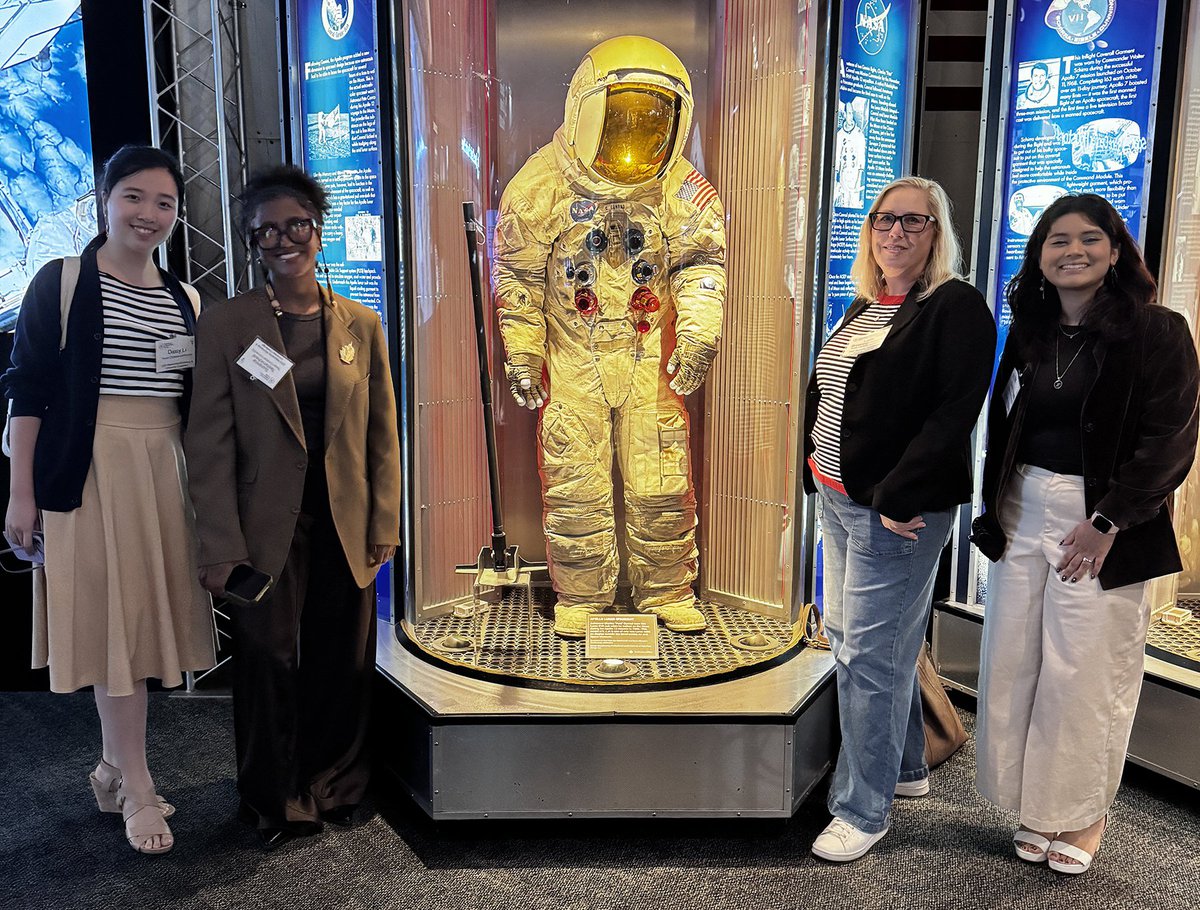
Late last spring, four TCU students, Daisy Li, Suzanna Tesfamichael, and Sunny Yusufji, along with their faculty mentor Leslie Browning-Samoni, packed up samples of a peculiar fabric innovation and drove to Houston’s Johnson Space Center. Their goal wasn’t to invent a new rocket or sensor but to tackle one of space travel’s most persistent problems: moon dust.
Sharp as glass and clingy as glitter, lunar regolith has long been the enemy of spacesuit designers, sneaking into joints, eroding material, and abrading anything that moves. The TCU team’s solution was deceptively simple: reimagine the seam itself. While their classmate Adelaide Lovett couldn’t make the trip, she had been instrumental in conceptualizing what they called the “mutant seam,” a flexible, low-profile joining method designed to keep lunar dust from breaching a suit’s interior.
At the Technology Collaboration Center’s Wearables Workshop, surrounded by NASA engineers and industry veterans, the TCU design stood out. By the end of the event, their mutant seam earned NASA’s 2025 Best Innovation Award. A few months later, they became one of only nine national finalists in Amentum’s “Back to the Moon Challenge,” a competition supporting NASA’s vision for long-term lunar habitation.
“It was my first time working with people outside chemistry,” Li said. “The mutant seam, and really the collaboration that inspired it, is what set us apart.”
Each student carried a distinct specialty into the project. Tesfamichael and Lovett handled the creative construction, experimenting with stitch patterns and materials, while Yusufji and Li oversaw the testing phase. “We divided and conquered,” Tesfamichael said. “Everyone owned their part.”
Yusufji laughed, remembering the chaos of the early testing period. “The lab didn’t control for humidity or temperature,” she said. “So we didn’t do either. We just focused on what mattered for lunar dust. It was kind of freeing, and terrifying.”
The collaboration didn’t end in Houston. With Yusufji later studying abroad, the team’s communication stretched across time zones. “We’d pass updates back and forth, share data, brainstorm next steps,” Tesfamichael said. “It was constant.” Lovett agreed: “I’ve done a lot of group projects, but this one was different. Everyone listened, and everyone cared.”
Their faculty mentor, Browning-Samoni, watched the project grow from an idea to a legitimate research pathway. “The College of Fine Arts and the fashion merchandising department invested nearly $10,000 in materials and travel,” she said. “Every student stepped up, from crafting samples to presenting at NASA, and their cohesion was incredible.”
That cohesion has carried the research far beyond the classroom. Lovett describes the work now as a “stair-step process,” refining the seam, testing new polyester thread counts, and exploring broader uses, from hazmat suits to potential Mars applications. “We want to test strength and durability in multiple contexts,” she said. “The seam isn’t just clever, it’s functional.”
The students say the collaboration changed how they think about science itself. “Working with people from different majors showed me how much more you can accomplish when everyone brings their own perspective,” Yusufji reflected. Li nodded in agreement. “It inspired me to stay open-minded. Real-world problems don’t come packaged by discipline.”
Dr. Charles Freeman, who advised the project at the program level, said the work symbolizes a new kind of research culture at TCU. “Innovation doesn’t have to come from a seasoned professor in a lab,” he said. “These undergraduates are producing ideas that could change the future of aerospace materials. They’ve laid a foundation that others will build on.”
Even with graduation looming, the team shows no sign of stopping. They continue to test, apply for new grants, and field questions from interested engineers. Tesfamichael smiled when asked what’s next. “It’s crazy to think we started this as a class project,” she said. “Now we’re testing new applications and seeing doors open we didn’t even know existed.”
Their journey, from fabric scraps to NASA accolades, is a lesson in the power of interdisciplinary curiosity. As Yusufji put it, “Working with people from different majors showed me that collaboration isn’t just a skill, it’s how you push the boundaries of what’s possible.”