
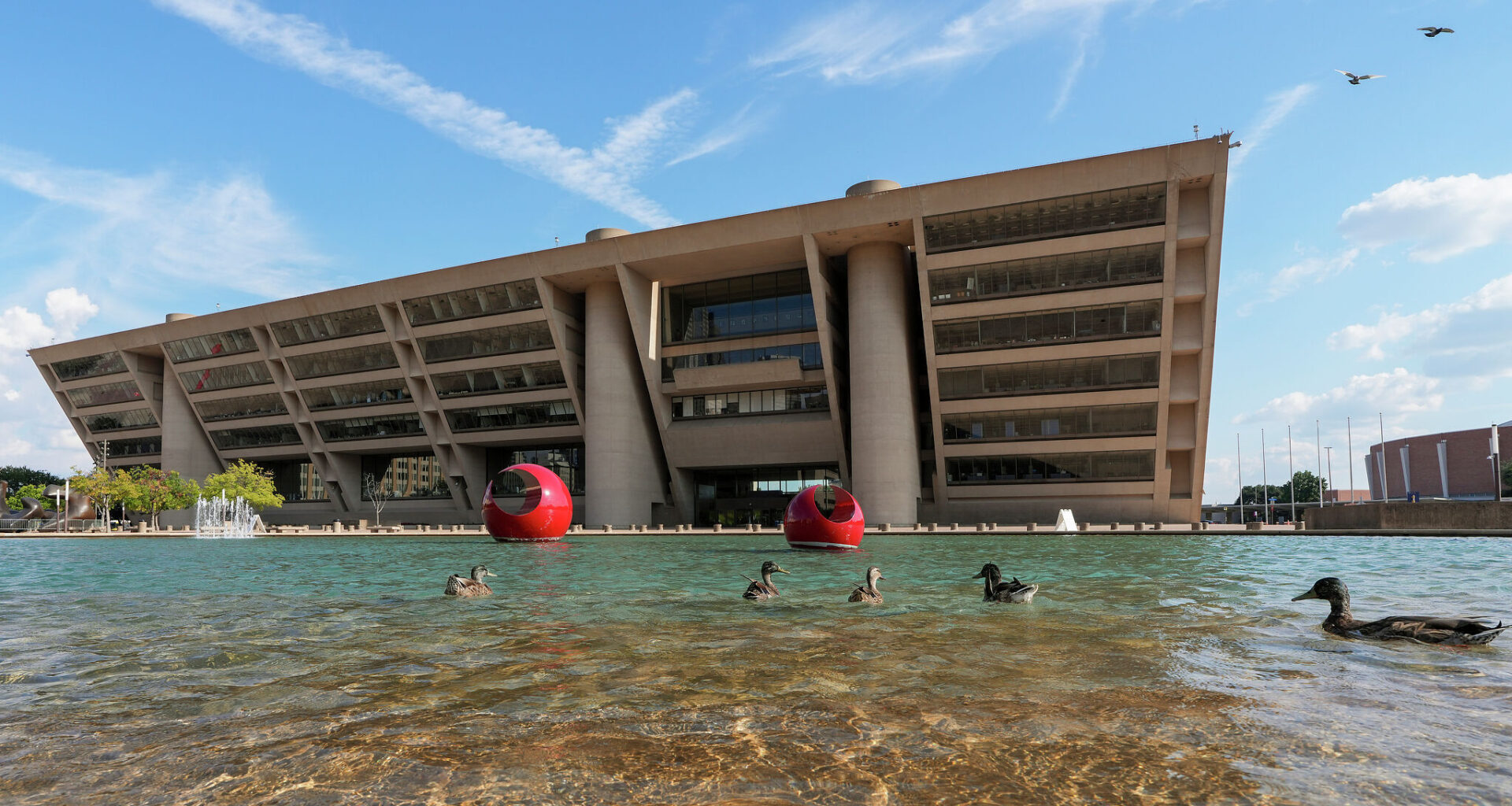
Ducks enjoy the reflecting pool in front of Dallas City Hall. The World Monuments Fund has included the iconic I.M. Pei-designed building on its “Irreplaceable America” list.
File photo/Dallas Morning News
Weekly budget discussions have forced city leaders to “bicker for hours over fractional line items” because increased public safety spending has left libraries, parks and recreation centers to compete for the leftovers.

“Our budget process is like a hunger games battle for survival,” Park Board member Rudy Karimi recently told City Council members.
Inflation and material costs are rising faster than the city is able to collect enough tax revenue. Experts say that unless these expenses are managed at a national level, most local governments may not be able to escape cuts.
Article continues below this ad
In Dallas, most departments have seen their overall department budgets grow over the past decade. But that doesn’t mean they’re occupying the same slice of the budget every year.
Streets and transportation spending has nearly doubled. Likewise, parks and recreation spending has also grown, primarily due to projects included in five bond programs over last year.
Despite the significant investments, both departments are taking up a smaller share of the general fund.
Budget writers are contending with a voter mandate to increase police staffing. City officials have also increased staffing and salaries for firefighters to match the investments in policing.
Article continues below this ad
In order for the police and fire departments to grow, other departments had to reduce their budgets.
Related: Dallas caps property tax rate, bucking hikes in other Texas cities
Public safety costs have grown faster than the city’s revenue growth for the past three years, resulting in net decreases for other departments.
Staffing and salary increases have led to a $65 million increase in the upcoming annual budget for the Dallas Police Department. The department’s spending has gone from taking up 34% of the general fund in 2020 to 40% now.
Residents have noticed. Dallas resident John Putnam told council members this month the city is “hamstringing future generations.”
Article continues below this ad
State law doesn’t allow municipalities to cut police funding without proportional cuts to the overall budget, making it unlikely the city will ever spend less on police than what it’s paying right now.
Plus, Dallas will be paying billions of dollars for the next couple decades to close a $5.5 billion gap in its uniformed and non-uniformed pension systems.
Across the nation, city government leaders have felt squeezed by recent budgeting cycles, and experts say the pressure is unlikely to go away without federal intervention.
Related: Dallas’ finances have come into question in recent years. Is the city in trouble?
Some North Texas cities and counties are increasing property tax rates to address the budget crunch. Collin County, for example, raised its tax rate for the first time in 33 years.
Article continues below this ad
Dallas leaders are projecting confidence by reducing the city’s tax rate. But, they’re also taking drastic measures to trim spending, including freezing the living wage rate for temporary workers, furloughing employees, eliminating positions and now, reducing healthcare plans.
“Governments, through conservative budgeting practices, are trying to rein in their spending,” said Farhad Omeyr, program director of research and data at the National League of Cities. “But no matter how much they try … they cannot control the costs as much as they would like to.”
City budget problems surfaced after ballooning costs during the pandemic, Omeyr said.
Supply chain issues drove up the price of building materials, and the price hasn’t dropped since. Cities cannot simply raise taxes the same amount that businesses have raised prices, which Omeyr called “an unfair fight.”
Article continues below this ad
Texas lawmakers have restrained a city’s ability to manage costs by placing restrictions on the amount of property tax revenue cities can collect every year.
Federal intervention during the pandemic — including the American Rescue Plan Act and the Infrastructure Investment and Job Act — “masked” the impact of rising costs on the municipal budgeting cycle for a few years, Omeyr said.
Many cities wisely planned for the funds to expire, but the absence is still revealing budget shortfalls.
“Governments are feeling the burn, if you will,” he said.
Article continues below this ad
The Dallas City Council will adopt its budget Wednesday.