
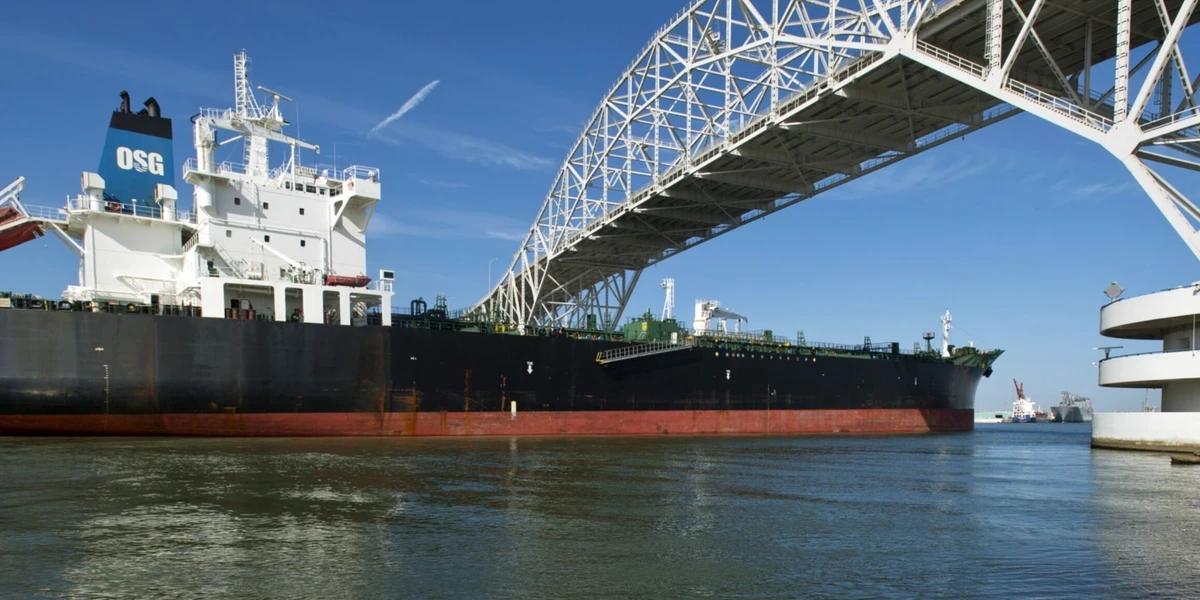
The Trump administration’s effort to turn US ports into incubators for nuclear-powered merchant ships is running into cautious companies that say they’re holding out until regulators decide details on agency rules and the division of authority.
Nuclear merchant ships are one of many initiatives the Trump administration has endorsed under its “nuclear renaissance” banner, as well as the president’s push to revitalize the shipbuilding industry. The US is pitching nuclear-powered cargo fleets as a faster transportation option for the 80% of global goods moved by sea.
The administration this year announced coordination plans to divide responsibilities among agencies, enlisted some of the largest cargo ship ports to allow reactor testing, and hosted delegations from dozens of countries to launch an atomic licensing initiative for nuclear use at sea. But that momentum has stopped short of licensed nuclear reactors hitting the water.
Stakeholders say they’re waiting for the Nuclear Regulatory Commission to publish a regulatory framework this fall that answers unresolved questions, including how the government will analyze the effects of extreme waves or capsizing on nuclear reactors’ safety systems, what safety classification looks like when environmental and population risks change, and how crews will be certified.
“We haven’t filed a specific license application yet because there is a determination that we have to make around how holistic the approach to licensing is here,” said Mikal Bøe, CEO of Core Power, the first company to sign an agreement with the US to help build a fleet of nuclear-powered merchant ships.
The scale of licensing depends on collaboration among several federal agencies with differing authorities over sea ports, export controls, and marine environments.
“It’s an all out government approach,” Bøe said.
Interagency feat
A clear division of responsibilities between agencies remains a significant hurdle for the technological innovation to push off from port.
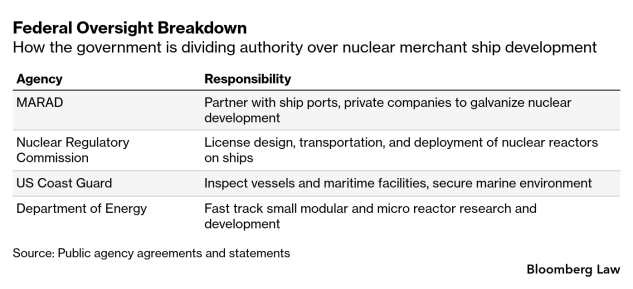
The US Maritime Administration has taken the role as the lead agency for overseeing nuclear cargo ship development. It has signed memorandums of cooperation with Core Power as well as with the Ports of Long Beach and Corpus Christi to explore how their infrastructures can accommodate testing small modular reactor-powered vessels.
MARAD Administrator Stephen M. Carmel is bullish on nuclear power’s capability to change the cargo shipping industry, but he isn’t trained in nuclear technology and “doesn’t have a huge staff of nuclear trained officers,” said Budd Haemer, a nuclear law professor at the George Washington University Law School.
That’s where the NRC’s agreement with the US Coast Guard, which often works in coordination with MARAD, comes in. Under a memorandum of understanding between the two agencies, the NRC is responsible for issuing design approvals and licenses for the nuclear reactors’ construction, installation, and deployment, while the Coast Guard will inspect the vessels and enforce maritime safety laws.
The agencies said in the agreement memo they will coordinate their compliance oversight “through the appropriate offices, while each retains and exercises its independent authorities.” But entities concerned about future enforcement say that statement is too vague.
In comments to MARAD, several companies asked for more details on how to handle mobile nuclear siting, emergency planning, and credentialing requirements for crews running the nuclear-powered ships.
“Neither the Coast Guard, nor MARAD, nor the classification societies in the US are ready to have nuclear propulsion ships now, the regulatory standards just aren’t there,” said Raymond Waid, who leads the maritime industry group at Liskow & Lewis.
Others remain optimistic on the developments moving forward as agencies solicit feedback.
“Reactor licensing can be accomplished today, it’s the transportation things, export controls and things that are intrinsic in the movement that are the unresolved questions,” said Brooke Clark, a former NRC general counsel who is now a partner at Morgan Lewis.
Agencies still have to clarify what parts of the ship belong under NRC jurisdiction, like whether the hull is a safety structure, and what components are part of the “nuclear island,” or the reactor core, Clark said.
The NRC said applicants may pitch what parts of a ship should be classified as either nuclear or maritime components, as regulatory specifics will depend on the technology. The hull may count as a radionuclide containment system for a high pressure reactor, but a low pressure reactor may not warrant classifying the entire underbelly of a boat as a safety barrier.
Some companies are opting to test their products under preliminary approvals from the Department of Energy. The agency has adopted a broad interpretation of its authority to greenlight new reactor design testing under the Atomic Energy Act. It’s an alternative path to get a viable nuclear model going, according to MC Hammond, an attorney with Pillsbury Winthrop Shaw Pittman LLP.
“If a company can demonstrate commercial viability with this, then they can certainly get private funding from the market under the structure that the Trump administration has used,” Hammond said.
NRC Limitations
The NRC’s review of nuclear design proposals comes as political pressure grows to speed up the technology’s development.
President Donald Trump mandated an 18-month timeline for final decisions on nuclear applications under a May 2025 executive order. The directive was aimed at overhauling the licensing process at a time when NRC was shedding office staff. Officials in May reported losing more than 500 workers over the past 16 months.
The order fits within a broader backdrop of nuclear licensing changes aiming to speed up an agency critics say has over-corrected for risk aversion, with licensing staff buried in lengthy safety and environmental reviews leading to years-long delays for project approvals.
The NRC’s office of advanced reactors has grown to around 220 people and the agency said it has the bandwidth for maritime applications, though industry interest has for now been primarily for land-based designs.
The agency has hit its targets for shortened review times for stationary reactors, but attorneys advise these timetables aren’t necessarily indicative for the maritime space.
“Applicants need to be lined up with the things that they can control,” Clark said.