
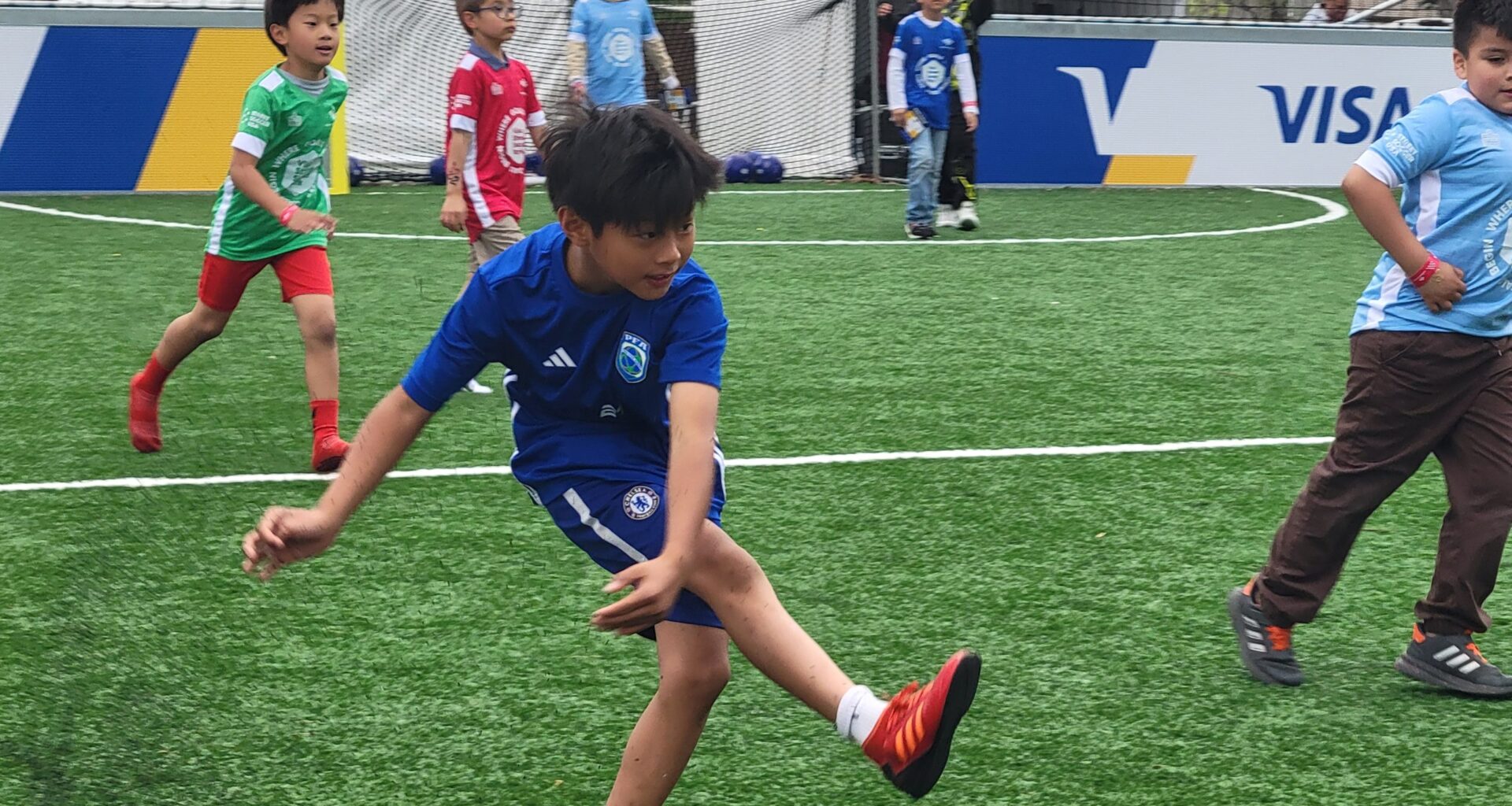
Seven-year-old Holden O’Dell never showed much interest in soccer.
Then the World Cup came to Tarrant County.
The O’Dells tried to catch as many matches as they could. While the tournament was underway, a neighbor offered the family a pair of soccer goals they no longer wanted. Holden soon had his first cleats, shin guards and soccer socks and was outside kicking a ball in the front yard whenever he could, with family and neighbors joining the almost-nightly games.
“He was out practicing in our front yard every chance he could get,” his mother, Kaci O’Dell, said.
The O’Dells are among the families and youth soccer organizations across Fort Worth that say the World Cup gave children new reasons to pick up a ball — and, in some cases, gave parents new reasons to sign them up. But whether that enthusiasm becomes a lasting participation boom is less certain.
Some neighborhood programs saw registrations surge during the tournament. Holden, for example, will play his first season of organized soccer with the Fort Worth Youth Soccer Association.
Others say their fall numbers will not be clear for weeks.
Organizers say the bigger questions are whether families can afford a league, whether programs have enough coaches and whether children have a field close enough to use.
World Cup interest surges in Diamond Hill
The clearest measurable increase so far has come from Diamond Hill North Side Youth Association, a neighborhood nonprofit led by executive director Roxanne Martinez, an elected Fort Worth ISD trustee.
The group registered 142 children ages 4 to 12 for its summer soccer program, more than double last year’s total of 70. The age range, registration period and number of sessions were comparable, Martinez said.
The organization did not attract enough players to form a division for 12-year-olds in 2025. This summer, it fielded four teams in that division, along with four teams each for 6-, 8- and 10-year-olds.
“We kept registration open all summer, and we were continuously adding kids,” Martinez said.
Sometimes, families brought friends or relatives to practice and asked whether they could join.
Martinez cannot say how many of the 72 additional players joined because of the tournament. She said the timing, conversations with families and what she saw at practices convinced her it played a role.
Children arrived in Lionel Messi and Cristiano Ronaldo jerseys. Some asked for Argentina blue or Spain red when teams chose colors. On nights when Mexico played, practices were scheduled to end in time for families to watch.
The growth tested the program’s limits.
Diamond Hill North Side Youth Association prefers seven or eight players on a team but expanded some rosters to 10. Martinez recruited additional high school- and college-age coaches after the season began.
Cost was another part of the equation.
The group charges $30, but 107 of its 142 players received full scholarships this summer. Every family that requested financial help received it, Martinez said.
Brenda Treviño-Mesa paid $30 apiece for her three children and declined assistance so it could go to another family.
The World Cup made all three more excited about the sport, Treviño-Mesa said. The family watched matches together and attended watch parties in Sundance Square and the Fort Worth Stockyards.
But she said her two younger children would not have played this summer without an inexpensive program close to home.
“Soccer is very expensive depending on what team you go for, or what organization,” she said.
Diamond Hill North Side Youth Association is now planning to launch a free, year-round Soccer for Success program this fall with help from the U.S. Soccer Foundation. The initial plan is to serve about 100 children in weekly sessions.
New interest meets old barriers
Another north Fort Worth nonprofit found similar interest — and a sharper financial cutoff.
Evolution United North Fort Worth founder Carlos Fernandez held seven free soccer clinics in June that drew 52 children — none of whom previously played soccer, he said.
Ultimately, 24 of those children registered for a fall recreational league. Fernandez said more than 10 others couldn’t register because the league costs $150 per player each season.
Other programs are seeing interest, too, although they say it is still too early to know how much will translate into players on the field.
Fort Worth Youth Soccer Association, where Holden will play this fall, registered about 2,100 recreational players, executive director Janet Norman said in late July. That was still below the roughly 2,400 players the association finished with each of the previous two falls, but Norman expected another 400 to 500 registrations after school began.
Several age divisions were already full or carrying waitlists, Norman said. The youth soccer association had enough referees but was still recruiting volunteer coaches. Limited space at the association’s fields could constrain future expansion, she said.
Keller Soccer Association was also running ahead of last fall’s sign-ups. President Jason Burbach said 1,671 players had registered by late July, up from 1,565 in fall 2025. About 1,000 played the previous season, while others were returning after time away rather than joining for the first time.
Still, Burbach said he had expected more newcomers. With soccer suddenly in front of children who bounce among various sports, he said, the World Cup could influence which one they choose to play this fall.
Fort Worth has room to grow
Fort Worth’s city-run youth league grew from 257 players in fall 2024 to 347 in fall 2025 — before the tournament arrived.
Registration this fall remains open into October, and city officials say newcomers tend to register closer to the season.
That makes it too early to distinguish a World Cup bump from growth that was already happening, said Kyle McClure with the Fort Worth Park & Recreation Department.
The city league costs $30 per child and has room for as many as 677 players, McClure said.
Fort Worth also has 49 competition soccer fields and enough field space systemwide for current demand, although individual leagues could still run short of room in the neighborhoods where they operate.
What will the World Cup leave behind?
Lowering the cost barrier is one reason World Cup legacy planners focused on smaller, free-to-use spaces.
Steve Davis, legacy director for the North Texas FIFA World Cup Organizing Committee, said the committee’s flagship effort is a network of mini-pitches designed especially for neighborhoods with fewer opportunities to play — and push back against youth sports’ pay-to-play model.
“There’s a lot of families that get shut out by that system,” Davis said.
Fort Worth already received a separate World Cup-related synthetic playing surface at Hillside Park. The organizing committee also funded a mini-pitch planned for Sylvania Park, Davis said.
Physical space is only part of the legacy, he said. A successful World Cup also leaves behind children who discovered the sport — and others who liked it before but now love it.
The challenge for Fort Worth is what happens after that.
Holden already plans to play again in the spring.
Months after he had little interest in soccer, the 7-year-old now has a favorite player — Norway striker Erling Haaland — and a front yard that has become his family’s soccer field.
The World Cup got him playing.
It also helped 7-year-old Giovanni Ortiz get his parents on board.
Giovanni had been trying since the spring to convince them to let him join a soccer team, his mother, Anakaren Vega Ortiz, said. They considered themselves a baseball family. Initially, they said no.
Then they watched nearly every World Cup match.
Giovanni followed Mexico and became fascinated with goalkeepers. His parents became more interested in the sport, too. By the end of the tournament, they agreed to sign him up for his first season.
“It was indeed due to the World Cup,” Vega Ortiz said.
Whether that lasts — for Holden, Giovanni and other children newly drawn to the game — depends on more than one summer of excitement.
It depends on whether they stay interested. Whether their families can find an affordable team. Whether there are enough coaches and places to play.
And on what remains after the world stage in their backyard becomes a memory.
Matthew Sgroi is an education reporter for the Fort Worth Report. Contact him at matthew.sgroi@fortworthreport.org or @matthewsgroi1.
News decisions are made independently of our board members and financial supporters. Read more about our editorial independence policy here.
This <a target=”_blank” href=”https://fortworthreport.org/2026/09/16/world-cup-got-more-fort-worth-kids-playing-soccer-will-the-momentum-last/”>article</a> first appeared on <a target=”_blank” href=”https://fortworthreport.org”>Fort Worth Report</a> and is republished here under a <a target=”_blank” href=”https://creativecommons.org/licenses/by-nd/4.0/”>Creative Commons Attribution-NoDerivatives 4.0 International License</a>.<img src=”https://i0.wp.com/fortworthreport.org/wp-content/uploads/2021/04/cropped-favicon.png?resize=150%2C150&ssl=1″ style=”width:1em;height:1em;margin-left:10px;”>
<img id=”republication-tracker-tool-source” src=”https://fortworthreport.org/?republication-pixel=true&post=786916&ga4=2820184429″ style=”width:1px;height:1px;”><script> PARSELY = { autotrack: false, onload: function() { PARSELY.beacon.trackPageView({ url: “https://fortworthreport.org/2026/09/16/world-cup-got-more-fort-worth-kids-playing-soccer-will-the-momentum-last/”, urlref: window.location.href }); } } </script> <script id=”parsely-cfg” src=”//cdn.parsely.com/keys/fortworthreport.org/p.js”></script>