
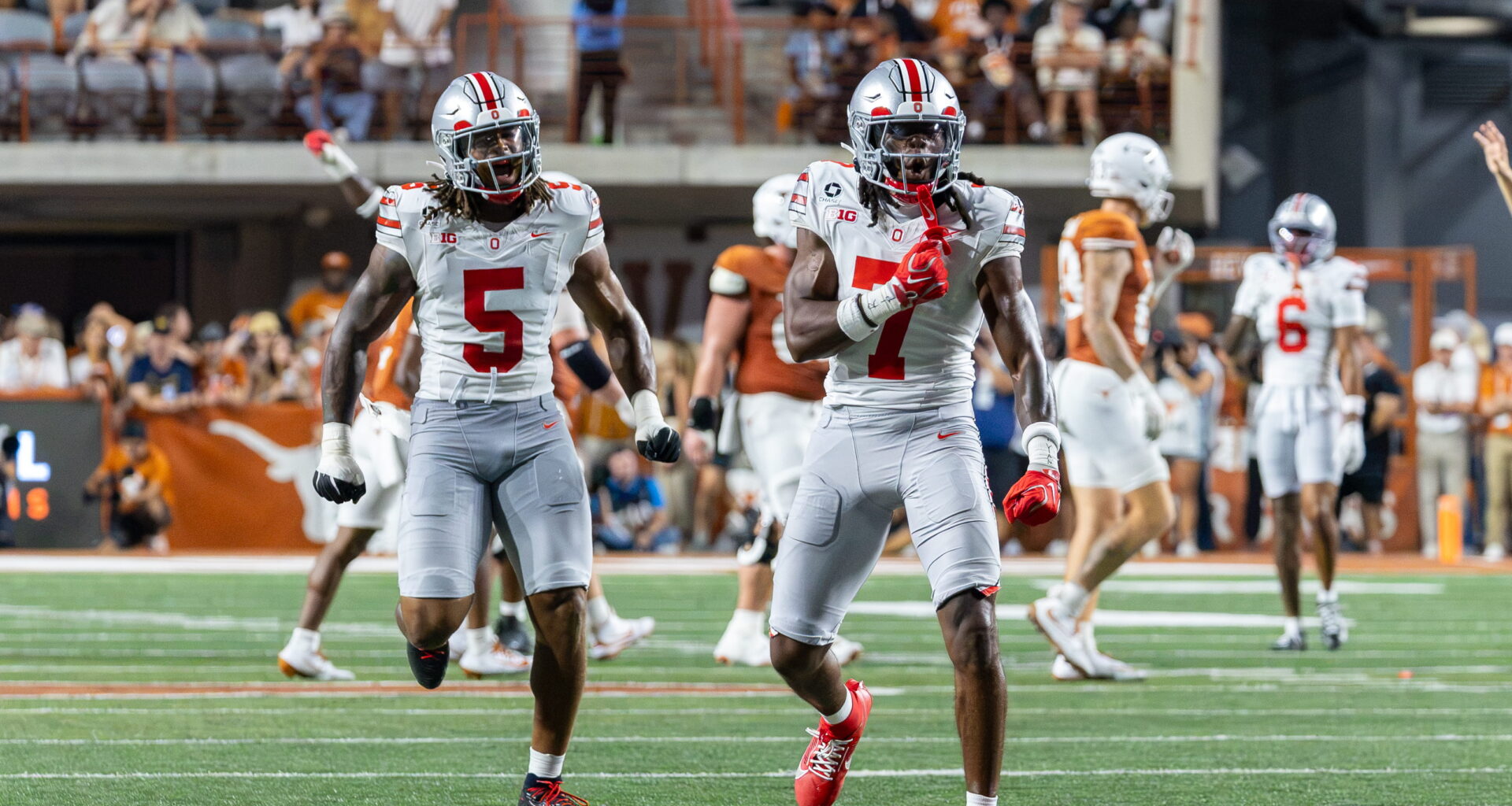
Defensive back Jermaine Mathews Jr. (7) celebrates with linebacker Riley Pettijohn (5) after making a stop against Texas on fourth down. The Buckeyes lost to Texas 24-23. Credit: Liam Ahern | Managing Photo Editor
Ohio State’s loss at Texas did more than drop the Buckeyes from the No. 1 ranked team in the country.
It exposed a problem head coach Ryan Day had emphasized throughout the offseason: finishing games in the fourth quarter.
Ohio State surrendered a 20-point lead and was outscored 21-0 in the final period of its 24-23 loss, but with a more demanding schedule ahead, the defeat could become either an early warning or a lesson for a team pursuing a College Football Playoff run.
“This year’s team is going to have potentially three or four games like this that they’re going to have to be better in the fourth quarter,” ESPN college football senior writer Adam Rittenberg said. “That can definitely be a teaching point, a place to learn and [to] do things differently.”
The Buckeyes went undefeated in their 2025 regular season, but did not face a single second-half deficit until the Big Ten championship, in which they ultimately fell 13-10 to Indiana. Ohio State then lost to Miami 24-14 in the quarterfinal of the College Football Playoff.
This year’s regular schedule provides a different test. After facing then-No. 4 Texas last weekend, Ohio State still faces five teams who are currently ranked in the AP top 25 poll.
“I think Ohio State, in hindsight, was hurt by a schedule last year that didn’t challenge itself enough,” Rittenberg said. “This year [Ohio State] could really benefit from a schedule that, at least as we sit here now, looks like there’s going to be a lot of challenges.”
Albert Breer, Sports Illustrated NFL senior writer and an Ohio State graduate, said dealing with a loss early in the season can allow the Buckeyes, who do not play another ranked team until Oct. 3 when they meet Iowa in Kinnick Stadium, to try to change personnel or schemes.
“You have a little flexibility, not much, but a little flexibility here to maybe tinker with some things that you wouldn’t have tinkered with otherwise,” Breer said.
Two seasons ago, when the College Football Playoff expanded from four to 12 teams, Ohio State ended the season hoisting the national championship trophy in Atlanta, despite having two regular season losses.
The Buckeyes, Breer explained, were able to bounce back from previous losses with the help of the leaders on the team.
“That was a veteran team and they had guys who’d been around for four years in the locker room,” Breer said. “So I think, now, the question becomes ‘Who are those guys are going to be for [Ohio State]?’”
Prior to the 2026 season, Ohio State announced quarterback Julian Sayin, offensive lineman Austin Siereveld, linebacker Payton Pierce, defensive end Kenyatta Jackson Jr., safety Jaylen McClain and wide receivers Brandon Inniss and Jeremiah Smith as team captains.
It marked just the seventh time in the Buckeyes’ program history that they had seven or more team captains.
Following the loss to Texas, the leadership from those captains and other leaders on Ohio State’s team has become crucial.
“When you have that many captains, that’s why you do that,” Rittenberg said. “It’s not some participation award or just to make people happy, you do that for times like this.”
Since the College Football Playoff started in 2014, only two teams have lost a game in September and went on to win the national championship: Ohio State in 2014 and Alabama in 2015.
The 2026 Buckeyes, who lost by one point in their first road game of the season, now look to become the third team to join that list.
“We have everything we need here and we just need to put it all together in a way that we can go make a championship run,” Day said on Tuesday.