
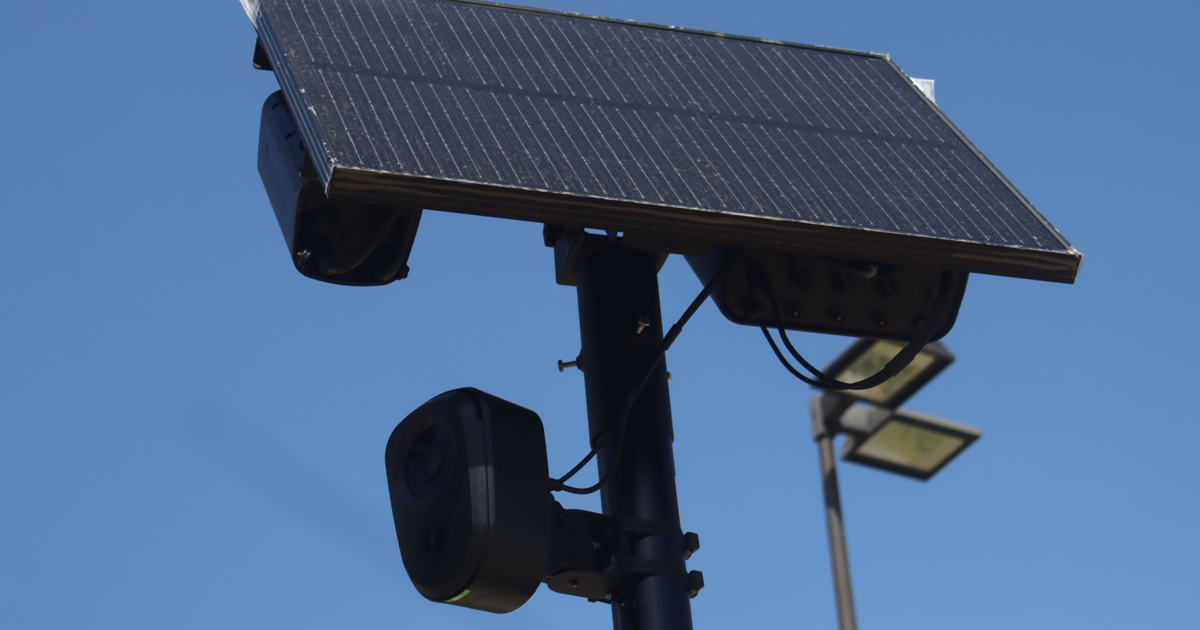

A Flock camera is stationed on South Center Street on Sept. 16. The Arlington Police Department has about 130 cameras around the city.
About two years ago, doctoral student Jimmy Haugh started seeing social media posts and news coverage about the new Flock Safety cameras growing in popularity.
A couple of weeks ago, Haugh decided to look at DeFlock, an open-source map with camera locations marked by community members, to see how many cameras were in the area.
“Within Arlington, UTA’s campus and the surrounding streets and areas is especially excessive in its density of cameras,” he said.
The automated license plate reading cameras, or LPRs, are part of a system made by public safety platform Flock Safety, which uses artificial intelligence to capture still photos and details of passing vehicles, according to Flock’s website. Over 140,000 automated LPRs have been mapped across the U.S., according to DeFlock.
On Aug. 27, Gov. Greg Abbott ordered all state agencies to pause funding for Flock cameras, according to The Texas Tribune.
This move follows increased scrutiny surrounding privacy concerns and the expansion of license plate reader cameras throughout Texas and nationwide.
Across the country, people have obscured the lenses, run them over, and sawed and shot down cameras to protest the rise of the technology in their neighborhoods.
Like Haugh, many have voiced concerns regarding the cameras, including privacy and mass surveillance worries, an increase in abuse and misuse by law enforcement officers and the potential for unauthorized use of the cameras by the U.S. Immigration and Customs Enforcement.
“There’s been a lot of negligence and misuse, so police targeting, pulling over, arresting and holding at gunpoint innocent people, children and families due to false hits or errors with these automatic license plate reader systems,” Haugh said.
For Haugh, one of his main concerns is the lack of transparency from government agencies.
“It seems like our local governments and federal governments are being kind of shady about this technology and aren’t willing to be fully open and transparent about the potential for misuse, which we’ve seen time and time again,” he said.
While there has been recent increased backlash, this kind of technology is not new for police departments.
The Arlington Police Department has been using Flock cameras since 2022, department spokesperson Tim Ciesco said. Since then, the city has amassed about 130 cameras.
“In pretty much every violent offense that we investigate, we are always looking to see if there’s something that the Flock cameras can help us with,” Ciesco said.
All of the cameras across the city are placed in public-facing areas, including roadways, big public destination areas and high vehicle traffic areas, he said.
“We decide where to put them based on crime trends,” Ciesco said. “The cameras are mobile, so we do have the ability to move them around. We may put cameras in areas where our data shows that we’ve been having some issues.”
The department declined to comment on how the budget freeze would affect its use of the cameras moving forward.
Apart from the location of the cameras, the public has also questioned how much data is collected from the cameras and given to law enforcement agencies.
“One misconception that a lot of people have is they assume that these cameras are collecting all sorts of data about them and providing us with all types of data about them,” Ciesco said. “They’ll tell us the license plate on a vehicle that passes one, and then they can also tell us the physical characteristics of the vehicle.”
UTA Police Capt. Jim Randles said in an email that the university department uses ALPR technology as a public safety and investigative tool. The department declined to provide information about where the cameras are located near or on campus, as well as the system or company that produces the cameras they use.
Randles said the cameras record a “point-in-time image of a vehicle and its license plate, along with observable vehicle characteristics and the date, time, and location of the observation.”
“Camera evidence played a supporting role in 64% of all UTA Police arrests during 2025,” Randles said. “This demonstrates the value of campus camera systems in identifying suspects, corroborating information, establishing timelines, preserving evidence, and improving investigative outcomes.”
About 153 cities across the country have canceled contract renewals or deactivated cameras in response to the public’s outcry against the technology, according to DeFlock.
In Texas, at least 15 cities, counties or agencies have canceled, limited or suspended their use of Flock cameras.
Among the agencies is the Dallas Police Department, which deactivated approximately 321 LPRs on Sept. 15, while over 300 remain active across the city, according to a Sept. 8 Dallas City Council meeting.
Haugh said that while the pause on funding is a good first step, there is no guarantee that the state would not renew contracts in the future or continue to use existing Flock camera infrastructure.
“Anything that is going to be able to track people like this and be able to have this potential for abuse and misuse needs to have regulations on it that are more stringent,” he said. “It’s kind of scary to me how quickly these technologies are being adopted by many different places without any of these regulations or legislation put into place.”
New websites and databases countering the Flock system have come out, such as Have I Been Flocked?, where citizens can check if Flock cameras have run their license plate.
The website only uses data from local governments that have made audit logs tracking Flock searches publicly available upon request, according to the website.
The Institute of Justice created a database to track reports of automatic LPR abuse and misuse across the country, which includes more than 230 incidents as of Sept. 14.
The database includes reports labeled as error, non-law enforcement use, other misuse and stalking. A majority of these reports shown in the database happened in eastern states, including Georgia, Illinois, Ohio and South Carolina with over 12 incidents each, as of Sept. 14. Texas has had at least 14 incidents, according to the database.
Last month, Flock updated its terms and conditions in an attempt to “strengthen customer protections, clarify how Customer Data is handled and protected, set clearer expectations for responsible use, and make applicable product, service, and jurisdiction-specific terms easier to find,” according to its website.
The changes address how Flock claims it handles customer data, but they come amid broader concerns about the use and oversight of surveillance technology.
“We have the perfect storm of abuse and misuse, plus a lack of transparency from our government, law enforcement and corporations, and then the concerns of data centers and prosecuting and tracking innocent people that are swirling to make this a really big issue in the United States and moving forward worldwide,” Haugh said.
While Abbott cut state funding, most of the money used to fund the cameras comes from the federal government, he said in a video posted by The Texas Tribune.
“It’s going to be up to city officials themselves to unplug the Flock cameras,” Abbott said in the video. “However, what has already been observed is that cities across the state are already unplugging from Flock cameras.”
@_.lexlie_