
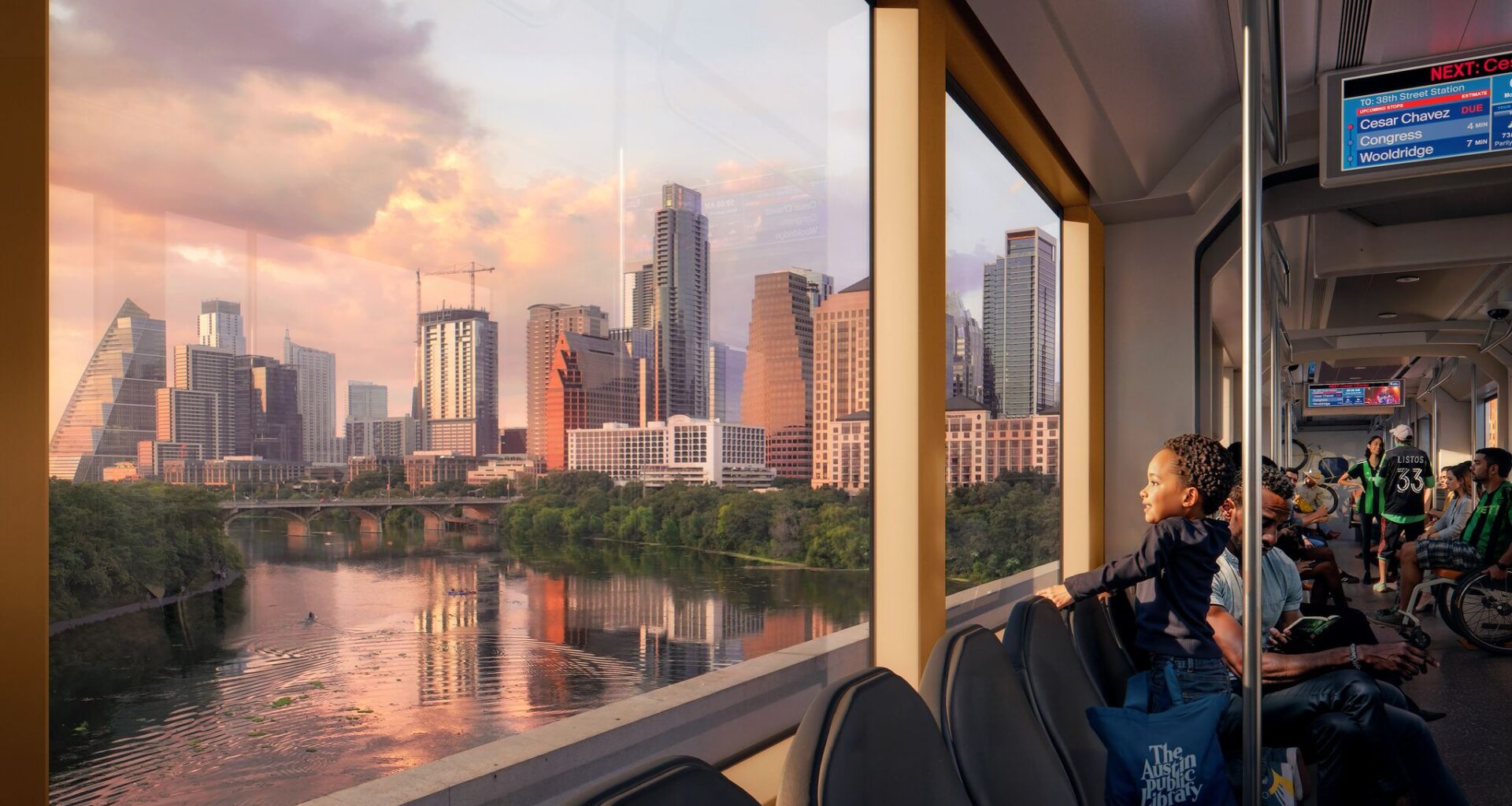
A conceptual rendering of Austin’s upcoming Project Connect light rail system, a nearly 10-mile line set to run through the Texas capital.
WAX/Artist conceptual visualization courtesy of Austin Transit Partnership
Nearly six years after residents in Texas’ capital city approved a comprehensive mass transit program, Central Texans are mere months away from dirt beginning to turn on the city’s first-ever light rail system.

In November 2020, Austin voters approved Project Connect, a robust public transportation program designed to advance multimodal forms in the Texas capital and ramp up both existing bus and rail lines alongside the introduction of a light rail system. In the years since, the program’s light rail project has been modified in scope to accommodate growing construction cost projections and budgetary constraints.
Article continues below this ad
Here’s a breakdown of what Texans can expect in the next few months as transportation crews kickstart construction work.
When will Austin begin construction on its first light rail system?
Austin Transit Partnership — the entity tasked with designing, constructing, and delivering the Project Connect light rail system — is currently in the midst of pre-construction work. Earlier this year, Austin Transit Partnership revealed Austin Rail Constructors will serve as contractor on the light rail line, while Kiewit Austin Partnership will build the maintenance facility to service the light rail vehicles and Stadler will manufacture the vehicles themselves.
Construction is poised to begin in 2027, and Austin Transit Partnership is accelerating the project’s design work alongside the manufacturers and contractors tapped for the project.
Article continues below this ad
Officials are slated to deliver more specific details on the project, including potential phasing and what Austinites can expect come 2027, during an Austin Transit Partnership board meeting in or around November. Under existing project estimates, construction is expected to wrap on the first phase of the light rail in 2033.
Conceptual rendering of Phase 1 of Austin’s Project Connect light rail system, highlighting its path along East Riverside Drive.
Courtesy the Austin Transit Partnership
What will be included in Austin’s first phase of light rail?
Phase 1 of Austin’s light rail system includes a 9.8-mile route that runs from 38th Street down to Oltorf Street and out to Yellow Jacket Lane. That initial route includes two priority extensions further north to the Crestview Station and southeast to connect directly at the Austin-Bergstrom International Airport.
Article continues below this ad
Phase 1 of Project Connect’s light rail system in Austin, which features 15 stations along a 9.8-mile route as well as two priority extensions further north and southeast to the Austin-Bergstrom International Airport.
Courtesy of Austin Transit Partnership
That nearly 10-mile route comprises 15 stops across Austin:
38th Street
University of Texas at Austin
15th Street
Wooldridge Square
Congress Avenue
Cesar Chavez Street
Waterfront
South Congress Avenue
Oltorf Street
Lakeshore Boulevard
Pleasant Valley Road
Grove Boulevard
Montopolis Drive
When voters approved the November 2020 ballot measure establishing Project Connect, the proposition also specifically allocated $300 million for anti-displacement funding to bolster affordable housing projects and minimize affordability issues near the line, where property values and costs of living could otherwise become unattainable for some residents.
Article continues below this ad
During a September 10 Austin City Council meeting, council members adopted an ordinance that the dais said will continue to support onsite and adjacent low-income and moderate-income housing near the light rail, instead of a fee-in-lieu alternative option.
How frequently will Austin’s light rail run?
The Texas capital’s light rail system is expected to operate on a frequency of every five to 10 minutes, per Austin Transit Partnership. The light rail line will be integrated into existing and future transportation methods in Austin, including the city’s existing CapMetro bus and rail systems.
A conceptual rendering of Austin’s upcoming Project Connect light rail system, a nearly 10-mile line set to run through the Texas capital.
WAX/Artist conceptual visualization courtesy of Austin Transit Partnership
How do Austinites feel about light rail?
Almost 60% of city voters approved the Project Connect program in November 2020. In the years since, however, the scope of the light rail project has changed from a roughly 20-mile multi-line system to a 9.8-mile route. That pivot to a smaller scale and a phased approach has garnered plenty of mixed feedback from residents over the years, as well as legal challenges from state leaders and some members of the Texas Legislature.
Article continues below this ad
A recent Austin subreddit post shared last week garnered hundreds of comments and had some residents divided over what was originally intended with light rail and what the current system is set to deliver. One user, @orthaeus, cited a Texas Tribune article published in late May that tracked the light rail project’s reduced rideshare projections, dropping from a minimum of 70,000 riders daily riders during its first 20 years operating down to 34,000 daily users.
“No one is mad that we’re building Public transportation. We’re mad that the whole scope changed drastically,” user @Frequent_Phone6396 wrote, with @vivabevo noting: “This is just the beginning of the system though. It has to start somewhere and this is the obvious/most populated corridor.”
A separate user, @dynamichunter, challenged that assessment, writing: “All of these rail projections ignore induced demand, increased foot & bike traffic, the ability to travel without a car, etc. which in turn increase ridership and local business spending (and therefore tax revenue) significantly along public transit corridors and stops.”