
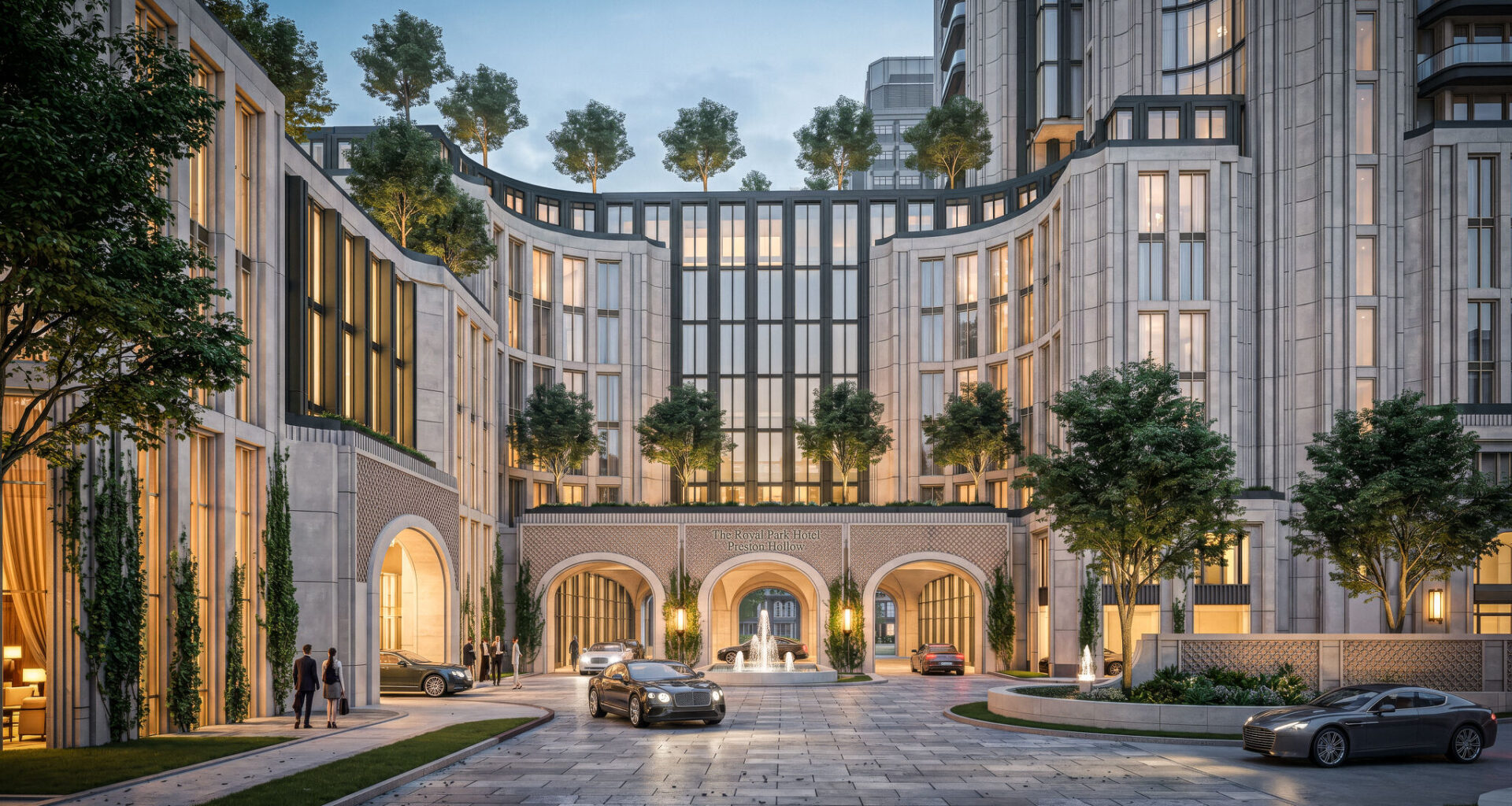
A generated rendering of a proposed $800M mixed-use development at the southwest corner of Preston Road and Royal Lane.
Courtesy of GFF
Muhammad Ali twice fought Joe Frazier before his famous “Thrilla in Manilla” match. People typically only remember the third bout. I’ve already written about the zoning case at Preston Road and Royal Lane twice, but we’re about to have a Thrilla on Marilla, so one more round seems prudent.
From City Hall at 1500 Marilla — itself a development dispute these days — the city council will decide if Dallas is moving forward or backward. With the budget where it is, you’d think forward would be better.
For more than 10 years, the council has passed property tax rate cuts (while often raising fees) that failed to keep up with rising property appraisals. Dallas has a tax rate among the highest in the state. If you live in Dallas, you pay for that privilege.
Article continues below this ad
According to the Dallas Central Appraisal District, the average Dallas home is worth about $616,000, with a taxable value of about $436,000. That means the value of this proposed development is similar to building about 1,800 houses. The most typical single-family lot size in the city is 7,500 square feet. As such, it would take more than 300 acres to build as much value as is going into the seven-acre development. That’s larger than Fair Park or the SMU campus. It’s a lot of bang for the buck.
Ray Perryman is something like the Big Tex of Texas economists — he doesn’t have any peers. The developer on this project hired Perryman to do an economic assessment. I got an early copy. Yes, Perryman was hired by the developer. And yes, I’m generally disposed toward development. But I’m not asking readers to simply believe me or Perryman. The facts speak for themselves, and Perryman shows his work.
“On an ongoing basis, business operations within the development as well as resident and visitor spending would generate notable economic benefits,” Perryman’s report read. “The development could be expected to lead to an estimated increase in annual business activity in the Dallas area including more than $483.9 million in annual gross product at maturity.”
According to Perryman, the project will generate $13.2 million in annual tax revenue for the city, and create 4,610 jobs. The development “represents a notable improvement to an area which previously sustained tornado damage and has struggled to revitalize since that time,” the report said.
According to Perryman, the construction bump alone from this project will be more than $920 million and create 8,260 job-years. These are huge numbers.
Article continues below this ad
What has the neighbors most concerned, however, is his prediction the development will “serve as a catalyst for further activity.” North Dallas is absolutely not willing to move into the 21st century. It’s perfectly fine retreating to the past. Dallas is a collection of suburban-style neighborhoods surrounding a lightly used downtown. We are way more 1950 than 2050.
At least that’s true of the most vocal activists, a dedicated group of anti-development people who have held the city back since the 1980s. All that lost opportunity cost, however, is coming back to haunt the city. So is the lack of population growth. It’s showing up in the city budget, and in tax bills.
Doug Hazelbaker, a leader of Preserve Preston Hollow, told me, “My whole issue is with the height.” This is a favorite issue among neighbors who oppose development. He’s not wrong that some of the buildings are tall, with one being 240 feet. Interestingly, 240 feet is a common height for buildings in Oak Lawn. Height brings the best type of construction, quality, longevity and taxable value.
Office tenants will pay premium rents, helping daytime traffic for the surrounding retail corners. Class A office buildings are scarce, and short ones don’t get built often. Dallas needs more outstanding office developments. Not everyone can office in Preston Center.
On the residential side, the views will be why people pay $5 million or more. Those views — and the tax revenue that comes with them — don’t happen without height.
Article continues below this ad
Dallas needs to go up; in many cases it’s the only direction for growth.
Traffic is another popular complaint for the no-development crowd. But the facts, as reported in a traffic study completed by a licensed traffic engineer and reviewed by the city’s transportation engineers, demonstrate the number of trips with full build-out will be only slightly more than the number of trips surrounding a development that could be built by right, without this planning fiasco. The council should demand that the developer put in all the traffic improvements that they have promised; that should be more than enough.
Neighbors say the project should be more like Preston Hollow Village. I wonder if they realize the undeveloped corner allows for a high rise. I worked on that project in 2006. There was plenty of neighborhood outcry — and way, way, way better behaved North Dallas neighbors. The zoning issues were not personalized. Meetings were cordial and respectful. When I had my firstborn during the process, more than one sent a card or gift. The personal attacks in this case are unnecessary; property owners have a right to ask for zoning.
Opponents complain the project would set a precedent. It won’t — every zoning case stands on its own — but if it did, that would be fine. Raising the bar on appraised value and quality is a good standard to set.
One of the things holding Dallas back is demographics. Dallas has a young population. The median age is 33.4, according to the city’s economic development corporation. That’s six years younger than the national median. Unfortunately, those young people don’t vote in large numbers, and they are too busy and hip to attend neighborhood meetings.
Article continues below this ad
So the voices that influence development decisions — the ones council members cater to — are much older and more resistant to change. We are planning the future for those who won’t be a part of it. Absurd.
Dallas is a top market for young professionals; they are not looking for a suburban lifestyle. The council must think about all the smart, ambitious young people who will comprise Y’all Street, not Yawn Street.
The nature of Dallas’ flawed 14-1 system of government is magnified in zoning issues. For decades, council members have catered to this older voting demographic, holding back necessary modernization. Often, they appoint plan commissioners to ensure nothing happens.
Kathy Coffman, a Far North Dallas plan commission member, posted online, “Make sure we are getting more signs out and we have petitions circulating.” Talk about not waiting until the hearing to make your decision.
Alicia Ramirez Serrato, a newer member of the commission, said she had to go with the neighbors. If the city makes decisions by crowd-sourcing, we don’t need a commission or council.
Article continues below this ad
These two were joined by two others but, thankfully, the final Plan Commission vote was 10-4 in favor of the development. Many of those voting in the affirmative made passionate remarks that make me optimistic other ambitious projects might spread across the city.
Vice-chair Darrell Herbert from District 3 said, “My fear is that the southern sector is now becoming south of 635. The northern suburbs are taking over. They’re taking our incomes, they’re taking our dollars, they’re taking our jobs. They’re taking our children. Think about that as you oppose developments in your neighborhoods.”
Another commissioner, Mike Sims, noted, “We cannot out-suburban the suburbs.”
Or as Maggie Parker summed up in these pages recently, “Times have changed. It’s no longer north Dallas versus southern Dallas. It’s the city of Dallas versus Southern Oklahoma.”
We need more neighborhoods willing to urbanize. All too often, neighbors simply want projects to be somewhere else. And all too often, they get what they want: Legacy West, The Star in Frisco, and the Stars at the Shops at Willow Bend. The projects go somewhere else and with them go the taxes. So don’t complain when the pools and libraries close; the city simply can’t pay for them with the current tax base.
Article continues below this ad
Next the Preston-Royal issue goes to the full council Oct. 14.
I think the opponents underestimate council member Gay Donnell Willis’ resolve and leadership. She’s told me no plenty of times. She votes for what she thinks is best, which is different from what’s popular. Some neighbors want to have to recall her for that. I don’t see them getting the 9,000 signatures required when only 7,000 people voted in the last two elections. It’s just intimidation.
Many of my North Dallas friends, colleagues and acquaintances support the project. They just do it quietly because of the opposition.
In the end, this project will work and turn out to be a popular spot. People will go out to eat there twice a week — just like at Preston Hollow Village.
I hope the City Council has the courage to approve this case. There will certainly be a few council members catering to the old-style, no-progress, no-apartments Dallasites, but their power and numbers are waning. Dallas has a shot at being a real city, something long past due.