
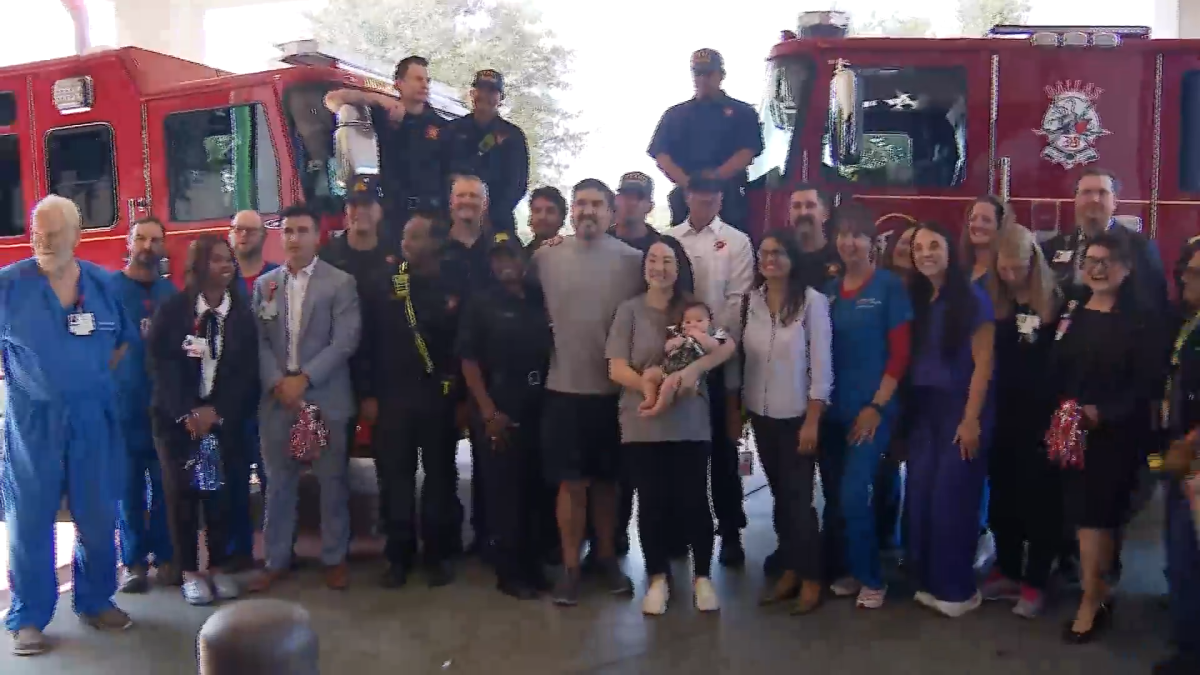
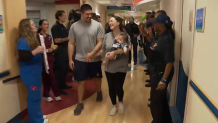
First responders and hospital staff filled the hallway at Medical City Children’s Hospital in Dallas Thursday morning, anxiously awaiting a special guest: 4-month-old Kenji Kammerer. The baby and his parents, Ian Kammerer and his wife, Lindsey, would walk the halls one final time before Kenji heads home after a long hospital stay.
Staff gave out plastic maracas with smiles printed on them, pom-poms, and bubbles, all part of an anticipated celebration. Firefighters stood alongside the doctors, nurses and hospital workers who had come to know Kenji over the months, two support systems gathered for one long-awaited goodbye.
In June, Ian Kammerer, a firefighter used to responding to 911 calls, had to make one for his then five-week-old son Kenji.
“We just picked him up, and he just screeched,” Ian explained, watching the blood draining from his son’s face and realizing he needed to call for help; “he just wasn’t himself. So we acted quickly and got to the hospital, thanks to Rescue 73.”
Ian and Lindsey waited as teams worked to stabilize Kenji for surgery, hospital doors opening periodically with updates as friends and Ian’s fellow firefighters arrived to support them.
“He was so sick at that time,” recalled Dr. Kris Bysani, saying of Kenji’s mother, Lindsey, “She came right to my face and said, ‘Do you think he’s going to make it?’”
Bysani described working to help reassure the Kammerer family by keeping them focused on the present.
“It is minute to minute, hour to hour, day to day,” Bysani said, “We all knew he was so sick; none of us are going to give up. Instead, we are going to do our best to keep him going,” he said.
Kenji was diagnosed with intestinal malrotation, a rare condition in which the bowel can twist and lose its blood supply, potentially causing life-threatening complications throughout the body.
Kenji would undergo four surgeries as doctors worked to treat complications affecting multiple organ systems.
Bysani believes the family’s quick response that morning gave Kenji a critical chance.
“I think the CPR was done as fast as they could, and they brought the baby here as fast as they could,” Bysani said. “Everybody did their job early on. That made a huge difference.”
As the weeks passed, Kenji grew stronger. His parents settled into a new routine inside the hospital, one with doctors’ rounds, therapy sessions and the steady beeping of monitors, all while the people caring for their son became part of the family’s ever-growing support system
“He spent more time in the hospital than we had him outside,” said Ian.
He described how the more than 75 members of Kenji’s care team positively impacted his recovery and were vital to the family’s sense of normalcy.
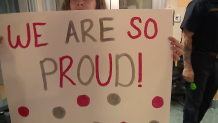
“It takes a village, and mine just expanded tremendously,” said Lindsey, reflecting on how far they’ve all come. “Yesterday I was tearing up, so I went to the bathroom to put myself together, and I distinctly remember a time over there where I was lying in the bathroom because I just couldn’t take the beeps of the monitors anymore,” she said.
The family described support from fellow firefighters and hospital staff as essential.
“I don’t think that they even truly understand how, as individuals, they’ve each impacted us,” Lindsey said. “You could put a person in front of me, and I could probably tell them a moment where they just saved me, or they saved Kenji.”
For the Kammerer family, each person they interacted with helped them get through an incredibly difficult time.
“It’s nurses, it’s respiratory therapists, it’s physical therapy, occupational therapy, speech therapy, everyone,” Lindsey said.
Even the voice on the other end of the room service line became familiar: “Even today, I was joking because I called our room service line because Miss Linda,” she said, explaining that she called to personally thank the person who took their food order for providing a much-needed sense of normalcy.
By Thursday morning, the little boy who had once been so critically ill was doing something wonderfully ordinary: fussing as his parents prepared to take him home.
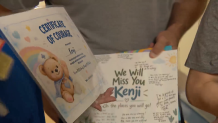
Before Kenji made his way down the hallway, his care team presented him with a “Certificate of Courage,” a recognition, they said, for the little boy who had done the hardest work of all.
“You go home and grow big,” a member of his care team told him.
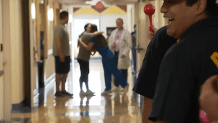
Then the doors opened. Maracas rattled, pom-poms waved and bubbles floated through the hallway as Kenji and his parents made their way between rows of hospital workers and Dallas firefighters cheering them on. The people who had helped carry the family through months of uncertainty were now there to watch them leave.
Kenji, meanwhile, fussed through part of the celebration, the kind of ordinary baby behavior his parents once could only hope to worry about.
For Bysani, who remembers just how sick Kenji was when he arrived, the contrast was hard to miss.

“I held him today,” said Dr. Bysani, “it is the most satisfaction we can get from doing this. I’m just going to remember him forever.”